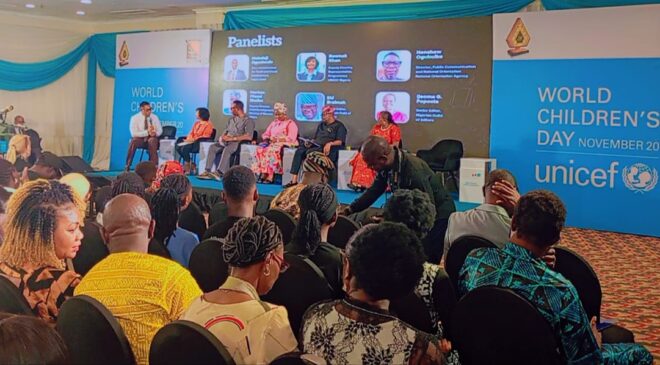
LAGOS/Nigeria: Publisher of Naija Times and member of the Nigerian Guild of Editors (NGE), Mr. Ehi Braimah, has urged the Federal Government and states to adopt a unified child rights law to ensure equal protection for every Nigerian child. Braimah made the call in Ikeja on Tuesday during a symposium themed “Equipping the Nigerian Child for the Future: How Prepared Are We?” organised by UNICEF in collaboration with the NGE and the Diamond Awards for Media Excellence (DAME).
Speaking as a panelist, Braimah criticised the varied child rights legislations across states, noting that while some adopt the Child Rights Law, others operate under a Child Protection Law with contradictory provisions. He highlighted that under the Child Protection Law, the minimum marriage age is 14 and age of maturity is 12 — provisions he said encourage child marriage and threaten the education and wellbeing of the girl child. In contrast, states that adopted the Child Rights Law set the minimum marriage age at 18, consistent with the federal Child Rights Act.
Braimah emphasised that education remains the strongest empowerment tool and must be accessible to all children. He called on governments to bridge gaps in education, healthcare and protection systems as part of a holistic strategy to safeguard the future of Nigerian children.
UNICEF Nigeria Country Representative, Ms. Wafa Saeed, said Nigeria had recorded notable improvements in child welfare over the past two decades, but warned that progress was too slow to meet acceptable standards. She said millions of Nigerian children remained unvaccinated, malnourished or out of school, stressing the urgent need for full implementation of the Safe School Declaration to protect learners.
Earlier, NGE President, Mr. Eze Anaba, lamented the impact of insecurity on education, citing frequent school disruptions, closures and abductions. He urged journalists to adopt data-driven reporting to push for strong policy responses to children’s challenges. “We must amplify the voices of the voiceless and embrace solutions and investigative journalism,” he said.
Consul-General of the Kingdom of the Netherlands in Lagos, Mr. Michel Deelen, reiterated that education is the bedrock of national development and requires greater investment, noting that several Nigerian schools still lack basic infrastructure.
Chairman of DAME, Mr. Lanre Idowu, said despite various reforms, the Nigerian child remains vulnerable. He encouraged the media to embrace development-oriented reporting that offers context and inspires action.
UNICEF Deputy Country Representative, Ms. Ronak Nkan, also a panelist, underscored the wide disparities in children’s living conditions across states. She cited data showing that nearly 90 per cent of Lagos households have access to safe water, compared to just three per cent in Kebbi. “No child should suffer because of geography. Every Nigerian child deserves equal opportunity,” she said.
Mrs. Mariam Shaibu of the Federal Ministry of Women Affairs outlined government efforts to curb the out-of-school crisis, including the Adolescent Girls Initiative for Learning and Empowerment and various programmes aimed at reducing absenteeism among girls.
Director of Public Communication at the National Orientation Agency (NOA), Mr. Henshaw Ogubuike, said the Federal Government had intensified nationwide sensitisation campaigns on child safety and appealed to journalists to amplify these efforts.
News Agency of Nigeria (NAN) Deputy Editor-in-Chief, Mrs. Ijeoma Popoola, urged parents to devote more time to supervising and mentoring their children, warning that poor parenting fuels vices such as gambling and cultism.
UNICEF youth advocate, Master Tinafi Akau, called for deployment of technology-driven safety solutions, including AI-enabled early-warning systems to protect schools from attacks.