By Mokobia Rita
ASABA/Nigeria: After decades of agitation, political negotiations, and cultural advocacy, the long-standing demand for the creation of Anioma State has entered what stakeholders describe as its most decisive phase yet, with fresh indications that the proposal is nearing critical legislative completion at the National Assembly.
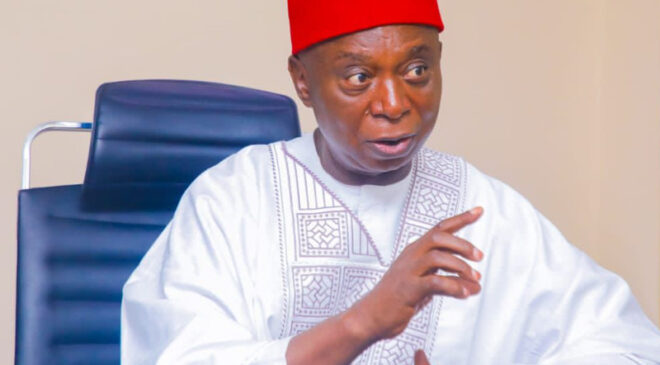
The development was disclosed by the Media and Publicity Director of the Anioma State Creation Technical Committee, Chief Barr. Tonnie Oganah, who revealed that the bill—spearheaded by Senator Ned Nwoko—has successfully scaled major legislative hurdles in both chambers of the National Assembly and is now approaching its final stages.
According to Oganah, the proposal is currently awaiting a third reading before proceeding to harmonisation between the Senate and the House of Representatives, a crucial step that could determine its fate.
He explained that upon successful harmonisation, the process will advance to a referendum to be conducted by the Independent National Electoral Commission (INEC), where eligible voters in the proposed Anioma State will decide through a simple yes-or-no vote.
“This is the closest we have ever come,” Oganah said, describing the current stage as a landmark achievement in a struggle spanning over seven decades.
Despite the progress, he cautioned that the journey to statehood remains fraught with political complexities, warning that emerging tensions and strategic opposition could pose significant challenges.
Oganah pointed to the fluid nature of national politics, particularly around the administration of President Bola Ahmed Tinubu, noting that shifting alliances and rivalries could influence the trajectory of the Anioma project.
He also warned the All Progressives Congress (APC) to guard against what he termed “fake members and supporters,” alleging that some individuals may seek to undermine both the Anioma initiative and the political standing of its chief proponent, Senator Nwoko.
Beyond legislative considerations, proponents have framed the Anioma agitation as a long-overdue correction of political and cultural imbalance.
Oganah argued that the Anioma people, despite cultural affinity with the Igbo, have experienced prolonged political marginalisation within Delta State, making the demand for state creation both an issue of identity and equitable representation.
Tracing the origins of the agitation to over 70 years ago, he paid tribute to early advocates while emphasising that the current momentum presents a rare generational opportunity that must not be squandered.
Supporters of the proposed state maintain that Anioma is not only politically viable but also economically prepared for self-sustenance.
Oganah highlighted existing infrastructure, including administrative and judicial institutions, educational facilities, and the strategic presence of an airport in Asaba, as indicators of readiness for statehood.
He noted that the proposed state has the capacity to sustain governance, generate revenue, attract investment, and create employment opportunities.
According to him, the creation of Anioma State would unlock new economic potential, accelerate infrastructure development, and deepen political inclusion for the region and the nation at large.
While the movement enjoys the backing of more than 70 traditional rulers, Oganah acknowledged internal divisions within the traditional institution, noting that not all royal fathers are aligned with the initiative.
He, however, urged dissenting stakeholders to prioritise long-term benefits over immediate political considerations.
“The greatest honour is to stand for your people. History remembers those who chose their people over politics,” he said.
Should the bill successfully scale all legislative stages and receive approval through referendum, a transitional administrative framework would be established to facilitate the emergence of the new state, including governance structures and democratic institutions.
For many observers, the Anioma agitation—long debated and often stalled—now stands at the threshold of realisation, with growing momentum suggesting that a decades-old aspiration may soon crystallise into political reality.