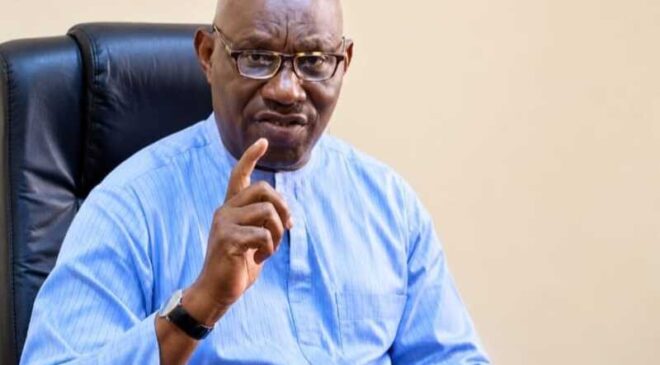
ASABA/Nigeria: The Executive Assistant to the Delta State Governor on Public Enlightenment (Projects and Policies), Mr. Olisa Ifeajika, has urged Nigerians not to lose faith in the country’s democratic process, insisting that democracy in Nigeria remains a work in progress that requires patience, commitment and active participation from citizens to achieve its full potential.
Speaking on Politics HQ, a programme on News Central Television, Ifeajika said Nigeria’s democracy should be assessed within the context of its relatively short history of uninterrupted civilian rule, noting that the country has practised democracy continuously for only about 27 years, unlike older democracies that have evolved over centuries.
He acknowledged that challenges still exist in critical areas such as the rule of law, protection of human rights and electoral integrity, but maintained that Nigeria has continued to make steady progress and should not be judged solely by its shortcomings.
According to him, mistakes are inevitable in every democratic system, particularly one that is still developing, stressing that the nation’s institutions would continue to improve as democratic culture becomes more entrenched.
“Our democracy is growing. We are still learning and improving. We may make mistakes along the way, but together, we will correct them and become better. Nigerians must have faith in the system because democracy is a journey,” he said.
Ifeajika also called on citizens to become more actively involved in the electoral process instead of allowing disappointment or skepticism to discourage participation.
He warned that voter apathy could weaken democratic institutions and undermine efforts to build accountable leadership, emphasizing that citizens ultimately determine the quality of governance they receive through their level of engagement in elections.
According to him, ongoing electoral reforms and voter education initiatives would further strengthen public confidence in the democratic process and improve governance outcomes.
The governor’s aide also weighed in on the renewed agitation for the creation of Anioma State, insisting that any successful state creation effort must be driven by the collective will of the people rather than the ambitions of a few political actors.
Tracing the agitation back nearly five decades, Ifeajika described the demand for Anioma State as a longstanding aspiration of the people of the area.
He, however, stressed that the proposed state must remain within Delta State and the South-South geopolitical zone, maintaining that the Anioma people have a distinct identity within the region.
“The Anioma State we want is one carved out of Delta State and located in the South-South with Asaba as its capital. Being Igbo does not mean we must belong to the South-East. We are Igbos in Delta State and proud members of the South-South region,” he said.
Ifeajika also dismissed claims that former Delta State Governor, Dr. Ifeanyi Okowa, opposed the creation of Anioma State, saying the former governor had consistently supported the agitation, provided it did not alter Delta State’s South-South identity.
He cautioned against the politicisation of the state creation campaign, arguing that the issue should be approached through broad consultations and consensus-building among stakeholders rather than partisan considerations.
According to him, the constitutional procedure for creating a new state is clearly defined and requires overwhelming support from the affected population before progressing to the National Assembly for legislative approval.
“It must come from the people. You do not impose a state on the people. Everybody must be carried along and agree that they need a state before the process can begin. Once there is genuine consensus, the governor and other stakeholders will naturally support it,” he said.
Reaffirming his optimism about Nigeria’s future, Ifeajika urged citizens to remain hopeful and committed to nation-building, expressing confidence that the country’s democracy would continue to grow stronger through sustained public participation and institutional reforms.