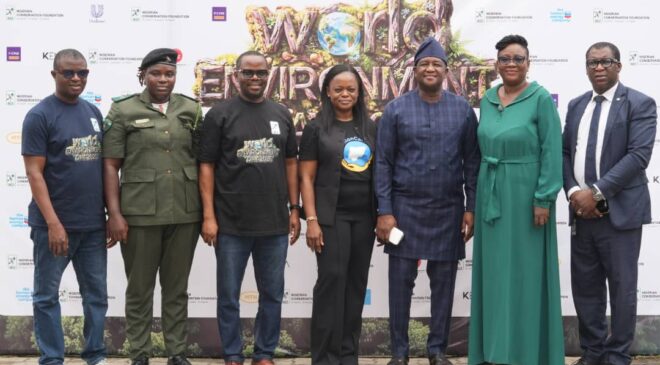
LAGOS/Nigeria: Environmental experts, government officials and private sector leaders have called for urgent and coordinated action to combat climate change, warning that rising temperatures, flooding, desertification and environmental degradation pose serious threats to Nigeria’s economy, livelihoods and long-term development.
The stakeholders made the call during activities marking the 2026 World Environment Day (WED), stressing that climate change is no longer a distant threat but a present reality requiring immediate intervention from governments, businesses and citizens.
Speaking at the event, Director-General of the Nigeria Conservation Foundation (NCF), Dr. Joseph Onoja, urged Nigerians to draw inspiration from nature in addressing environmental challenges, noting that nature provides practical solutions to many human problems.
According to him, the natural world remains a rich source of innovation, citing the peregrine falcon, regarded as the fastest bird in the world, whose speed and hunting techniques have inspired technological advancements.
“Nature has all the models we need to lead well on earth. We must learn from it and apply those lessons,” Onoja said.
The conservation expert stressed that environmental protection is fundamentally about safeguarding humanity and ensuring a sustainable future for coming generations.
He warned that while the earth possesses the capacity to regenerate itself, human survival depends on maintaining healthy ecosystems and a stable environment.
“If we do not take care of the earth, it may eventually restore itself by getting rid of us,” he cautioned.
Onoja called on individuals, organisations and governments to adopt practical measures that promote biodiversity conservation, climate resilience and sustainable development.
He also commended corporate organisations, including First City Monument Bank (FCMB), Union Bank and MTN Nigeria, for supporting environmental sustainability initiatives and partnering with the foundation.
Also speaking, Divisional Head, Corporate Affairs of FCMB, Mr. Diran Olojo, described climate change as one of the most pressing challenges confronting societies worldwide.
According to him, the effects of climate change are already evident through increasing cases of flooding, rising temperatures, water scarcity and growing concerns over energy security.
Olojo stressed that sustainability should no longer be treated as a secondary issue but integrated into business strategies, investment decisions and public policy formulation.
He disclosed that environmental, social and governance considerations now form part of FCMB’s lending, investment and risk management framework.
The bank executive added that support for climate-smart agriculture, renewable energy financing and financial inclusion programmes had been expanded to promote sustainable growth.
He noted that renewable energy initiatives were helping households and businesses transition to cleaner and more sustainable energy sources.
Warning of the consequences of environmental neglect, Olojo said failure to act could lead to increased flooding, insecurity, economic instability and disruption of livelihoods.
He urged Nigerians to embrace practical environmental actions such as tree planting, recycling, proper waste management and sustainable investment practices.
A climate action advocate, Mr. Daze Nga, also described climate change as one of the most urgent challenges facing humanity, noting that extreme weather events across the globe underscore the seriousness of the crisis.
Nga said rising temperatures, prolonged droughts, devastating floods and other climate-related disasters have demonstrated that climate change is already affecting millions of lives.
He called for stronger collaboration among governments, businesses and citizens to reduce greenhouse gas emissions and strengthen climate resilience.
According to him, investment in clean energy, sustainable transportation systems and climate-resilient infrastructure remains critical to addressing the climate crisis.
He further highlighted Nigeria’s environmental challenges, including flooding, coastal erosion, desertification, oil pollution and ecosystem degradation.
“Environmental protection requires collective action. No single institution or sector can address these challenges alone,” he said.
Representing the Federal Ministry of Environment, Director of Pollution Control and Environmental Health, Mrs. Olabimpe Adenaike, reaffirmed the Federal Government’s commitment to tackling environmental challenges through strategic policies and partnerships.
She identified climate change, biodiversity loss, pollution, deforestation, land degradation and desertification as some of the major environmental threats confronting the country.
Adenaike cited several government initiatives, including the National Climate Change Policy, Nigeria’s Nationally Determined Contributions under the Paris Agreement and the country’s commitment to achieving net-zero greenhouse gas emissions by 2060.
She explained that the Energy Transition Plan was designed to accelerate the adoption of clean energy technologies, improve transportation systems and expand access to sustainable energy nationwide.
According to her, renewable energy solutions have already been deployed across the 36 states and the Federal Capital Territory as part of efforts to reduce dependence on fossil fuels.
The director also highlighted Nigeria’s participation in the African Union’s Great Green Wall Initiative, which targets land restoration, climate resilience and climate-smart agriculture in 11 frontline states affected by desertification.
She noted that improved waste management systems were also playing an important role in advancing climate action and environmental sustainability.
“Environmental challenges transcend sectors and borders, making strategic partnerships essential for sustainable solutions,” she said.
The event featured exhibitions and environmental awareness activities by secondary schools from different parts of the country, showcasing innovative projects developed from recycled and upcycled materials.
Participating schools included Noble House College, Abeokuta; Unique Minds International School, Ile-Ife; Brilliant Stars College, Ibadan; FIEF Academy, Okota; D’Cherub Schools, Ajah; Obele Community Senior High School; Wesley Girls Senior Secondary School; Lagos City Senior College, Yaba; Surulere Senior Secondary School; and Lagos Progressive Senior Secondary School.
The students demonstrated how young people can contribute meaningfully to environmental protection and sustainable development through innovation and responsible environmental practices.
The event concluded with the presentation of awards to corporate partners and outstanding student participants in recognition of their contributions to environmental sustainability and climate action.
