By Chief Jerry Ogwu.
- Who are the Ukwuani?
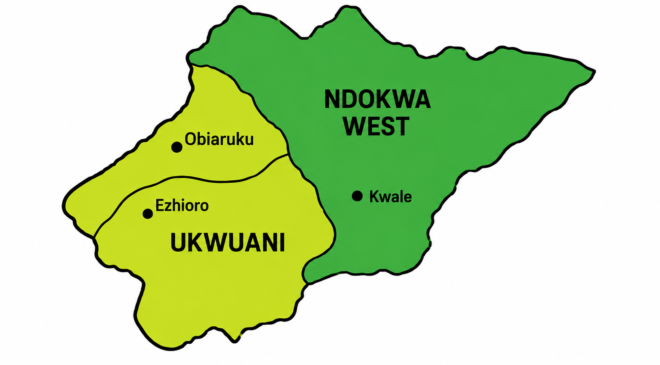
The Ukwuani are an indigenous people of the western Niger Delta, concentrated principally in present-day Ukwuani, Ndokwa West and parts of Ndokwa East Local Government Areas of Delta State, with Ukwuani-speaking communities also found in parts of Rivers State.
They are sometimes referred to within the wider Ndokwa identity. The term Ndokwa is a relatively modern administrative/historical designation associated with Ndosumili and Ukwuani, rather than the original name of a single ancient ethnic group.
The historical territory has also been called Kwale in colonial and European records. The name “Kwale” was particularly associated with the area around present-day Kwale.
- The Question of Ukwuani Origin
This is perhaps the most debated aspect of Ukwuani history.
The Igbo connection
Recent linguistic and historical scholarship strongly emphasizes the Igboid character of Ukwuani. The Ukwuani language belongs to the Igboid branch of the Niger-Congo language family, and scholars have used language, customs, oral traditions and social institutions as evidence in examining the people’s origins.
A 2024 study by Princely Ifinedo and Paul Oshagwu Opone specifically reassessed the competing theories of Ukwuani/Ndosumili origins using archival material and oral testimony.
A subsequent 2026 study by Ifinedo, Opone and Ugochukwu Odagwe went further, examining historical evidence alongside genetic-relative matching. Its authors argue that the linguistic, cultural and historical evidence points more strongly toward an Igboid connection than an Edo/Benin origin.
The Benin/Edo connection
There is also a longstanding tradition that connects some Ukwuani communities and ruling lineages with Benin/Edo. This is not surprising given the extensive historical interaction between the Niger Delta peoples and the Benin Kingdom.
Importantly, however, Benin influence should not automatically be equated with Benin origin. The Ukwuani lived in a region where the Benin Kingdom, Igbo communities, Ijaw, Urhobo, Isoko, Itsekiri and other peoples interacted through migration, trade, warfare, diplomacy and intermarriage.
The most balanced historical conclusion
The safest scholarly conclusion is therefore:
Ukwuani society developed in the western Niger Delta through the settlement and interaction of populations with strong Igboid connections, together with substantial historical interaction with Benin/Edo and neighbouring Niger Delta peoples.
The precise origins of individual clans and towns are not necessarily identical. Some communities have their own migration traditions, founders and ancestral narratives.
- Ukwuani as a Niger Delta People
The geography of Ukwuani profoundly influenced its history.
The territory lies within the rainforest and freshwater-swamp environment of the Niger Delta, with rivers, creeks, fertile agricultural land and extensive forest resources.
This made the Ukwuani country an important meeting point between the interior Igbo-speaking world and the riverine Niger Delta.
Consequently, the Ukwuani historically maintained relationships with:
Aboh/Ndosumili
Ijaw
Urhobo
Isoko
Ika
Aniocha
Benin/Edo
Itsekiri
other neighbouring Niger Delta communities.
Historical research shows that these were not merely cultural relationships. They involved trade, diplomacy, migration, intermarriage and sometimes conflict.
- The Ukwuani Clans
Historical sources identify a number of major Ukwuani clans. One academic catalogue of Ukwuani history identifies fifteen traditional clans, including:
- Abbi
- Akoku
- Amai
- Ebedei
- Eziokpor
- Ezionum/Ezeonum
- Obiaruku
- Ogume
- Onicha-Ukwuani
- Umuebu
- Umukwata
- Umutu
- Utagba-Ogbe
- Utagba-Uno
- — with variations in the enumeration of clans across sources.
The precise classification of communities can vary depending on whether a historian is discussing clans, districts, towns, kingdoms or language communities.
This is important because Ukwuani traditional identity is fundamentally community- and clan-based.
- Traditional Political Organisation
Historically, Ukwuani communities were not governed as one centralized kingdom comparable to the Benin Kingdom.
Instead, political authority was generally distributed among families, villages, clans, elders and traditional institutions.
Traditional leaders and institutions included figures such as:
Okpala/Okpala-Uku – senior lineage or clan authority
Eze – a traditional ruler/title holder in communities where the institution developed
elders
lineage heads
village heads
age grades.
The extended family was an important foundation of political and social organisation.
This decentralized structure also explains why it is difficult to speak of one single “Ukwuani kingdom” in pre-colonial history.
- The Importance of the Family and Ancestors
Ukwuani culture, like many neighbouring Igboid societies, places considerable importance on ancestry, lineage and family history.
A person’s identity traditionally involved knowing:
family → village → clan → ancestral origin.
Oral history was consequently extremely important.
Historical knowledge was preserved through:
proverbs
songs
folktales
praise names
genealogies
rituals
festivals
stories of migration.
Modern historians therefore frequently have to combine oral traditions with archival and archaeological evidence because written indigenous records from the pre-colonial period are limited.
- Traditional Economy
Ukwuani society was historically predominantly agricultural.
Important crops included:
yam
cassava
maize
plantain
vegetables
palm products.
Cassava became particularly important, with garri production becoming a significant economic activity. Palm oil and palm kernels were also important for local consumption and external trade.
Because of the riverine environment, fishing and exploitation of aquatic resources were also important, especially toward the southern and swampier areas.
Traditional crafts
Ukwuani communities also traditionally produced:
mats
earthen pots
mortars
pestles
baskets and other household implements.
- Ukwuani Trade
Trade was an important part of pre-colonial Ukwuani history.
The geographical position of Ukwuani allowed its people to interact economically with neighbouring communities.
Trade involved agricultural products, palm products, forest products and other commodities.
The Ukwuani were therefore not isolated farmers. They were part of the wider economic network of the Niger Delta, linking inland communities with riverine trading systems.
Historical research specifically documents Ukwuani relationships with Aboh, Urhobo, Isoko, Ijaw, Benin, Ika and other neighbouring peoples.
- Ukwuani Language
One of the strongest markers of Ukwuani identity is the Ukwuani language.
Ukwuani-Aboh-Ndoni is classified within the Igboid branch of the Niger-Congo language family.
The language is therefore a major piece of evidence in the scholarly debate concerning Ukwuani identity and origins.
It is also important to understand that Ukwuani is not simply a dialect that appeared recently. It represents a distinct historical speech community that developed through centuries of interaction with surrounding peoples.
- Ukwuani Traditional Religion
Before the spread of Christianity and Islam, Ukwuani communities practiced indigenous religious traditions centred around:
belief in a supreme creator;
ancestral reverence;
community deities;
sacred places;
divination;
traditional priests;
ritual observances;
festivals.
As in other parts of southeastern and Niger Delta Nigeria, the ancestors were traditionally regarded as having an important relationship with the living community.
Christianity has subsequently become dominant among many Ukwuani communities, but elements of traditional culture remain visible in festivals, titles, ceremonies, names, marriage customs and community institutions.
- Marriage and Family Culture
Traditional Ukwuani marriage was more than a relationship between two individuals. It involved two families and, in a broader sense, two lineages.
Important elements traditionally included:
family introductions;
negotiation between families;
presentation of marriage requirements;
bride-related ceremonies;
involvement of elders;
traditional prayers/blessings;
communal celebration.
Respect for parents, elders and extended family has historically been an important part of Ukwuani social values.
- Festivals, Music and Dance
Music is an important part of Ukwuani cultural expression.
Traditional music accompanies:
festivals
funerals
marriages
title-taking ceremonies
community celebrations
masquerade performances.
Drums, dances, songs and praise poetry have traditionally served not merely as entertainment but also as a means of preserving history and transmitting community values.
Academic descriptions specifically note that the Ukwuani have distinctive music associated with their culture.
- Masquerades and Traditional Performances
Masquerades historically occupied an important place in many Ukwuani communities.
They could have religious, social, entertainment and disciplinary functions.
Traditional performances could communicate:
ancestral traditions;
community history;
moral lessons;
social criticism;
celebration of important occasions.
However, masquerade traditions differ from one Ukwuani community to another, so it is better not to treat every practice as universal across Ukwuani land.
- Colonial History
The colonial period significantly changed Ukwuani political organisation.
British authorities initially had relatively limited control over much of the interior Ukwuani territory.
Historical accounts indicate that by the 1890s, British imperial expansion was reaching Ukwuani territory, but the area was among the later parts of the western Niger Delta to come under effective British colonial control.
Colonial administration subsequently reorganised the area into administrative units.
The development of Aboh Division, with Kwale as an important administrative centre, became particularly significant in the later colonial period.
The later term Ndokwa emerged from the administrative history connecting Ndosumili and Ukwuani.
- What Does “Ndokwa” Mean Historically?
This distinction is very important.
Ukwuani and Ndokwa are related but are not historically identical terms.
“Ukwuani” refers to the people, their language and their historical territory.
“Ndokwa” developed as a broader regional identity associated particularly with the Ukwuani and Ndosumili/Aboh areas.
One historical explanation is that Ndokwa was formed from parts of the names Ndosumili and Ukwuani during the administrative history of the area.
Today, however, Ndokwa Nation is widely used as a broader socio-cultural and political identity encompassing communities in the Ndokwa area.
- Ukwuani Identity Today
Modern Ukwuani identity combines several layers:
Ukwuani identity → clan identity → community identity → Ndokwa identity → wider Delta/Anioma identity.
This layered identity is one reason why debates about whether Ukwuani are “Igbo,” “Benin,” “Anioma,” “Ndokwa” or a distinct ethnic group can become complicated.
A person can simultaneously identify with:
their immediate village,
their clan,
Ukwuani,
Ndokwa,
Anioma,
Delta State,
and Nigeria.
These identities are not necessarily mutually exclusive.
- What the Historical Evidence Tells Us
After reviewing the available scholarship, I would summarize the evidence this way:
Area Historical picture
Location Western Niger Delta, principally Delta State
Language Ukwuani-Aboh-Ndoni, classified as Igboid
Origin Contested; strong evidence for Igboid connections, with significant Benin/Edo interaction
Settlement Developed through migrations and settlement of different communities/clans
Political structure Decentralized clan, village, lineage and elder-based systems
Economy Agriculture, fishing, palm production, crafts and trade
Major crops Yam, cassava, maize, plantain and vegetables
External relations Benin, Ijaw, Urhobo, Isoko, Ika, Aniocha, Aboh and others
Traditional values Family, ancestry, community, respect for elders and communal solidarity
Colonial identity Strongly affected by Aboh Division and later administrative restructuring
Modern regional identity Ukwuani/Ndokwa, with connections to wider Anioma and Delta identities
A particularly important conclusion
The 2024 and 2026 scholarly studies are especially important because they revisit older assumptions about Ukwuani history rather than simply repeating traditional claims. The 2026 study argues from language, oral history, cultural practices, archival material and genetic-relative evidence that the evidence is more consistent with an Igboid historical connection than the older narrative that emphasized Benin origins.
At the same time, the historical interaction with Benin and other Niger Delta peoples is undeniable. Therefore, Ukwuani history is best understood as the history of a distinct Niger Delta people whose culture developed through centuries of interaction and migration, with particularly strong Igboid linguistic and cultural connections.