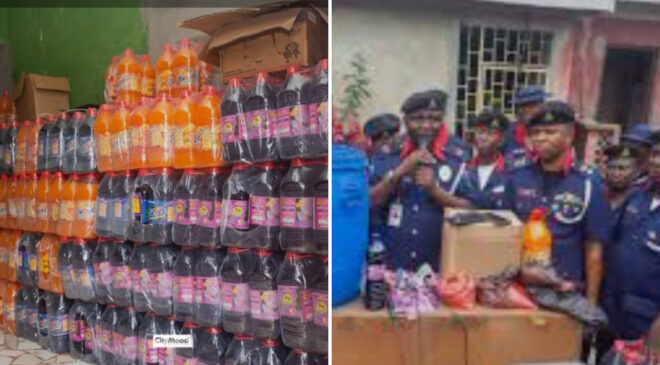
LAGOS/Nigeria: Five days of surveillance and intelligence gathering have led operatives of the Nigeria Security and Civil Defence Corps (NSCDC), Lagos State Command, to an unregistered facility in Badagry allegedly used for the production of adulterated fruit juice.
Two women, aged 48 and 50, were arrested during the operation and are being investigated over the alleged production and distribution of the product known as “Barkas Juice.”
The development was disclosed by the Lagos State Command Public Relations Officer, SC Oluwaseun Abolurin, in a statement on Monday, as the Corps said its Badagry operatives carried out the operation in collaboration with a Nigerian Army formation in the area.
According to Abolurin, the operation followed sustained surveillance of the facility, with the security teams overcoming attempts by some youths to resist the raid.
He said the breakthrough also reflected the impact of the command’s community engagement initiatives, which he said had helped strengthen relationships between the NSCDC and residents and encouraged the flow of security information.
The command said preliminary investigation indicated that the suspected juice was produced by combining water, synthetic flavourings, industrial sweeteners, artificial colourants, dyes and other additives, without the use of real fruit.
The NSCDC further alleged that the production was carried out in unhygienic conditions and that the products were being distributed to markets in Lagos, Benin City in Edo State and other parts of the country.
A particularly significant aspect of the investigation, according to the Corps, is the account allegedly given by the 48-year-old woman identified as the owner of the business.
Abolurin said the suspect told investigators that her grandmother had initially operated a water production business before the enterprise was expanded into Barkas fruit juice production, which she allegedly inherited about 20 years ago.
The command said investigators also found that the product was being marketed with a purported National Agency for Food and Drug Administration and Control (NAFDAC) registration number, 01-2166L, which it described as fake.
The NSCDC said the alleged use of the registration number was part of the issues being examined as investigations continue.
The Corps expressed concern over the composition of the suspected adulterated product, saying preliminary findings showed high levels of sugar, together with water, colourants, dyes and additives.
It further warned that consumption of adulterated products could expose consumers to health risks, while citing conditions such as Type 2 diabetes and liver and kidney problems among the potential consequences. These health concerns were presented by the NSCDC as part of its preliminary assessment and have not been independently established in the statement by a medical authority.
Items recovered from the premises included a truck, cartons of the suspected adulterated juice, production machinery, chemicals, drums and a gas cylinder, among other exhibits.
The State Commandant, Mr. Adedotun Keshinro, ordered the immediate shutdown of the facility, according to Abolurin, saying the action was necessary to prevent further distribution of the suspected product to unsuspecting consumers.
Keshinro also directed that the suspects be subjected to further investigation and prosecution in accordance with the law.
The command said it would work with the National Agency for Food and Drug Administration and Control (NAFDAC) and other relevant agencies as the investigation progresses.
The NSCDC urged residents to continue providing credible information on suspicious activities, stressing that cooperation between communities and security agencies remained important in detecting activities that could threaten public safety.
