By Emmanuel Enebeli
Development is often discussed as if it begins and ends with government.
A road is awarded, a school is renovated, a health centre is equipped or an electricity project is delivered, and the government is expected to receive the credit. When nothing happens, the government is blamed.
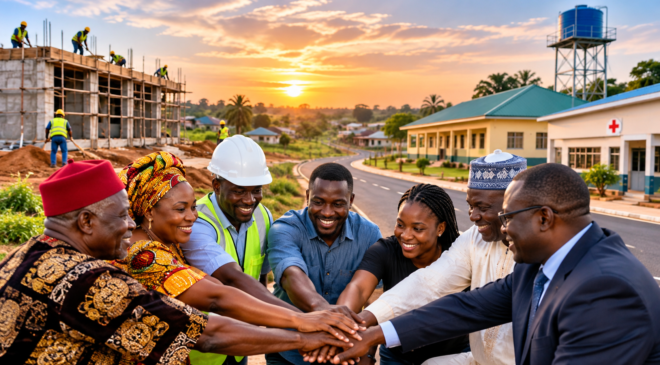
But across Nigeria, another part of the development story is receiving increasing attention: what happens when communities themselves become active participants in determining and improving their future?
The question is particularly important at a time when public resources are under pressure and communities continue to face challenges that cannot always wait for government intervention.
A community is not merely a geographical location. It is a network of people, institutions, businesses, traditional authorities, professionals, young people, women, religious organisations and residents living outside the community who remain connected to it.
When these groups work together around clearly defined priorities, development can take on a different character.
The issue, therefore, is not whether government should develop communities. Government has a constitutional and public responsibility to provide infrastructure and services.
The more useful question is whether government intervention becomes more sustainable when communities themselves participate in identifying needs, supporting implementation, monitoring projects and protecting what has been provided.
Recent developments across Delta State provide different illustrations of this wider conversation.
In Oboro community in Burutu Local Government Area, residents have undertaken self-help projects aimed at addressing longstanding environmental challenges. The initiative has attracted contributions from individuals and organisations, demonstrating how community action and private support can sometimes respond to immediate needs.
But community self-help should not be misunderstood.
When residents contribute money, materials or labour to provide a public facility, that should not automatically mean government has been relieved of its responsibility. Rather, it demonstrates that development can involve several layers of responsibility.
Government provides public policy, infrastructure and services. Communities provide local knowledge, participation and ownership. Businesses can provide investment and employment. Professionals can contribute expertise. The diaspora can provide capital, skills and networks.
Civil society organisations can provide advocacy and monitoring. The question is how these contributions can be coordinated rather than operating as isolated efforts.
DEVELOPMENT BEGINS WITH KNOWING WHAT A COMMUNITY NEEDS
One of the weaknesses of development planning is the tendency to begin with projects rather than problems.
A community may receive a building when what it urgently needs is staffing. It may receive equipment without maintenance funding. A road may be constructed without adequate attention to drainage. A public facility may be commissioned without a realistic plan for its continued operation.
Community participation can help address this gap because residents experience these problems directly.
They know which roads become impassable during the rainy season. They know which health facilities lack essential personnel. They know where young people gather because there are few productive alternatives. They know which markets need better access and which agricultural products struggle to reach buyers.
That local knowledge should form part of serious development planning.
It is not a substitute for technical expertise or government planning. But it can make planning more responsive.
THE COMMUNITY DEVELOPMENT ASSOCIATION QUESTION
Across Nigeria, community development associations have long played important roles in providing infrastructure and mobilising residents.
But their effectiveness depends heavily on leadership, transparency and accountability.
When residents contribute money for a project, they should be able to know how much was raised, how much was spent, who handled the funds and what was delivered.
Without accountability, community development can reproduce some of the same problems that citizens complain about in public administration.
A community association should therefore not simply be a fundraising body.
It should be an institution capable of identifying priorities, setting measurable objectives, keeping proper records, engaging stakeholders and reporting back to residents.
That is particularly important for communities with large populations of people living outside their hometowns.
The diaspora represents an important potential source of capital and expertise. But diaspora contributions are more likely to have lasting impact when they are connected to a transparent development plan rather than scattered across unrelated projects.
TRADITIONAL INSTITUTIONS HAVE A ROLE TOO
Traditional institutions remain influential in many Nigerian communities.
Their role in development, however, can extend beyond ceremonies and dispute resolution.
Traditional rulers and community leaders can help build consensus around development priorities, encourage peaceful cooperation, mobilise residents and create channels through which government and communities can communicate.
They can also help protect community assets once they have been provided.
A newly constructed health centre, school or community facility can deteriorate quickly if nobody feels responsible for protecting it.
Development is therefore not completed when a ribbon is cut.
It is completed when the facility continues to serve the people for whom it was created.
YOUNG PEOPLE CANNOT BE TREATED AS SPECTATORS
Another important part of community development is youth participation.
Young people are often described as the future of a community, but development decisions frequently concern their present.
They need opportunities to contribute ideas, acquire skills, start businesses and participate in local decision-making.
Recent community and development initiatives across Delta have repeatedly placed emphasis on livelihoods, empowerment and participation.
But the larger challenge is to move beyond occasional empowerment events.
Giving people items or one-off financial assistance may provide immediate relief, but sustainable development requires systems that allow people to continue generating income after the intervention has ended.
A community that wants its young people to remain productive must therefore think about skills, electricity, internet access, markets, transport, finance, education and enterprise.
These are development issues, not merely youth issues.
BUSINESSES ARE PART OF THE COMMUNITY TOO
Private businesses operating within or around communities also have a role.
A business cannot thrive indefinitely in an environment where roads are unusable, security is poor, public spaces deteriorate and residents have little purchasing power.
There is therefore a mutual interest between communities and businesses.
Businesses can contribute through employment, skills development, local procurement, community investment and responsible corporate citizenship.
Communities, in turn, can create an environment where legitimate businesses can operate, grow and invest.
The objective should not be to turn every business into a substitute government.
It should be to recognise that economic development and community development are closely connected.
WHAT THIS MEANS FOR NDOKWA
For Ndokwa, the conversation is particularly relevant.
The region’s development concerns are already well documented: electricity, roads, agriculture, jobs, education, healthcare, environmental management and economic opportunity have featured prominently in recent community consultations and public discussions.
But identifying problems is only the first step. The harder question is what happens next.
Can communities establish development priorities that survive political cycles?
Can community organisations maintain transparent records of contributions and projects?
Can professionals contribute technical knowledge? Can businesses become stronger partners in local economic development?
Can young people participate in decisions affecting their future? Can people in the diaspora move from individual donations to coordinated investment?
And can government be engaged as a partner while still being held accountable for its responsibilities? These questions are bigger than any single local government area.
They apply to communities across Delta State and Nigeria.
GOVERNMENT MUST STILL ANSWER FOR PUBLIC RESPONSIBILITIES
There is an important line that should not be crossed.
Community participation must never become an excuse for government to withdraw from its responsibilities.
Citizens pay taxes and other charges. Governments control public resources and are responsible for public infrastructure and essential services.
A community raising money to repair a road does not remove the government’s responsibility for an effective transport network.
A community equipping a health centre does not remove the government’s responsibility to provide functional healthcare.
Parents contributing to school development does not eliminate the state’s responsibility for public education.
Community action should therefore be viewed as partnership and participation, not privatisation of public responsibility.
That distinction is essential.
FROM COMPLAINTS TO COMMUNITY DEVELOPMENT PLANS
Perhaps the next stage of community development in Nigeria should be a shift from general complaints to measurable community development plans.
Instead of simply saying that a community needs development, residents and their leaders could identify five or ten priorities and determine:
What is the problem? What can the community do? What requires government intervention? What can businesses support? What expertise is required? How much will it cost? Who is responsible for following up? When should progress be reviewed? That approach would make development conversations more practical.
It would also make it easier for citizens to hold both community leaders and government officials accountable.
THE BIGGER QUESTION
Nigeria does not lack communities with talented people.
What is often missing is the organisation required to convert talent, goodwill and resources into sustained development.
A professional living in Lagos may have expertise that could help a hometown project. A business owner may be willing to invest. A young person may have a technology solution. A traditional ruler may have the influence to build consensus. A government agency may have the mandate and resources.
The challenge is bringing these resources together around a common and transparent plan.
That is where community development becomes more than the construction of physical infrastructure.
It becomes the building of institutions, relationships, economic opportunities and a culture of responsibility.
Government remains central.
But government cannot be everywhere at once, and no government can substitute completely for an organised citizenry.
The strongest communities are likely to be those where people do not simply wait for someone else to solve every problem, but where citizens understand what they can do themselves, what they should demand from government and how both responsibilities can work together.
For Ndokwa, Delta and communities across Nigeria, that may be one of the most important development conversations to have.
The real question is not whether government should develop the community. It is whether government, citizens and institutions can each do their part well enough to ensure that development lasts.
DEVELOPMENT PERSPECTIVE
Community development should never be reduced to political announcements, commissioned projects or occasional donations. The measure of development is whether people experience lasting improvements in their daily lives.
Government must remain accountable for public responsibilities. At the same time, communities should not surrender their own agency. They need organised leadership, transparent community institutions, active citizens and development priorities that survive election cycles.
A developed community is not simply one with projects. It is one with the capacity to identify its needs, mobilise its people, attract investment, demand accountability and protect the gains it makes.
That is the conversation Nigeria’s communities should be having.
