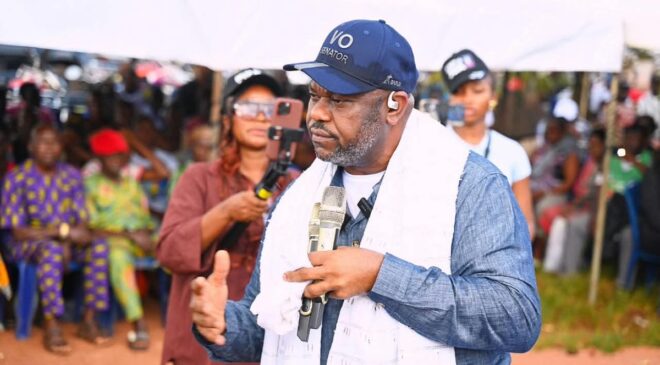
ASABA/Nigeria: A community-by-community development mapping exercise and coordinated agricultural production system have been proposed as part of a development plan for Delta North by former Delta State House of Assembly Speaker, Rt. Hon. Victor Onyekachi Ochei.
Ochei presented the proposals during an engagement with Presidents-General from communities across Aniocha and Oshimili, where he said development planning should begin with identifying the specific needs, resources and economic potential of individual communities.
He described Presidents-General as important links between communities and public officeholders, urging them to articulate local concerns and demand accountability from elected representatives.
According to him, effective representation requires regular engagement with residents and a clear understanding of the problems that affect different communities rather than relying on a uniform development approach.
At the centre of his proposal is a comprehensive mapping exercise covering communities across Delta North. He said the process would document infrastructure deficiencies, agricultural opportunities, mineral resources and other economic assets that could inform development planning.
Ochei said the exercise should involve community leaders, farmers, youths, women, professionals and other stakeholders so that development priorities are determined with input from the people directly affected.
He also proposed the creation of agricultural farm clusters, with farmers producing similar crops organised into cooperatives and linked to inputs, mechanisation, irrigation, finance, extension services and markets.
The proposed clusters, he said, would be adapted to the agricultural potential of individual locations, with crops and activities including cassava, rice, oil palm, vegetables, livestock and fish production.
His proposal also envisages connecting the farm clusters to agro-industrial centres for processing, packaging, storage, transportation and marketing.
Ochei said such an arrangement could enable farmers to participate beyond primary production and retain greater economic value from their output.
He used cassava production to illustrate the potential, saying Delta North should move beyond the sale of raw agricultural products and explore the production of starch, flour, animal feed, sweeteners and other industrial derivatives.
He also identified agricultural waste as a potential source of additional income, citing cassava peels for animal feed, crop residues for composting and renewable-energy applications, and surplus or rejected fruits for juice and concentrate production.
The proposed approach, he said, would require investment in electricity, rural roads, storage and market access to make agricultural production and processing commercially viable.
Ochei identified the availability and reliability of electricity as another constraint on businesses and communities, despite Delta State’s gas resources. Drawing on his engineering background, he proposed investment in power infrastructure, including substations, transmission and distribution facilities.
He said improved electricity supply would support farms, processing facilities and small businesses, while better rural roads would reduce the difficulty of moving agricultural produce from farms to processing centres and markets.
The former Speaker also linked the proposed agricultural and industrial development model to youth employment, arguing that skills programmes should be connected to equipment, finance, markets and actual economic opportunities.
He said young people could find opportunities across agriculture, food processing, transportation, packaging, storage, marketing, technology and export services, while also identifying manufacturing, textiles, sports and the creative sector as areas with potential.
Ochei cited a stadium he said he personally built in Onicha-Olona as an example of how investment in sports infrastructure could create opportunities beyond sporting activities, including for traders, transport operators, food vendors and hospitality businesses.
He described himself as an engineer and lawyer by training, a businessman by profession and a politician by choice, saying public office should be used to expand opportunities and address community needs.
The political context of the proposal is significant. Ochei is the National Democratic Congress (NDC) candidate for Delta North in the January 16, 2027 senatorial election, according to the final candidate information published following INEC’s release of the National Assembly candidate list.
The Delta North race includes former governor Ifeanyi Okowa of the All Progressives Congress, Ochei of the NDC, Valentine Ogoliegbune of the African Democratic Congress and Onyeama Ogannah of the Peoples Democratic Party, among other candidates on INEC’s list.
At the community meeting, Ochei asked the Presidents-General to take his proposals back to their communities, discuss them with residents and assess his record and programme before making their political choices.
The proposals form part of what his campaign describes as a “Delta North Rescue Mission,” although the specific development measures outlined at the meeting—community mapping, agricultural clusters, agro-processing, infrastructure and youth enterprise—are proposals from Ochei and not established government programmes.
The engagement adds a development-planning dimension to the growing political activity in Delta North ahead of the 2027 election, with candidates increasingly presenting programmes around agriculture, employment, infrastructure and community representation.
