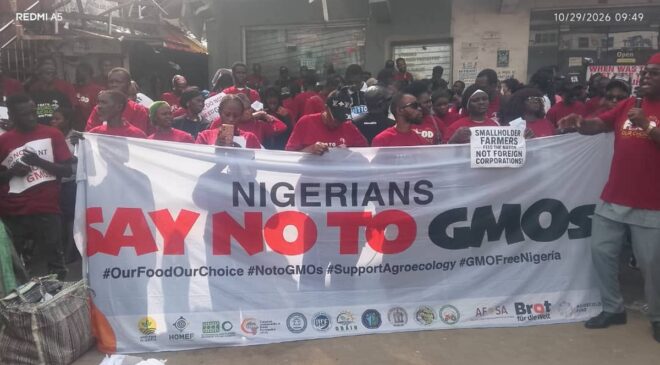
LAGOS/Nigeria: Environmental and public health advocates have called on the Lagos State House of Assembly to restrict genetically modified organisms (GMOs), review existing approvals and promote agroecological farming as an alternative approach to strengthening food security.
The demand was made during an advocacy march organised by the Health of Mother Earth Foundation (HOMEF) in Lagos, as campaigners raised concerns about the potential implications of genetically modified crops for public health, biodiversity, indigenous seeds and farmers’ independence.
The rally, held on Thursday, October 29, 2026, began at Computer Village, Ikeja, and proceeded to the Lagos State House of Assembly complex in Alausa under the campaign theme, “GMOs Will Not Address Nigeria’s Food Crises.”
Speaking during the exercise, Mr Olamide Ogunlade of Corporate Accountability and Public Participation Africa, representing the OCA consortium, said the campaign was designed to increase public awareness and encourage government intervention in the country’s agricultural and food systems.
He expressed concern about what he described as the growing influence of corporate interests in agricultural production, arguing that government policies should give greater attention to local farmers, organic farming and environmentally sustainable agricultural practices.
Ogunlade identified public sensitisation and engagement with policymakers as the two major objectives of the campaign, noting that Lagos was strategically positioned to influence wider discussions on agricultural policies in Nigeria.
He maintained that greater investment in agroecology would help promote environmentally responsible farming while reducing excessive dependence on synthetic agricultural inputs.
The Director of Programmes at HOMEF, Ms Joyce Brown, said the organisation was seeking a prohibition of GMOs in Lagos, alongside measures to protect indigenous seed varieties and strengthen farmers’ control over their agricultural resources.
Brown raised concerns about possible cross-pollination between genetically modified crops and traditional varieties, warning that such developments could threaten the preservation of indigenous seeds and farmers’ ability to maintain traditional planting practices.
She also expressed concern that commercial dependence on patented seeds could gradually make farmers reliant on biotechnology companies for planting materials, weakening the traditional practice of saving, reusing and exchanging seeds.
According to her, protecting indigenous agricultural resources should form an important part of Nigeria’s food security strategy.
Brown cited countries that have adopted restrictions on genetically modified crops, arguing that Nigeria should carefully examine the implications of such technologies for its agricultural biodiversity and food sovereignty.
She called for independent and long-term scientific assessments of the potential health and environmental effects of genetically modified crops, insisting that further approvals should be suspended pending credible investigations.
The HOMEF official also urged the Lagos Assembly to develop policies that would support smallholder farmers, encourage agroecological practices and protect traditional agricultural knowledge.
She further appealed to the Federal Government to revisit a motion reportedly moved in the House of Representatives in 2024 concerning the regulation and approval of GMOs.
A molecular biologist and public health analyst, Dr Casmir Ifeanyi, also called for stronger legislative oversight of genetically modified crops, questioning the adequacy of Nigeria’s existing biosafety regulatory framework.
Ifeanyi, a member of the Network of African Scientists in Biosafety, Biodiversity and Health, said concerns about the regulation of GMOs had persisted since the enactment of the National Biosafety Management Act in 2015.
He alleged that regulatory approvals had been granted without sufficient attention to concerns raised by independent researchers and other stakeholders.
The scientist claimed that more than 16 genetically modified crops had received approval in Nigeria, adding that some imported processed food products could contain ingredients derived from genetically modified crops.
He questioned whether adequate baseline studies and independent long-term investigations had been conducted to assess possible health implications associated with the consumption of genetically modified foods.
He also raised concerns about potential effects on biodiversity, soil microorganisms and the nutritional composition of agricultural products.
Beyond the health debate, Ifeanyi warned that increased dependence on patented planting materials could affect farmers’ traditional rights to save and exchange seeds, potentially shifting greater control of agricultural production to commercial suppliers.
He urged state lawmakers to examine the implications of biotechnology policies for public health, environmental protection and the country’s food sovereignty.
In a petition presented as part of the campaign, the advocates called on the Lagos State Government to introduce policies protecting indigenous seeds, strengthen support for smallholder farmers and promote organic and agroecological farming.
They also demanded greater public access to information about the seeds and agricultural technologies being introduced into the country’s food production system.
The campaign reflects a growing debate over the direction of Nigeria’s agricultural policy, particularly the balance between biotechnology, environmental protection, farmers’ rights and the need to increase food production.
While the advocates are pressing for restrictions on GMOs and greater investment in agroecology, their demands also place renewed attention on the responsibility of regulatory institutions to ensure transparent decision-making, credible scientific assessments and public participation in matters affecting the nation’s food system.
