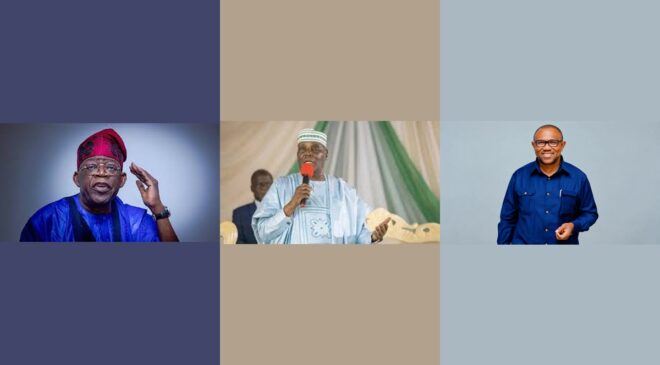
ASABA/Nigeria: The Network Against Corruption and Trafficking (NACAT) has challenged President Bola Ahmed Tinubu, former Vice President Atiku Abubakar and former Labour Party presidential candidate Peter Obi to make policy proposals, rather than personal attacks, the centrepiece of their campaigns ahead of the 2027 general elections.
The organisation’s position was contained in a statement signed by its Operations Manager, Stanley Ugagbe, who expressed concern that political exchanges among supporters of the leading presidential contenders were increasingly dominated by insults, character attacks and political propaganda at the expense of substantive discussions on national development.
NACAT argued that the emerging pattern of political communication was a distraction from the pressing issues confronting Nigerians, particularly economic hardship, insecurity, corruption, unemployment and deteriorating public infrastructure.
It maintained that the country’s political leaders should use the electioneering period to explain how they intend to address these challenges rather than allow campaign activities to become platforms for personal confrontations.
The anti-corruption organisation said Nigerians deserved to assess presidential contenders based on the practicality of their policies, the credibility of their proposed solutions and their ability to deliver measurable results.
On corruption and public accountability, NACAT urged the candidates to explain how they would strengthen the independence and operational capacity of the Economic and Financial Crimes Commission (EFCC) and the Independent Corrupt Practices and Other Related Offences Commission (ICPC).
It also called for comprehensive plans to address oil theft, budget padding, financial leakages and irregularities in public procurement, while advocating the use of technology to improve transparency in government expenditure and revenue collection.
On the economy, the organisation said the candidates should present clear strategies for tackling inflation, stabilising the naira, managing public debt and reducing the cost of living.
It also challenged them to explain how their proposed economic policies would stimulate micro, small and medium-sized enterprises, expand employment opportunities and reduce the country’s dependence on crude oil as a major source of foreign exchange earnings.
Addressing the security situation, NACAT called for detailed proposals on intelligence-led policing, border surveillance and judicial reforms to strengthen the fight against terrorism, kidnapping, banditry and other violent crimes.
The group further urged the presidential hopefuls to clarify their positions on state policing and local government autonomy, including specific timelines and implementation strategies.
It also drew attention to the relationship between economic hardship, irregular migration and human trafficking, warning that the increasing desire among young Nigerians to seek opportunities abroad could expose vulnerable citizens to exploitation and modern slavery.
NACAT therefore called for policies that would promote local employment, strengthen vocational education and improve opportunities for young people.
It specifically urged the contenders to outline how they would support the National Agency for the Prohibition of Trafficking in Persons (NAPTIP), including improved funding, institutional capacity and inter-agency collaboration to dismantle trafficking networks.
On infrastructure and food security, the organisation identified electricity shortages, inadequate transportation networks and insecurity in farming communities as major obstacles to economic growth.
It asked the candidates to provide realistic investment plans for renewable energy, electricity grid decentralisation, road and railway development, as well as measures to protect farmers and strengthen agricultural supply chains.
The organisation warned that promises without clear implementation frameworks, funding arrangements and measurable targets would offer little assurance to an electorate seeking meaningful improvements in living conditions.
It consequently appealed to the presidential candidates to exercise restraint in their campaign organisations, media teams and support networks, urging them to prioritise policy-driven communication.
NACAT also called on media organisations, civil society groups and Nigerians to demand detailed explanations of campaign promises during political debates, town hall meetings and other public engagements.
The organisation said it would continue to monitor political communication ahead of the 2027 elections and challenge candidates whose campaigns, in its assessment, rely on personal attacks and political distractions rather than substantive national issues.
It maintained that the quality of leadership emerging from the 2027 elections would depend significantly on the ability of voters to scrutinise competing policy proposals and hold political actors accountable for their commitments.
