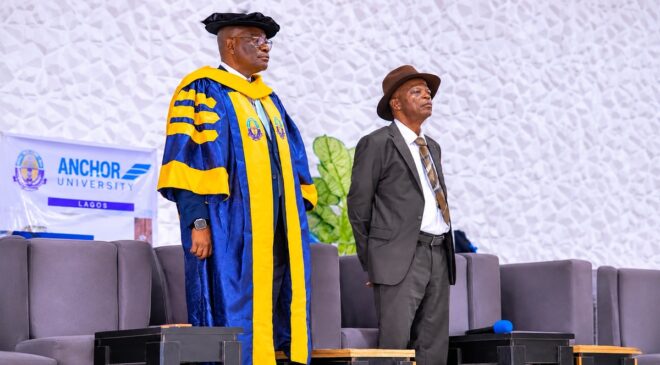
LAGOS/Nigeria: The Chairman of the Governing Board of the National Universities Commission (NUC), Professor Oluwatoyin Ogundipe, has challenged African universities to move beyond conventional teaching and become centres of innovation, research and transformational leadership capable of addressing the continent’s development challenges.
He argued that Africa’s prosperity would depend increasingly on the quality of its human capital, intellectual capacity and institutional leadership rather than its abundance of natural resources.
Ogundipe, a former Vice-Chancellor of the University of Lagos, made the call on Friday, November 20, 2026, while delivering the 2026 convocation lecture of Anchor University, Ayobo, Lagos, as part of activities marking the institution’s 10th anniversary.
The lecture, titled ANCHOR@10: University Education, Transformational Leadership and the Future of Africa, examined the relationship between higher education, responsible leadership and the continent’s prospects for sustainable development.
According to him, Africa’s development prospects would remain limited if its universities failed to translate academic knowledge into innovation, productive enterprises and solutions to pressing social and economic problems.
He maintained that the ability to generate knowledge, encourage innovation and produce leaders with integrity would increasingly determine the competitiveness of nations in the 21st century.
The professor observed that despite its considerable natural and human resources, Africa continued to struggle with poverty, unemployment, weak institutions, infrastructure deficits and governance challenges.
He questioned why a continent endowed with valuable resources continued to depend heavily on the export of raw materials while importing finished products and specialised expertise.
For Ogundipe, the underlying problem goes beyond the availability of resources. It reflects weaknesses in institutional development, leadership and the continent’s capacity to produce and apply knowledge.
He therefore identified human capital development, knowledge production and ethical formation as essential pillars for Africa’s transformation.
The NUC Governing Board chairman said universities must recognise that their responsibilities extend beyond awarding degrees and preparing graduates for employment. They must also cultivate moral reasoning, civic responsibility, public service and the capacity to contribute meaningfully to society.
He explained that the relevance of higher institutions would increasingly depend on their ability to prepare graduates for a rapidly changing world, where knowledge and professional competencies require continuous improvement.
Ogundipe urged universities to become centres where research findings are converted into practical solutions, commercial products and sustainable livelihoods.
He stressed that institutions could no longer rely solely on inherited knowledge or conventional classroom instruction, noting that graduates must acquire the creativity, adaptability and problem-solving abilities required to remain relevant in a changing global economy.
He also emphasised the importance of research-driven universities, arguing that institutions must prioritise original knowledge production rather than merely reproduce existing ideas.
Beyond research, he advocated stronger connections between universities and their immediate communities, insisting that higher education institutions must remain responsive to local needs, cultures and development priorities.
Addressing the subject of transformational leadership, the former UNILAG vice-chancellor maintained that the strength of any institution ultimately depends on the quality and integrity of those entrusted with its leadership.
He said effective leadership requires more than administrative competence, adding that integrity, personal example and accountability are essential for building institutional trust.
He further highlighted the spiritual dimension of leadership, particularly within faith-based institutions such as Anchor University.
According to him, the fear of God and the understanding that leadership involves responsibility and stewardship provide an important moral foundation for directing competence and courage towards the common good.
Reflecting on Anchor University’s first decade, Ogundipe said its anniversary should provide an opportunity for the institution to assess its achievements, examine its shortcomings and define a more ambitious direction for the future.
Using the symbolism of an anchor, he explained that its importance becomes most evident when a vessel encounters difficult conditions, helping it maintain stability against strong winds and currents.
He said the university was established to provide a firm foundation of faith, character and academic excellence for young Nigerians and Africans in a world experiencing rapid changes in values and expectations.
He urged the institution to move deliberately from its first decade of promise towards greater academic distinction, identifying research excellence, digital transformation, industry partnerships and international academic collaboration as important priorities.
He also called for stronger relationships between academic programmes and the labour market through internships, innovation incubators and curricula developed in collaboration with industry practitioners.
The professor further encouraged the university to deepen partnerships with reputable institutions within and outside Africa to strengthen its research capacity, academic visibility and international relevance.
He maintained that the institution’s impact should be measurable not only through its academic achievements but also through the benefits it delivers to the Ayobo community, Lagos State and Nigeria.
Ogundipe challenged the university to demonstrate that meaningful institutional impact does not require centuries of existence, urging its management to pursue excellence and social relevance from its present stage of development.
Addressing the graduating students, he reminded them that their education should prepare them for responsibilities beyond obtaining employment or acquiring professional qualifications.
He urged them to approach the next phase of their lives with faith, discipline, integrity and a commitment to making meaningful contributions to society.
Drawing from biblical teachings, he encouraged the graduates to trust in God, acknowledge Him in their decisions and allow their values to guide their individual and professional journeys.
He described graduation not as the conclusion of their personal development but as the beginning of a new responsibility to apply their knowledge, skills and character to the challenges confronting society.
Ogundipe said universities must continue to serve as centres of excellence, hope and renewal, while producing graduates capable of influencing positive change.
His message placed a significant responsibility on African higher institutions: to produce not merely certificate holders, but innovative thinkers, responsible leaders and problem-solvers equipped to contribute to the continent’s development.
