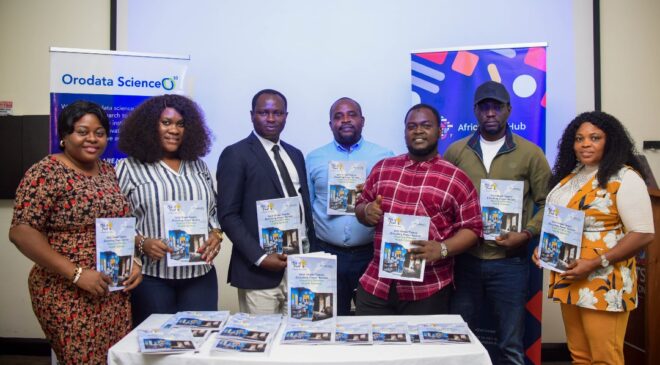
LAGOS/Nigeria: Orodata Science, in collaboration with the Africa Data Hub, has completed a three-month capacity-building programme designed to strengthen the health desks of ten newsrooms across Nigeria, culminating in a hybrid close-out event on Tuesday, November 25, 2025, at the Four Points Hotel, Lagos. The session featured in-depth discussions on data-driven health reporting and the official launch of the 2024/2025 PHC Energy Report.
Over the course of the programme, participating journalists were trained by leading industry professionals on key modules including data journalism, fact-checking, visualisation and solutions journalism — tools intended to reshape how the media reports complex health and development issues.
In his opening remarks, Country Operations Lead at Orodata Science, Mr. John Eromosele, described the newsroom as the “engine room of narratives,” stressing the importance of telling compelling, people-centred stories anchored in data. He highlighted the impact of the Africa Data Hub across West, East and Southern Africa, noting its support for health desks through story grants and access to vital datasets.
Eromosele addressed longstanding challenges journalists face in obtaining primary data, explaining that the recently concluded six-week virtual training was specifically curated to close that gap. Citing Orodata’s CheckMyPHC portal — which has mapped over 1,500 primary healthcare centres nationwide — he said the data holds countless untold stories waiting to be uncovered.;
“There are a lot of untold stories behind the data,” he noted, emphasising that the goal is to equip journalists with the skills to create clear and impactful visualisations that elevate their reporting.
During his technical session, Eromosele led modules on Fundamentals of Data Analysis using spreadsheets, data scraping from repositories, and introductory training on Flourish and Datawrapper. He described visualisation as indispensable in modern journalism, helping simplify complex datasets, build audience trust and enhance newsroom credibility. He also introduced Canva as a tool for producing social-first infographics and static visuals.
He underscored that digital tools are only enablers, reminding participants: “Flourish, Datawrapper, Canva, etc., are just means. Always remember that the story is the real power. You are not just reporters; you are storytellers and catalysts for change.”
The close-out event concluded with the launch of ‘Grid Ghost Towns: Elevating Power Across Nigeria’s Primary Health Centres,’ a landmark report that exposes the worsening energy crisis crippling PHCs across Osun, Anambra, Taraba, Sokoto, Cross River and Benue states.
The report highlights unreliable grid supply, rising diesel and electricity costs, and growing dependence on backup generators — pressures that weaken state budgets and restrict critical medical services. With national grid output fluctuating between 3,500 and 4,500 MW for a population of more than 220 million, the report warns that without state-specific reforms and increased investment in decentralised renewable energy, many PHCs risk becoming literal “Grid Ghost Towns.”
The initiative marks a significant push to deepen the capacity of Nigerian journalists to produce evidence-based stories that drive accountability and strengthen the nation’s health systems.