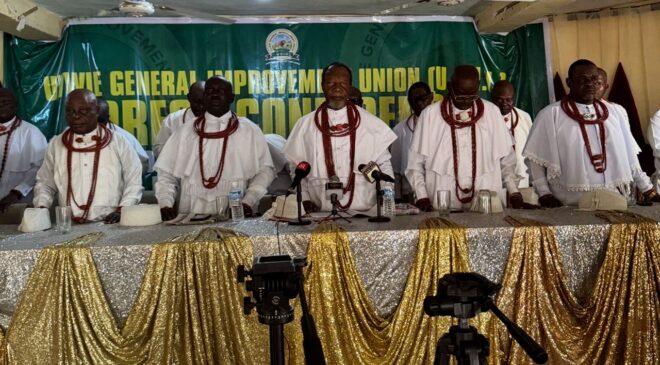
EFFURUN/Nigeria: The Uvwie General Improvement Union (UGIU) has issued a firm warning to individuals it described as “misguided Itsekiri elements,” cautioning against what it termed deliberate attempts to distort history and incite discord in Delta State, while stressing that the peaceful disposition of the Uvwie people should not be misconstrued as weakness.
Addressing a world press conference in Effurun on April 24, 2026, President General of UGIU, Chief Hope Erute, declared that the Uvwie Kingdom remains resolute in defending its territorial integrity, heritage, and people. “The Uvwie Kingdom is not afraid, and will never be afraid, to defend its territory, its heritage, and its people,” he said.
Erute explained that the Union was compelled to respond following what it described as “fallacious and provocative claims” allegedly made by some Itsekiri individuals, who, according to him, have been asserting that they founded several communities within Uvwie Local Government Area, including Ugbenuowhoru (also referred to as Ukpolokposo), Okwatata, Iteregbi, and Ugbomro.
He noted that the claims were reportedly amplified during a recent cultural festival of the Itsekiri nation, where a narrative was presented suggesting that the communities in question were founded by Itsekiri ancestors. The UGIU leader dismissed the assertions as unfounded, stating that while the Uvwie people are not inclined to respond to what he termed “delusional folktales,” persistent repetition of such claims necessitated a formal clarification.
“Silence in the face of persistent falsehoods can sometimes be mistaken for consent. Therefore, we state the facts for the record to properly educate discerning minds,” Erute said.
Providing historical context, the UGIU president maintained that available records and genealogies contradict the claims, arguing that even accounts cited by Itsekiri sources acknowledge pre-existing Uvwie roots in the disputed communities. He referenced narratives surrounding Prince Udefi, noting that such accounts indicate he settled in an already established Uvwie settlement linked to his maternal lineage.
Erute further contended that historical migration patterns show that Itsekiri groups moved across riverine areas seeking refuge, insisting that they were not aboriginal settlers in the hinterland communities now under contention. He accused certain individuals of attempting to “shop for favourable judgments” to support what he described as revisionist claims.
On specific communities, the UGIU maintained that Ugbenuowhoru originated as a settlement granted by the Erovie people of Uvwie to maternal relations of Itsekiri descent, while Ugbomro, according to him, was founded by Uwherume of the Abadi family in Uvwie. He added that the existing ruling houses in Ugbomro reflect this history and that no aboriginal Itsekiri lineage exists in the town.
The Union also cited historical episodes involving the late King Nana of Itsekiri, stating that he had maternal ties to Uvwie and reportedly sought refuge in the area during conflicts with British forces. Erute recalled that Uvwie communities suffered reprisals, including the burning of Effurun in the 1890s, during British expeditions linked to the pursuit of the Itsekiri leader.
According to him, subsequent migrations, including movements from Koko in present-day Warri North, contributed to the demographic growth of Ugbenuowhoru, reinforcing its role as a refuge linked to maternal ancestry rather than evidence of Itsekiri founding rights.
Erute further referenced historical developments in Itsekiri leadership structures, arguing that the evolution of kingship in Itsekiri land followed the decline of King Nana’s authority, and that later institutional arrangements did not extend territorial control over certain areas now being claimed.
He also recalled the tensions that followed the 1952 change of title from “Olu of Itsekiri” to “Olu of Warri,” noting that while violence led to the displacement of Itsekiri populations in some areas, Uvwie communities protected those residing in Ugbenuowhoru on the basis of shared maternal ties.
Describing current claims as “mischievous and provocative,” the UGIU warned that any attempt to rewrite history or assert ownership over Uvwie lands would not be tolerated, even as it reaffirmed the longstanding tradition of peaceful coexistence between the Uvwie and Itsekiri peoples.
“We do not seek conflict with any neighbour. We believe in truth, evidence, and historical record. The narrative being propagated is fictional and trouble-seeking,” Erute stated.
The Union called on those promoting the claims to desist, urging them instead to focus on the development of their communities and avoid actions capable of destabilising inter-ethnic harmony in the region.
Reaffirming its position, the UGIU declared that Ugbomro, Okwatata, Iteregbi, and Ugbenuowhoru remain integral parts of Uvwie Kingdom, noting that while some residents may have paternal Itsekiri ancestry, they are regarded as maternal relations under the authority of the Ovie of Uvwie.
The group further appealed to the Delta State Government and security agencies to monitor the situation and take proactive steps to prevent any escalation of tensions arising from what it described as inciting narratives.
“The path of peace and mutual respect is wide enough for all. There is no need to manufacture crisis where none exists,” Erute added.