By Mokobia Rita
ASABA/Nigeria: Delta State’s drive to attract fresh investments into key sectors of its economy has received a significant boost, with prospective investors from Brazil and China already indicating interest in participating in the forthcoming Delta State Investment and Economic Summit, a development expected to strengthen the state’s efforts to diversify its economy, create jobs and expand industrial growth.
The summit, which is expected to bring together government officials, development finance institutions, business leaders and international investors, is being positioned as more than an investment conference. State officials say it is designed to convert Delta’s natural resources, strategic location and growing infrastructure into bankable projects capable of attracting long-term local and foreign investments.
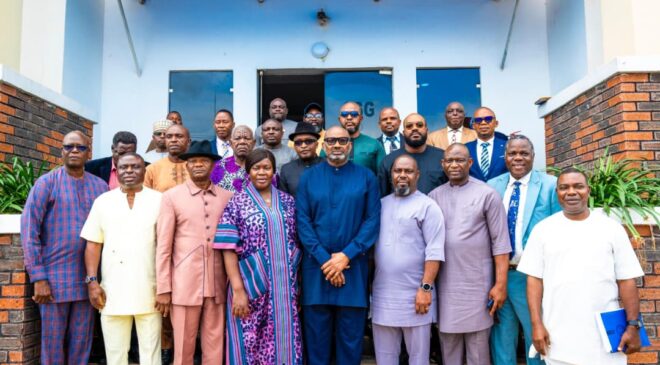
Secretary to the State Government (SSG) and Chairman of the Main Organising Committee, Dr. Kingsley Emu, disclosed this on Monday during an interactive session with stakeholders in Asaba, where he outlined the state’s preparations for the summit.
According to Emu, no fewer than 25 prospective investors from Brazil have already confirmed interest in attending, while several others from China are also expected to participate.
He said the summit, themed “Harnessing Our Strengths, Unlocking Our Potential,” would attract a high-profile list of participants, including Vice President Kashim Shettima, Director-General of the World Trade Organisation (WTO), Dr. Ngozi Okonjo-Iweala, the Minister of Finance and Coordinating Minister of the Economy, Mr. Taiwo Oyedele, development finance institutions and leading private sector operators. Renowned oil and gas executive Engr. Austin Avuru will chair the event.
“To date, 25 potential investors are coming in from Brazil and many others from China. They have indicated interest and we are already making preparations for them,” Emu said.
He described the summit as a major opportunity to connect Delta’s economic opportunities with international investment capital while positioning the state as one of Nigeria’s preferred investment destinations.
Beyond attracting foreign investors, the SSG stressed that indigenous businesses would play a central role in the success of the summit, explaining that many of the foreign companies seeking to invest in Delta had already expressed interest in partnering with credible local enterprises.
According to him, such partnerships would ensure that investments generate sustainable economic activities while creating employment opportunities for Deltans.
“The significant success we will achieve on this journey will depend on your cooperation, collaboration and positive disposition to what we want to do,” he told stakeholders.
Emu explained that the state was approaching the summit with clearly defined investment opportunities rather than a broad promotional campaign, identifying agriculture, aquaculture, power, oil and gas, manufacturing, solid minerals and the blue economy as sectors with strong commercial potential.
He said Delta possesses several competitive advantages, including abundant oil and gas resources, extensive land and waterways, expanding infrastructure, a youthful population and a growing network of tertiary, technical and vocational institutions capable of supplying skilled manpower for industries.
According to him, the state’s economic transformation agenda is deliberately shifting beyond dependence on crude oil by promoting investments in agriculture, services and other non-oil sectors.
Emu noted that Delta’s four state-owned universities, technical colleges and vocational institutions provide investors with opportunities to develop industry-specific skills through partnerships that can produce a steady pipeline of qualified workers.
On agriculture, he identified cassava, rice, oil palm, aquaculture and agro-processing as priority investment areas, stressing that the government’s objective is to expand value addition rather than continue exporting raw agricultural produce.
He described aquaculture as one of the state’s most promising but underdeveloped sectors, noting that investments in fish feed production, cold storage facilities and processing plants would significantly improve productivity and strengthen Delta’s position as a leading fish-producing state.
The SSG also highlighted the commercial opportunities within the state’s vast waterways, saying they present enormous potential for commercial fishing, fish processing and other blue economy ventures.
On mining, Emu identified kaolin, coal, silica, clay and lignite as commercially viable mineral resources capable of attracting further private investment, noting that some deposits are already under active commercial development.
He also described electricity as one of the state’s most strategic investment frontiers, citing Delta’s abundant natural gas reserves and proximity to critical gas infrastructure as major advantages for industrial expansion.
According to him, the state government is exploring decentralised electricity solutions, particularly mini-grids and captive power generation, to guarantee reliable electricity supply for industries, manufacturing clusters and commercial centres.
“If you have consistent power supply, the economy will do much better. We have the gas, we have the strategic location and we have the opportunity to provide competitive power for industries,” Emu said.
He assured stakeholders that the investment summit would extend beyond conference presentations to include sector-specific engagements, business matchmaking sessions, investment site visits and structured follow-up mechanisms designed to convert investor interest into viable projects.
Also speaking, the Commissioner for Works (Rural Roads) and Public Information, Mr. Charles Aniagwu, urged indigenous entrepreneurs to position themselves as investors and strategic partners rather than merely attending the summit as observers.
He said while foreign investors may possess greater financial capacity, local businesses have a deeper understanding of the state’s economy and therefore remain critical to the long-term success of investment initiatives.
Aniagwu encouraged business owners to form partnerships and establish Special Purpose Vehicles (SPVs) to mobilise resources for large-scale investments that may be difficult to execute individually.
“It is not all about what you are going to do at the summit or the sessions you will participate in. At your own end, how are you going to get involved?” he asked.
He urged Delta’s private sector to take advantage of emerging opportunities across agriculture, manufacturing, oil and gas, power generation and other productive sectors.
Speaking on behalf of the Nigerian Association of Chambers of Commerce, Industry, Mines and Agriculture (NACCIMA), Janet Olisa reaffirmed the organised private sector’s commitment to partnering with the Delta State Government.
She expressed confidence that sustained collaboration between government and the private sector would help translate the summit into tangible investments, job creation and sustainable economic growth across the state.