By Ijeoma Okoro
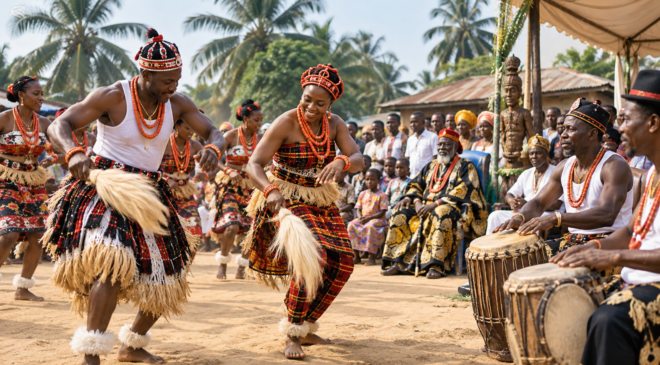
ASABA/Nigeria: The drums may stop, the dancers may return home and the festival grounds may become quiet again, but the cultural institutions behind many traditional celebrations continue to shape community identity long after the last performance.
Across Delta State, traditional festivals remain an important part of community life. They bring together people who may have spent months or years away from home, create opportunities for younger generations to encounter customs they did not grow up practising and reinforce the institutions through which communities preserve collective memory.
This year’s cultural calendar provides several reminders.
The people of Ubulu-Uku recently celebrated their INE Festival, a gathering associated with culture, peace and renewal.
In Onicha-Olona, the 2026 New Yam Festival is running from September 13 to 26, bringing indigenes, families and visitors together around an annual harvest tradition.
The significance of such celebrations goes beyond the ceremonies themselves.
For communities whose populations have become increasingly dispersed through education, employment, business and migration, festivals can serve as occasions for reconnection.
A person may live in Lagos, Abuja, Port Harcourt, Asaba or outside Nigeria for most of the year and still regard an annual community festival as an important date on the personal calendar.
That return home is itself a cultural act.
It creates an opportunity for younger members of families to meet relatives they may know mainly through telephone calls and social media. It allows children who have grown up in cities to see their ancestral communities and encounter traditions that cannot easily be transmitted through photographs or videos.
This is where traditional institutions remain relevant.
The traditional ruler, elders, community leaders and cultural custodians are not simply ceremonial figures during festivals. They often provide the institutional framework through which customs, oral histories, community values and traditional responsibilities are preserved.
But the role of these institutions is changing.
Modern Delta is not the same society that existed several generations ago. Education, Christianity, urbanisation, migration, technology and social media have transformed the way people communicate and understand identity.
Young people can now consume cultural material from anywhere in the world within seconds.
That creates opportunities but also presents a challenge.
A tradition that is not explained to the next generation can easily become a performance without meaning.
A dance may survive while the story behind the dance disappears. A festival may attract crowds while younger participants become less familiar with the values it was created to transmit. Traditional foods may remain popular while the knowledge of how they were produced or their cultural significance gradually fades.
Language presents an even greater challenge.
Culture is not only found in costumes, festivals or ceremonies. It also lives in the words people use to describe relationships, land, food, history and community.
When indigenous languages weaken, some cultural knowledge can become harder to transmit.
This does not mean that traditional culture must reject modern life.
On the contrary, the challenge for cultural institutions is how to make tradition meaningful within contemporary society.
Technology can become part of that process.
Young people who may not attend every traditional gathering can encounter their heritage through documentaries, podcasts, digital archives, social media storytelling and online language resources.
Festivals can also become opportunities for cultural education rather than simply entertainment.
Schools and community organisations could use festival periods to teach children about the history of their communities, traditional institutions, local heroes, indigenous foods, music, crafts and oral traditions.
There is also an economic dimension.
Nigeria’s Federal Government recently urged states, event organisers, tourism operators and other stakeholders to populate the national “Ember to Remember” calendar with festivals and cultural events, as part of efforts to turn the festive season into sustainable economic value.
For Delta, this presents an opportunity to think beyond the annual celebration.
A festival can create work for caterers, transport operators, decorators, photographers, performers, fashion designers, artisans and hospitality businesses.
But commercialisation must not completely replace cultural meaning.
A festival that becomes only a commercial event may attract visitors while gradually losing the values that made it significant to the community in the first place.
The task, therefore, is balance.
Traditional institutions must preserve the authenticity of their customs while allowing younger generations to participate in ways that reflect contemporary realities.
Young people, on the other hand, need opportunities to become custodians rather than merely spectators.
The future of Delta’s culture will not be determined only by the elders who currently preserve it.
It will ultimately depend on whether the younger generation understands enough of its heritage to carry it forward.
That is why the real test of a festival is not how many people attend.
It is what remains after everyone has gone home.