By Martina Egobuike-Enebeli
ASABA/Nigeria: Before the first guest arrives at a Saturday wedding, birthday celebration, burial ceremony or community gathering, a network of small businesses has often been working for days, and sometimes weeks, to make the event possible.
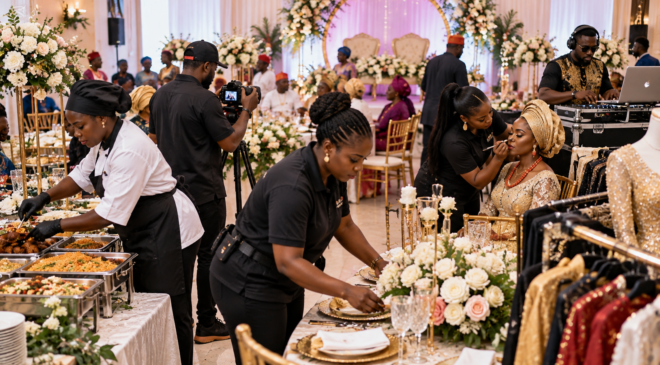
The decorator has bought materials. The caterer has arranged food. The photographer has prepared equipment. The tailor has completed clothes. The makeup artist has booked appointments. The disc jockey has selected music. The event centre has prepared its space.
For the people attending the event, it may be simply another Saturday celebration.
For the businesses behind it, it is work.
This largely invisible economic activity has become an important part of social life in Delta State, where weekends frequently bring together weddings, traditional ceremonies, community meetings, birthday celebrations, church programmes and other gatherings.
The scale of the individual transactions varies considerably, but the economic chain is much wider than the person paying for the event.
A caterer may buy food from a market trader. A decorator may purchase fabrics, flowers, balloons or other materials from suppliers. A photographer may employ an assistant. A makeup artist may purchase cosmetics from a distributor. An event centre may engage cleaners, security personnel and other service providers.
One celebration can therefore support several layers of economic activity.
This is particularly significant at a time when small businesses are under pressure to maintain cash flow.
Recent developments in Delta show increasing attention to the challenges facing small businesses. The Asaba Chamber of Commerce, Industry, Mines and Agriculture recently entered a partnership with Keystone Bank aimed at improving access to finance, capacity building and business support for small and medium enterprises in the state.
The state government has also said its current empowerment initiatives are intended to strengthen purchasing power and grassroots economic activity, including support for nano businesses.
Against that background, the weekend social economy deserves greater attention.
Unlike formal businesses with permanent premises and large workforces, many people operating in this space work through personal networks.
A decorator may not have a large office but could handle several events in a month. A photographer may work from a small studio or entirely through bookings. A caterer may operate from a home kitchen and mobilise temporary assistants when an event is secured.
Social media has also changed the way these businesses find customers.
A good photograph of a decorated hall, wedding dress, meal or makeup job can become an advertisement. WhatsApp statuses, Instagram pages, Facebook posts and referrals can generate new customers without the cost of conventional advertising.
But visibility does not automatically translate into profitability.
The cost of materials, transportation, electricity, equipment maintenance and labour can reduce margins.
There is also the challenge of customers expecting increasingly elaborate events.
Social media has contributed to a culture in which celebrations are frequently photographed and displayed publicly. This can encourage competition over decoration, clothing, venues, food presentation and entertainment.
For some families, that creates pressure to spend more than they had originally planned.
For businesses, however, the same demand creates opportunities.
The growth of event culture has expanded the number of specialised services available. People who once provided one service may now develop several related offerings.
A photographer may add video coverage. A caterer may add event decoration. A fashion designer may provide styling. A makeup artist may offer training. An MC may develop event-management services.
This diversification can help small operators survive periods when demand for one service is weak.
There is another important dimension: employment.
Not everyone involved in an event is a permanent employee. Many are freelancers, casual workers or apprentices who are called upon when work is available.
That arrangement can provide income for young people who may otherwise struggle to find formal employment.
But it also means that the sector remains vulnerable.
When household finances become tighter, some families reduce the size of celebrations, postpone ceremonies or look for cheaper alternatives. Businesses that depend heavily on events therefore feel changes in household purchasing power quickly.
This makes the weekend economy a useful indicator of how people are responding to broader economic conditions.
A busy event calendar does not necessarily mean households are financially comfortable. People may continue to celebrate important milestones while cutting costs elsewhere.
Similarly, a quieter period does not necessarily mean that social life has disappeared. It may indicate that people are changing the way they spend.
The future of the sector will therefore depend partly on whether small operators can become more organised.
Record-keeping, customer service, digital marketing, pricing, savings, insurance, equipment maintenance and access to finance can determine whether a person remains an occasional service provider or develops a sustainable business.
There is also room for stronger professional networks.
Photographers, caterers, decorators, fashion designers, entertainers and event managers can benefit from associations that promote standards, training and fair business practices.
For customers, professionalism matters too.
A cheaper service is not necessarily cheaper if poor delivery creates additional costs or damages an important occasion.
The Saturday economy is therefore more than parties.
It is a network of entrepreneurs, artisans, freelancers and service providers whose work often disappears behind the photographs and celebrations they help create.
Every weekend, while guests dance, eat and take pictures, another group of people is counting costs, delivering services, building customer relationships and trying to turn one event into the next opportunity.
That is the business behind the celebration.