By Mokobia Rita.
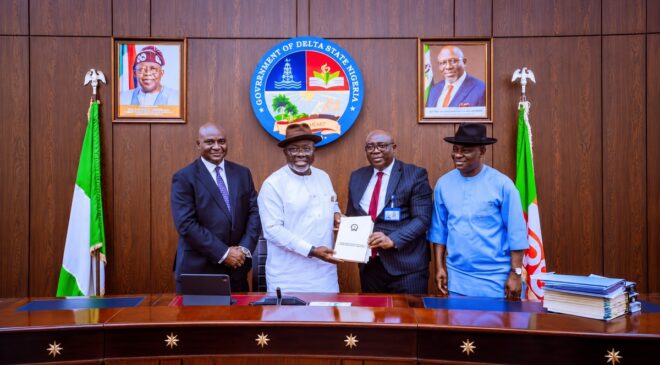
ASABA/Nigeria: Delta State Governor Sheriff Oborevwori has enacted five laws covering workers’ welfare, judicial capacity, property protection and revenue administration, with the introduction of a statutory 13th-month salary emerging as one of the key measures.
The governor signed the bills on Wednesday, October 28, 2026, at the Executive Council Chambers, Government House, Asaba, describing the legislation as part of his administration’s M.O.R.E Agenda to strengthen institutions, improve service delivery and stimulate economic growth.
The Thirteenth Month Salary Law, 2026, establishes a legal framework for an additional annual salary payment to eligible public servants. Governor Oborevwori said the initiative was intended to boost workers’ morale and productivity, while the outgoing Head of Service, Dr. Mininim Oseji, said the measure could improve family welfare and stimulate business activity.
The legislative package also provides for an increase in the number of Delta State High Court judges from 46 to 50 and Customary Court of Appeal judges from nine to 12. The changes are intended to strengthen the state’s judicial capacity and support more efficient justice delivery.
Another measure, the Public and Private Properties Protection Amendment Law, seeks to strengthen safeguards against unlawful occupation and destruction of property. The Delta State Revenue Service (Consolidated) Law, 2026, is designed to harmonise tax administration, address multiple taxation and encourage investment by creating a more coordinated revenue framework.
Oborevwori commended the Delta State House of Assembly for its legislative support and urged the relevant agencies to ensure effective implementation of the new laws.
Speaker of the House, Rt. Hon. Emomotimi Guwor, said the measures would strengthen governance, improve judicial efficiency and protect investments. He welcomed the legislative action as part of efforts to improve the state’s institutional and economic environment.
The practical impact of the laws will depend on their implementation, including the arrangements for administering the additional salary, filling the new judicial positions and enforcing the provisions on property protection and revenue collection.
