By Magnus Emuji
ASABA/Nigeria: he Association of Civil Society Organisations in Malaria Control, Immunisation and Nutrition (ACOMIN) has called on the Delta State Government, local government authorities and private sector operators to take greater responsibility for sustaining improvements in primary healthcare delivery as the Global Fund Grant Cycle 7 (GC7) approaches its close-out.
The organisation warned that community-driven improvements achieved through Community-Led Monitoring (CLM) must not be reversed when donor-supported interventions wind down, urging government and other stakeholders to strengthen domestic health financing and maintain grassroots participation in healthcare delivery.
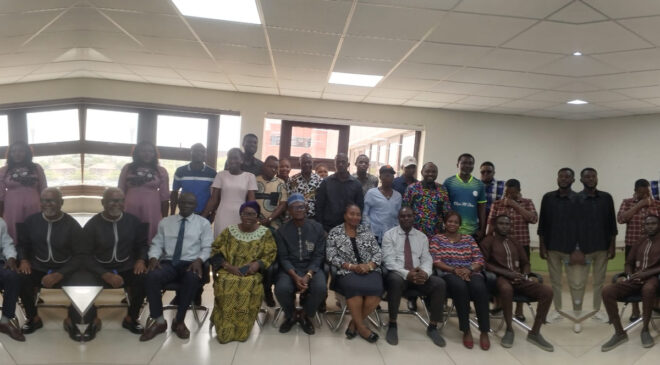
ACOMIN State Programme Officer, Sir Austin Uwede, made the appeal during a media engagement in Asaba, where the organisation reviewed its activities and achievements in the fight against HIV/AIDS, tuberculosis and malaria over the preceding six months.
Uwede explained that Community-Led Monitoring had provided communities with an opportunity to identify deficiencies in healthcare services, engage relevant authorities and mobilise local resources to address challenges affecting primary healthcare facilities.
He said the intervention, supported by the Global Fund, had improved community participation in healthcare accountability, particularly in areas of service accessibility, availability, acceptability and quality for vulnerable and underserved populations.
Highlighting specific interventions in Delta State, Uwede identified several instances where community members, philanthropists and local groups had responded to deficiencies in primary healthcare centres.
At Idheze Primary Healthcare Centre in Isoko South Local Government Area, community members facilitated repairs to two drip stands and replaced faulty door keys. Community efforts also led to the clearing of the access road to Eboh-Orogun PHC in Ughelli North Local Government Area, while youths in Kokori, Ethiope East, undertook the desilting of drainage at the local health facility.
Other interventions included the donation of ceiling fans and regulators to Oleh PHC by a philanthropist, repairs to a leaking overhead water storage tank at Oviri-Olomu PHC in Ughelli South, and the donation of 10 plastic chairs to Uduophori PHC by community members.
At Idheze PHC, community leadership also provided mobile solar lights to improve the facility’s lighting arrangements.
Uwede said these interventions demonstrated how community participation could help address practical healthcare challenges, strengthen local ownership and encourage the mobilisation of resources beyond government funding.
He, however, emphasised that voluntary contributions should complement rather than replace the statutory responsibilities of government in providing functional healthcare facilities and essential services.
He therefore urged the state and local governments to increase investment in healthcare, incorporate evidence generated through Community-Led Monitoring into health policies and development plans, and establish stronger accountability mechanisms to ensure identified deficiencies receive attention.
The ACOMIN official also called on traditional rulers, religious institutions, civil society organisations and community-based organisations to sustain grassroots monitoring, document service delivery challenges and engage decision-makers on necessary interventions.
He stressed that the responsibility for controlling HIV/AIDS, tuberculosis and malaria extended beyond health institutions, requiring sustained cooperation among government, communities, development partners and the media.
Earlier, ACOMIN State Coordinator, Pastor Gregory Sifo, reaffirmed the organisation’s commitment to reducing the burden of the three diseases through public enlightenment, community engagement, early diagnosis, treatment adherence and collaboration with relevant stakeholders.
Sifo said the media engagement provided an opportunity to assess progress, identify outstanding challenges and strengthen partnerships aimed at ensuring that essential health information and services reached vulnerable populations.
He noted that the organisation’s activities during the reporting period included efforts to promote HIV testing and treatment, improve tuberculosis detection and treatment, and intensify malaria prevention and control.
The coordinator described the media as an important partner in public health advocacy, urging journalists to provide accurate information, counter misinformation, encourage healthy practices and hold relevant institutions accountable for their commitments.
Representatives of partner organisations also acknowledged ACOMIN’s contribution to community healthcare interventions and called for sustained media support.
Among those who spoke were the State Team Lead of the Society for Family Health, Mrs Mercy Momoh; Delta State Malaria Programme Manager, Ministry of Health, Dr Julie Aniah; representative of the State AIDS and STI Viral Hepatitis Control Programme, Mr Franklin Osanebi; and State Coordinator of the Network of People Living with HIV/AIDS in Nigeria (NEPWHAN), Mr Christopher Ogberetitinor.
The stakeholders described community-based organisations as an important link between government health programmes and residents, particularly in rural and underserved communities.
Osanebi emphasised the importance of integrating interventions across different disease-control programmes to prevent gaps in service delivery, while assuring that medicines for HIV treatment were available.
Aniah highlighted the importance of community counselling and public education in encouraging people to know their HIV status, adhere to prescribed treatment and maintain appropriate nutritional practices.
She also called for sustained malaria prevention efforts, urging residents to use insecticide-treated mosquito nets and maintain clean surroundings to reduce mosquito breeding.
She further stressed the need to encourage people affected by HIV and tuberculosis to seek appropriate healthcare without fear of discrimination or stigma.
For Delta State, the challenge now is to ensure that improvements recorded through community participation are not lost when external funding arrangements change.
