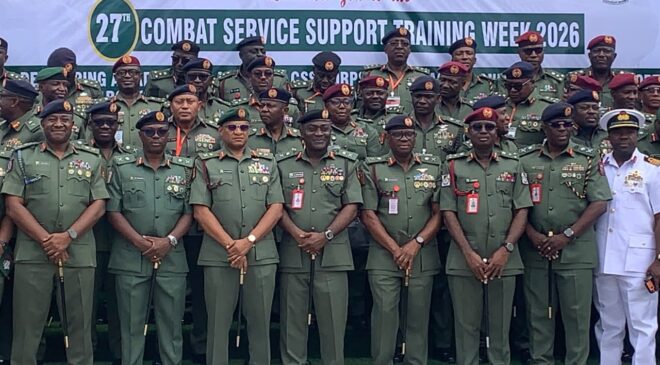
LAGOS/Nigeria: The Nigerian Army must strengthen its logistics and support systems to match the expansion of its force structure and ensure that newly established formations can operate effectively, Chief of Army Staff, Lt.-Gen. Waidi Shaibu, has said.
Shaibu spoke on Monday at the opening of the 27th Combat Service Support Training Week at the Nigerian Army Ordnance Corps, Abalti Barracks, Ojuelegba, Lagos.
The Army chief, who was represented by the Chief of Logistics, Maj.-Gen. Adebayo Adeyinka, said the creation of additional divisions, formations and units had increased the demands on the Combat Service Support Corps.
He said the five-day training, which runs from August 17 to 21, was an opportunity for the corps to assess its preparedness, examine emerging sustainment challenges and develop practical responses to the changing demands of military operations.
The training is themed, “Developing an Adaptable and Agile Combat Service Support Corps for Proactive and Sustainable Support to the Nigerian Army in the Discharge of its Responsibilities within a Joint and Multi-Agency Environment.”
Shaibu said the theme was consistent with the operational readiness focus of his command philosophy, stressing that military effectiveness depended not only on combat formations but also on the systems responsible for keeping troops supplied and operational.
He identified ammunition, fuel, mobility, medical services, equipment maintenance, engineering support and infrastructure as essential components of the Army’s operational support structure.
The Army chief said the newly established formations were expected to improve the military’s operational reach and responsiveness, but warned that their effectiveness would depend on the capacity of the logistics system supporting them.
“New formations without corresponding logistics capability will merely increase structure without producing the required operational effect,” he said.
Shaibu called for improvements in supply-chain management, transportation, equipment recovery and maintenance, medical support, ammunition management, fuel distribution and forward logistics.
He also urged the Army to make greater use of technology, data-driven planning and improved forecasting to build supply networks capable of supporting operations in difficult and contested environments.
According to him, the training week would examine the sustainment requirements of the expanded Army and develop practical recommendations for taking the newly established formations from their initial stages to full operational capability.
He said particular attention should be paid to the distribution and scaling of logistics assets, maintenance facilities, medical services, transport resources and supply systems so that the new formations could remain operationally sustainable.
Shaibu described logistics as a critical determinant of military success, particularly as the Army continues to operate in an environment involving terrorism, insurgency, banditry, difficult terrain, extended lines of communication and increasingly sophisticated threats.
He said the circumstances required a support system capable of anticipating operational needs and sustaining troops deployed for prolonged operations across different theatres.
The Chief of Army Staff tasked participants with producing recommendations capable of strengthening the Army’s logistics architecture, improving equipment availability, reducing response time and making supply chains more resilient.
He also pledged continued support for measures aimed at improving the Army’s sustainment capacity, saying the expansion of the force structure must be accompanied by corresponding investment in infrastructure, logistics platforms, maintenance capability, technology, manpower development and efficient resource management.
Shaibu commended President Bola Tinubu for approving the expansion of the Nigerian Army, saying the decision demonstrated the Federal Government’s determination to strengthen the country’s response to evolving security challenges.
He expressed appreciation for the President’s support for personnel welfare, operational capability and institutional development.
The Army chief reaffirmed the commitment of officers and soldiers to the Constitution of the Federal Republic of Nigeria and their determination to continue carrying out their responsibilities with professionalism and dedication.