LAGOS/Nigeria: The Nigerian Army is reviewing its logistics and supply systems to meet the demands created by the expansion of its formations and growing operational commitments across the country.
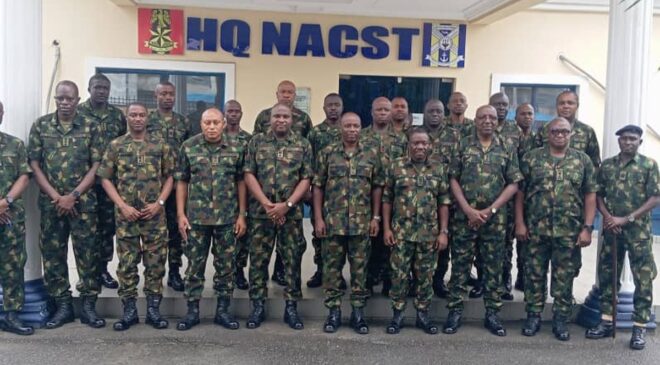
The move was a major focus of a two-day conference of senior officers of the Nigerian Army Corps of Supply and Transport (NACST), held from September 29 to 30 at the Headquarters of the Nigerian Army School of Supply and Transport, Bonny Cantonment, Victoria Island, Lagos.
The conference, organised under the theme, “Repositioning Supply and Transport Sustainment to Enhance the Operational Effectiveness of an Expanding Nigerian Army,” brought together commanders and senior officers to examine existing logistics arrangements and identify measures for improving support to troops.
Corps Commander Supply and Transport, Maj.-Gen. Nansak Danjuma Shagaya, said the Army’s expansion in formations, capabilities and operational responsibilities had increased the demand for dependable supply, mobility, maintenance and other logistics services.
He said the Corps had to continuously adapt its systems to ensure that troops received timely and effective support across different operational environments.
According to Shagaya, logistics remained fundamental to the Army’s ability to maintain operational momentum, particularly as its responsibilities expand.
He identified supply, transportation, fleet maintenance, petroleum distribution, catering and other sustainment services as critical components of the support structure required for effective military operations.
The commander said the conference provided an opportunity for senior officers to examine existing practices, share operational experiences and develop practical responses to challenges confronting the Corps.
He called for greater attention to demand forecasting, inventory management, stock visibility, warehousing and delivery timelines as part of efforts to strengthen the Army’s supply chain.
Shagaya also advocated improved fleet management through preventive maintenance, driver training, recovery capabilities and measures to increase vehicle availability and reliability.
Another area he identified was the adoption of digital logistics tools, including asset tracking, automation and data analytics, as well as the responsible application of artificial intelligence to planning, accountability and decision-making.
He also called for greater collaboration with Nigeria’s defence industries, research institutions and local technology providers to develop indigenous solutions for maintenance, vehicle support and other logistics requirements.
Shagaya said reducing dependence on external solutions where reliable local alternatives could be developed would contribute to the long-term sustainability of the Army’s logistics system.
He said the Corps’ effectiveness would ultimately depend on the professionalism, competence and discipline of its personnel, urging participants to ensure that the conference produced recommendations capable of translating into measurable improvements.
The Chief of Logistics, Nigerian Army, Maj.-Gen. Adekunle Adeyinka, challenged the senior officers to improve the efficiency of their operations by making better use of available resources, reducing errors and limiting avoidable risks.
Adeyinka also emphasised the responsibility of commanders to mentor and guide younger officers, including female personnel, to enable them develop their professional capabilities.
He urged officers to give greater attention to developing their subordinates and creating an environment in which personnel could contribute effectively to the Corps.
The Chief of Staff, NACST, Brig.-Gen. Philip Ebuk, said the Army’s expansion from eight to 12 divisions provided an opportunity for the Supply and Transport Corps to extend and strengthen the quality of its logistics support.
Ebuk said the changing operational environment required logistics officers to remain adaptable without compromising the support provided to formations and troops.
He noted that future logistics effectiveness would depend not only on infrastructure and technology but also on the Corps’ ability to collaborate, innovate and respond to changing operational demands.
The conference, according to the organisers, was also intended to facilitate the exchange of experience among commanders and generate strategies for strengthening the Corps’ relevance as the Nigerian Army continues to expand its operational responsibilities.