Delta State’s proposed ₦1.2368 trillion budget for 2027 presents the state with an important opportunity to consolidate infrastructure development, strengthen public services and improve the economic circumstances of its residents. But beyond the impressive figures and promises of sustained prosperity, the real test of the proposal will be whether the resources are properly allocated, transparently managed and translated into tangible improvements across the state.
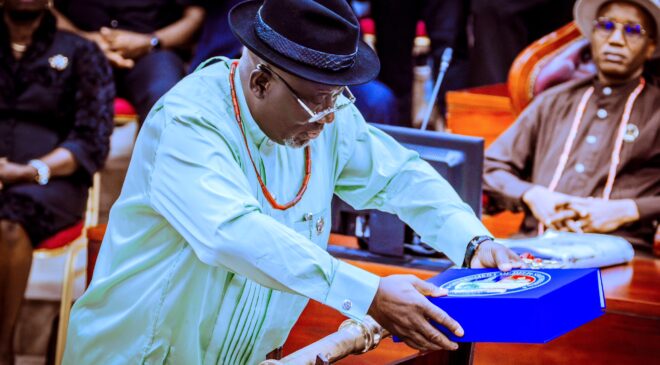
Governor Sheriff Oborevwori presented the proposed Appropriation Bill to the Delta State House of Assembly on November 16, describing it as the “Budget of Sustained Prosperity and Enhanced Growth”. The proposal provides ₦806.8 billion for capital expenditure and ₦430 billion for recurrent expenditure. It is approximately ₦493 billion, or 28.5 per cent, lower than the ₦1.729 trillion approved for 2026.
The reduction is significant. The governor said the administration intended to align expenditure with more realistic revenue expectations and avoid borrowing to finance its programmes, while remaining open to grants and other non-repayable support. The stated approach suggests an attempt to exercise fiscal discipline. Yet a smaller budget is not automatically a more responsible budget. Its credibility will depend on the accuracy of revenue projections, the quality of spending priorities and the government’s capacity to implement what it proposes.
The House of Assembly therefore has a responsibility that goes beyond receiving the document, debating its general objectives and eventually approving it. Lawmakers must interrogate the assumptions behind the figures and establish whether the proposed expenditure adequately addresses the needs of the people they represent.
A capital-heavy budget is welcome only when capital projects are properly selected, costed, monitored and completed. The proposed ₦806.8 billion capital component represents about 65 per cent of the total estimates. That ratio indicates a strong emphasis on development spending, but the public should be able to see the specific projects and expected outcomes behind the allocation.
Roads and other transport infrastructure are particularly important in a state with extensive rural and riverine communities. For farmers, traders, students and patients, a passable road is not merely a symbol of development; it determines whether produce can reach markets, whether children can get to school and whether residents can access healthcare without unnecessary difficulty.
The legislature should therefore request a detailed project schedule identifying new projects separately from ongoing ones. Each major project should have a disclosed location, estimated cost, implementation period, responsible agency and measurable completion target. Projects carried over from previous budgets should be accompanied by explanations of their current status, the funds previously released and the reasons for any delay.
For communities that have endured years of poor access roads, particularly in rural and riverine parts of Ndokwa, Isoko, Ijaw and other areas of the state, the measure of government performance is not the number of projects announced but the number completed and put to productive use. A fair distribution of projects should also be considered so that development does not become concentrated in a few urban centres.
The proposed allocations to education and healthcare deserve equally careful examination. These sectors directly affect the quality of life, productivity and future prospects of the state’s population. The Assembly should seek clear implementation targets: the number of schools to be rehabilitated, classrooms and laboratories to be equipped, teachers to be trained, health facilities to be upgraded and essential services to be made more accessible.
In healthcare, capital investment must be matched by provision for personnel, medicines, equipment maintenance and reliable operations. A renovated hospital without adequate staff, drugs or diagnostic capacity cannot deliver the quality of care residents need. In education, buildings alone cannot guarantee learning outcomes without qualified teachers, instructional materials and a safe learning environment.
The proposal should also be examined for its support to agriculture, small businesses and productive enterprise. Delta cannot build a sustainable economy solely on roads and public infrastructure. It must strengthen agriculture, support local processing, improve access to markets, create opportunities for small businesses and help young people acquire skills that connect them to real economic activity.
Agriculture deserves particular attention because of its potential to improve food security, generate income and create jobs across rural communities. The budget should make clear how farmers will benefit from extension services, improved inputs, storage, processing facilities and market access. The Assembly should ask whether the proposed interventions are large enough to produce measurable gains and whether they are coordinated with the state’s wider economic diversification plans.
Revenue generation is another major issue that should attract legislative scrutiny. During the budget presentation, the governor said Delta’s internally generated revenue had increased from ₦83 billion in 2023 to a projected ₦283 billion by December 2026. He attributed the improvement to technology-driven collection, an expanded revenue base and efforts to reduce leakages.
If sustained, stronger internally generated revenue would give the state greater capacity to finance development programmes without excessive dependence on federal allocations. But the projection must be supported by verifiable revenue performance, realistic assumptions and a clear explanation of the sectors expected to contribute to the increase. The government must also demonstrate that revenue mobilisation will not become an unfair burden on ordinary residents and struggling businesses. Improving collection efficiency, blocking leakages and broadening the tax base fairly should remain central to the process.
The governor also disclosed that his administration had repaid ₦400 billion of an inherited debt of ₦463 billion, leaving ₦63 billion outstanding. He expressed confidence that the remaining amount would be cleared by the end of the first quarter of 2027. This is an important claim with implications for the state’s financial position, but it should be supported by accessible records showing the original obligations, repayments made, outstanding liabilities and the sources of funds used to service the debt.
Independent verification of the debt position would strengthen public confidence and provide a clearer basis for evaluating the administration’s financial performance. The Assembly should request relevant debt-management records and ensure that the state’s fiscal obligations are accurately reflected in the estimates.
The budget’s recurrent component also requires scrutiny. Recurrent expenditure is necessary to pay salaries, maintain public institutions and keep essential services operating. The objective should not be to reduce recurrent spending indiscriminately, but to ensure that administrative costs are reasonable and that sufficient resources remain available for service delivery and development.
The House should also examine procurement procedures, contract awards, variations and project monitoring arrangements. Citizens should be able to compare approved allocations with actual releases and completed projects. Regular publication of budget implementation reports would make it easier for residents, civil society organisations and the media to assess progress and identify gaps.
The 2027 fiscal year will coincide with preparations for the general elections. That makes transparency especially important. Election periods can place additional pressure on public expenditure and political decision-making. Government must demonstrate that project selection, contract awards and the release of public funds will be guided by developmental priorities rather than political considerations.
The Speaker of the House, Rt. Hon. Emomotimi Dennis Guwor, has indicated that the legislature will consider the proposal. That assurance must translate into rigorous examination of the document. The Assembly should not allow political cordiality between the executive and legislature to weaken its oversight responsibility. Cooperation between the two arms of government is desirable, but it must never replace independent scrutiny.
For the people of Delta, the most important issue is what the budget will change in their everyday lives. Will communities gain access to better roads? Will public hospitals become more functional? Will schools have the facilities required for effective learning? Will farmers and small businesses receive meaningful support? Will young people find more opportunities for employment and enterprise?
These are the questions against which the proposed budget should be measured. At this stage, the ₦1.2368 trillion proposal remains a spending plan awaiting legislative consideration and approval. Its allocations should not be confused with money already released or projects already delivered. The government must make implementation records available throughout the fiscal year so that citizens can assess progress against approved targets.
Delta State has the financial resources and economic potential to pursue a more inclusive development agenda. What is required is not simply a large budget or an impressive capital expenditure ratio, but disciplined planning, transparent procurement, effective monitoring and a genuine commitment to equitable development.
The House of Assembly now has an important opportunity to demonstrate that legislative oversight is more than a constitutional formality. It must examine the numbers, question the assumptions, demand clarity on projects and insist on measurable performance.
The position of Ndokwa Reporters is clear: a state budget is not a political trophy for any administration. It is a public commitment funded by the resources of the people. Its success must be judged not by the promises made during presentation, but by the projects completed, the services improved, the opportunities created and the lives positively transformed.
Delta deserves a budget that works beyond the pages of an appropriation document. And the responsibility to ensure that happens begins with the scrutiny taking place in the State House of Assembly.
