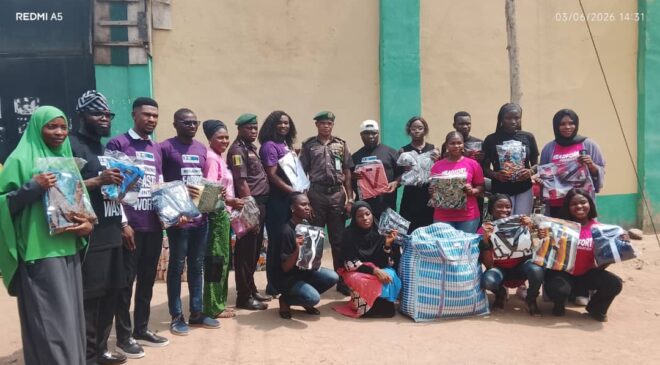
IBARA/Nigeria: As part of activities marking International Women’s Day, the Headfort Foundation for Justice, in collaboration with its partners, has donated 100 pieces of clothing to inmates at the Ibara Correctional Centre in Ogun State, bringing relief to inmates facing severe shortages of decent clothing.
The donation forms part of a social impact initiative aimed at transforming fashion waste into wearable garments, demonstrating how discarded textiles can be repurposed to meet pressing social needs while promoting environmental sustainability.
The project, implemented under the “Waste to Wealth in Fashion” concept by the Fashion and Textile Recycling and Upcycling Alliance in partnership with legal and development organisations, reflects the broader commitment of the Headfort Foundation for Justice to uphold dignity and justice for vulnerable populations.
Founder of Mateen Lander Limited and President of the Fashion and Textile Recycling and Upcycling Alliance, Ms. Siddikath Folami, said textile waste remains a major environmental challenge despite the value embedded in discarded materials.
According to her, the initiative was designed to promote environmental sustainability while also addressing urgent social needs within underserved communities.
Folami explained that large volumes of fashion waste generated by tailors, garment factories, households, hotels and other sources are often burned or dumped, despite their potential for reuse.
She warned that burning textile waste releases harmful gases that threaten public health, while the production of new fabrics consumes significant volumes of water and contributes to greenhouse gas emissions.
“Recycling textiles not only reduces environmental pollution but also creates social value by providing clothing to underserved communities,” she said.
Speaking on the initiative, legal practitioner and public interest advocate, Mr. Yusuf Nurudeen, disclosed that the project was implemented through a collaborative effort by fellows of the Innocent Chukwuma Social Impact Chair and Fellowship.
Nurudeen said the partnership brought together lawyers, development organisations and volunteers committed to improving the welfare of inmates in correctional facilities.
“We gathered large volumes of waste clothing materials from fashion designers and volunteers who supported us by sewing them into proper garments,” he said.
“The goal is to give inmates some form of dignity so that when they appear in court they are not forced to go in tattered clothes.”
Executive Director of the Headfort Foundation for Justice, Mrs. Oluyemi Orija, said the initiative also aligns with the values of International Women’s Day, particularly the promotion of dignity, equity and social justice.
She explained that the idea for the project emerged from a fellowship programme held at the Lagos Business School where participants were trained on ethical leadership and development-focused initiatives.
According to her, the fellows later developed and presented the “Dignity from Waste” project, which subsequently received support for implementation.
Orija noted that the lack of decent clothing often discourages inmates from appearing in court, a situation that can lead to repeated adjournments and prolonged detention.
“To bridge that gap, we produced clothing from fashion waste materials and today we are donating 100 unisex pieces to inmates,” she said.
She added that the initiative would be expanded to other correctional centres across Nigeria.
The organisers also revealed plans to train inmates within correctional facilities on garment production, creating opportunities for skills acquisition and long-term sustainability.
Through partnerships with tailors, environmental organisations and other stakeholders, the initiative aims to scale the project while promoting responsible textile recycling, social inclusion and dignity for people within the justice system.