By Mokobia Rita.
ASABA/Nigeria: The Delta State Government is expanding its anti-drug awareness campaign to tertiary institutions as part of efforts to address substance abuse among young people and strengthen prevention, counselling and rehabilitation initiatives.
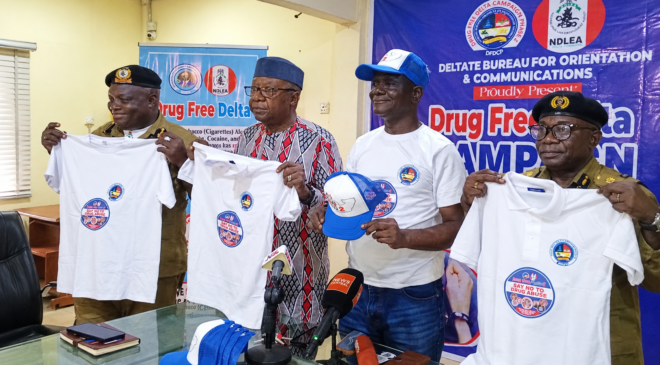
The second phase of the Drug-Free Delta Campaign, organised by the State Bureau for Orientation and Communications in partnership with the National Drug Law Enforcement Agency (NDLEA), Delta State Command, is scheduled to begin on September 21, 2026.
The Director-General of the Bureau, Olorogun Fred Latimore Oghenesivbe, announced the development on Wednesday, September 16, during a joint press conference at the bureau’s Conference Hall in Asaba.
He said the campaign would cover colleges, polytechnics, universities and other higher institutions across Delta’s three senatorial districts, with emphasis on educating students about the dangers of substance abuse and encouraging responsible choices.
Oghenesivbe explained that young people often face pressures, including peer influence, experimentation and misinformation, which could affect decisions with long-term consequences.
He said the initiative was designed to go beyond enforcement by promoting public education, early intervention, counselling and community participation in protecting the state’s youth population.
The Director-General cited figures from the NDLEA’s 2025 Annual Report, which recorded 19,944 arrests, 3,655 convictions and seizures of more than 4.8 million kilogrammes of illicit drugs nationwide.
He also referenced Delta State figures indicating over 1,100 arrests and 268 convictions linked to drug-related offences during the period under review.
According to him, the figures reinforce the need for prevention and sustained awareness alongside enforcement operations.
Oghenesivbe called on parents and guardians to take a more active role in guiding young people, while urging schools, religious organisations, traditional institutions, youth groups and community leaders to support the campaign.
He further appealed to media practitioners to continue educating the public on the consequences of substance abuse and the importance of seeking help when necessary.
Speaking at the briefing, the NDLEA Delta State Commander, Mr Halilu Hamidu, described the campaign as timely and stressed the importance of reaching students before substance use develops into a more serious problem.
Hamidu said substance abuse could affect academic performance, relationships, family life and general wellbeing, and in some circumstances contribute to involvement in criminal activities.
He assured participants of the command’s support, noting that the agency’s responsibilities included prevention, demand reduction, counselling and community protection in addition to arrests and seizures.
“We have a duty to prevent drug use before it begins, provide accurate information, counsel those who need help and work with institutions to create environments where students can make better choices,” he said.
The commander urged stakeholders to contribute to efforts aimed at reducing the demand for illicit substances and disrupting their supply.
Also addressing the briefing, the Chairman of the Asaba Drug Awareness and Rehabilitation Committee, Dr Ify Uraih, highlighted the need to combine prevention with treatment and reintegration.
Uraih disclosed that the committee was working towards the full take-off of a rehabilitation centre in Asaba, adding that a facility had been secured for the project.
He said arrangements had been concluded with the Federal Medical Centre, Asaba, to provide psychiatric services and professional support for individuals undergoing treatment and rehabilitation.
The committee chairman appealed for increased government support to enable the centre to become fully operational and provide comprehensive care for people affected by drug dependence.
He stressed that recovery should include opportunities for affected individuals to rebuild their lives and reintegrate into society.
The stakeholders agreed that sustained progress in tackling substance abuse would require coordinated action involving prevention, enforcement, treatment, rehabilitation and public enlightenment.