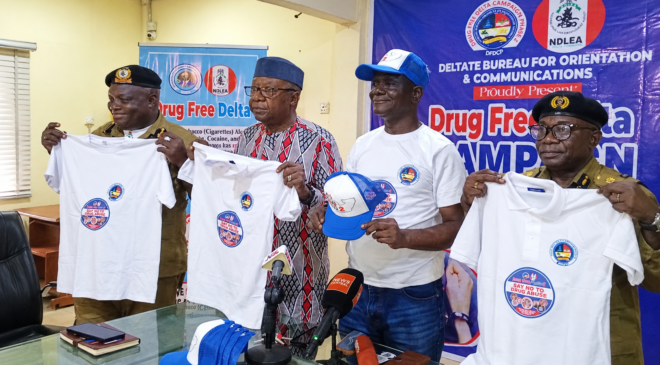
ASABA/Nigeria: The Delta State Government and the National Drug Law Enforcement Agency (NDLEA) have called for stronger collaboration among families, schools and communities as the state prepares to expand its Drug-Free Delta Campaign.
The appeal was made during a joint press conference in Asaba on Wednesday, where officials outlined plans for the second phase of the initiative, scheduled to begin on Monday, September 21, 2026, in selected secondary and tertiary institutions across Delta’s three senatorial districts.
Director-General of the Delta State Bureau for Orientation and Communications, Olorogun Fred Latimore Oghenesivbe, said the campaign was designed to strengthen drug prevention, public enlightenment and early intervention, particularly among young people.
He identified the family as a critical first line of defence against substance abuse, urging parents and guardians to pay attention to their children’s friendships, social environments, academic performance and behavioural changes.
Oghenesivbe stressed the importance of effective communication, supervision, discipline, affection and the development of sound moral values, while encouraging parents to create an atmosphere in which children could discuss difficult issues without fear.
He said drug prevention should not be restricted to government campaigns, but should become a continuing responsibility shared by homes, educational institutions, religious organisations and communities.
The Bureau chief also appealed to traditional rulers, youth organisations, civil society groups and media practitioners to support sustained public education on substance abuse. He urged the media to report the issue responsibly, avoiding the stigmatisation of people affected by drug use and dependency.
According to him, Phase Two of the Drug-Free Delta Campaign is wholly funded by the Delta State Government.
NDLEA Reports 248 Convictions, Drug Seizures
The NDLEA Delta State Commander, Mr Halilu Hamidu, presented an account of the command’s enforcement and preventive activities during the briefing.
Hamidu said that between July 2025 and September 2026, the command secured 248 convictions, while 223 cases remained pending before the courts.
He added that the command conducted 181 War Against Drug Abuse (WADA) and other sensitisation activities, during which 693 persons—463 males and 230 females—received counselling.
The commander further disclosed that operatives seized 2.446497 tonnes of solid drug exhibits and 1,304.630 litres of liquid drug exhibits during the period.
The substances recovered included cannabis, tramadol, cocaine, heroin, methamphetamine, diazepam, codeine, pentazocine and other psychotropic substances.
Hamidu cited the raid of a warehouse at Oko Market, Asaba, where illicit substances valued at more than N150 million were recovered, alongside interceptions of vehicles conveying prohibited substances on major highways in the state.
He said the operational results underscored the need for intelligence-driven enforcement, but maintained that arrests and seizures alone could not resolve the substance abuse challenge.
“A student who never starts using illicit drugs is a success for every agency involved in this campaign,” Hamidu said.
He encouraged young people to resist peer pressure and the pursuit of quick pleasure, while urging those experiencing drug-related difficulties to seek assistance at an early stage.
Rehabilitation Facilities, Operational Support
The NDLEA commander appealed to the Delta State Government to expedite the completion and operationalisation of rehabilitation centres in Kwale and Agbor.
He said functional facilities would improve access to rehabilitation and reintegration services for people affected by substance use disorders.
Hamidu also requested suitable office accommodation and logistical support in Asaba to strengthen the command’s operations in the state capital.
Chairman of the Asaba Drug and Rehabilitation Committee, Dr Ify Uraih, joined the appeal for government support, particularly towards the planned October opening ceremony of the Asaba Rehabilitation Centre.
Uraih commended the NDLEA for its work in Delta and stressed the importance of making rehabilitation services accessible to people who require assistance.
Oghenesivbe, in turn, acknowledged the NDLEA’s partnership in the Drug-Free Delta initiative and reiterated the state government’s commitment to protecting young people from the harmful effects of substance abuse.
He urged stakeholders to treat prevention as a collective responsibility involving government, families, schools, traditional institutions, faith-based organisations, civil society and the media.
The briefing ended with the unveiling of campaign materials for Phase Two of the Drug-Free Delta Campaign by the Bureau, with senior officials of the NDLEA and the Asaba Drug and Rehabilitation Committee in attendance.