By Mokobia Rita.
Asaba/Nigeria: The Delta Special Economic Zone (DSEZ) is positioning its Koko and Kwale clusters as major centres for manufacturing, agro-processing, energy and logistics as the Delta State Government intensifies efforts to build an economy less dependent on oil.
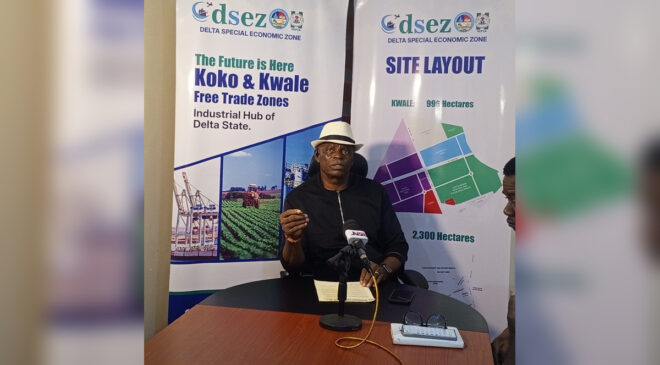
The Chairman of the Delta Special Economic Zone Management Company (DSEZ-MC), Brig. Gen. Mike Ndubisi (retd.), disclosed this during a media briefing at the company’s headquarters on Thursday, October 8, 2026, saying the project was central to the state’s drive to expand its industrial base and attract new investments.
Ndubisi said the DSEZ, initiated during the administration of former Governor Ifeanyi Okowa and subsequently expanded under Governor Sheriff Oborevwori, covers 3,200 hectares, comprising 2,200 hectares at Koko and 1,000 hectares at Kwale.
He said the two locations were being developed around their different economic advantages, with Koko positioned to take advantage of its proximity to the port and transport infrastructure, while Kwale was being developed around gas, agriculture and agro-industrial opportunities.
According to him, the Koko Free Trade Zone has the potential to develop into a gas-based industrial centre accommodating petrochemical, steel, refining, logistics and agro-processing activities.
Ndubisi said the location’s proximity to Koko Port could provide investors with an important link for the movement of raw materials and finished products, while incentives available within the free trade zone were expected to improve its attractiveness to local and international investors.
He listed incentives available to investors to include tax concessions, duty exemptions, profit repatriation and a one-stop framework intended to simplify investment processes.
The chairman also pointed to the Kwale Free Trade Zone as an important component of the DSEZ’s broader industrialisation strategy, particularly because of its location within the state’s oil and gas-producing belt and its links to existing energy infrastructure.
The Director of Zones, Mr Ofunne Emmanuel, said physical infrastructure was also being developed to support industrial activities, with internal road construction nearing completion in parts of the zone.
Ofunne said the DSEZ was working with the African Development Bank (AfDB) to develop an agro-industrial model that would connect agricultural production with processing and manufacturing.
He disclosed that about 60,000 hectares had been identified for agricultural value-chain development, with cassava, fish and other agricultural products among the commodities being considered for large-scale processing.
According to him, consultations with development partners and potential investors had raised the prospect of establishing as many as 120 agro-processing factories around the Kwale axis within the next five years.
If realised, he said, the proposed industrial network would provide a market for agricultural produce, increase local value addition and create opportunities for farmers and other participants in the agricultural value chain.
The development, Ofunne added, could also help address post-harvest losses by bringing processing facilities closer to production areas.
He said the economic benefits were expected to extend beyond Ndokwa communities, with the industrial and agricultural value chains potentially creating linkages across Delta North, Delta Central and Delta South.
The officials also disclosed that Phoenix Gas was preparing to commence operations within the zone, with the potential for surplus electricity generated from its operations to support industries and surrounding communities.
They said additional infrastructure projects approved by the state government were also expected to strengthen the investment environment around the two economic zones.
The development of the DSEZ comes against the background of Delta State’s long-standing effort to broaden its economic base beyond petroleum and build stronger links between the state’s natural resources, agriculture, manufacturing and trade.
Earlier developments at the Kwale zone had already attracted investment commitments and plans for an industrial corridor linking the Kwale and Koko clusters, with the Nigerian Ports Authority and AfDB identified among partners in the broader infrastructure strategy.
The DSEZ management said the immediate priority was to provide the infrastructure and investment environment required for companies to establish production facilities, process local raw materials and participate in domestic and international value chains.
For Delta, the proposed model represents an attempt to move beyond the traditional extraction of raw materials by creating industrial capacity around them — particularly through gas-based manufacturing at Koko and agricultural processing around Kwale.
However, the projected number of factories, investments and jobs will depend on the completion of infrastructure, investor commitments and the ability of the zone’s management and government partners to translate the plans into operational businesses.
