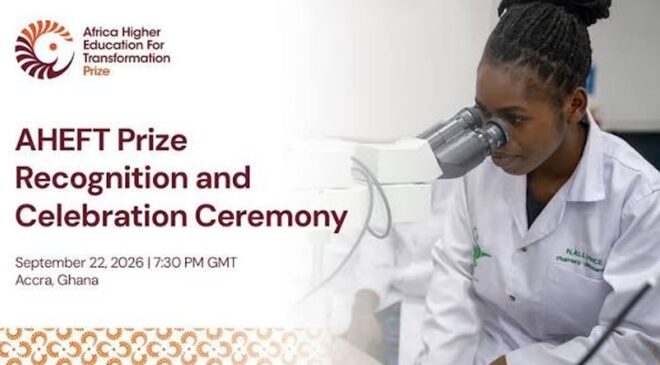
ACCRA/Ghana: Five universities from across Africa have received a combined US$15 million under the inaugural Africa Higher Education for Transformation (AHEFT) Prize, as education leaders gathered in Accra to examine how universities can better connect learning, research and innovation with the continent’s development needs.
Each of the five institutions received US$3 million to strengthen and scale the initiatives for which they were recognised. The awards were presented on September 22 during the inaugural Higher Education Transformation Convening organised by the Mastercard Foundation.
The beneficiaries are Addis Ababa University, Ethiopia; the International Institute for Water and Environmental Engineering (2iE), Burkina Faso; Kwame Nkrumah University of Science and Technology (KNUST), Ghana; Muni University, Uganda; and the University of Rwanda. The Mastercard Foundation said the AHEFT Prize is intended to identify and support institutions pursuing sustained, institution-wide transformation.
The Accra meeting, held under the theme “Reimagining Higher Education for Africa’s Human Capital Development,” brought together representatives of universities, governments, the African Union, financial institutions, industry and young people to discuss the changing role of higher education in Africa.
Rather than focusing only on access to university education, discussions centred on how institutions can produce graduates with relevant skills, strengthen links with employers, commercialise research and innovation, and contribute more directly to challenges facing their communities and economies.
Mastercard Foundation President and CEO, Sewit Ahderom, said the transformation of higher education should involve closer links between universities and employers, credentials that demonstrate graduates’ capabilities, stronger preparation for emerging technologies and research that moves beyond campuses into industry, government and communities.
The Foundation’s Executive Director for Higher Education and Strategic Initiatives, Dr John Nkengasong, described higher education transformation as an economic issue as well as an education concern, stressing the need for governments, universities, businesses, investors and development partners to work together.
The five institutions were recognised in different areas of higher education transformation. 2iE was recognised for excellence in teaching and learning; Addis Ababa University and KNUST for research and innovation; Muni University for transitions to employment; while the University of Rwanda received recognition for excellence in health.
At KNUST, the award recognised the university’s research-to-innovation ecosystem and its links between science, technology, entrepreneurship and industry. The university said the prize would support its continuing work in research, innovation and national development.
Muni University was recognised for its Refugee and Host Community Youth Empowerment and Transformation Initiative (RETI), which focuses on skills development, entrepreneurship, financial inclusion and pathways into employment for refugees and underserved young people.
For the University of Rwanda, the recognition was linked to its contribution to health education and workforce development. The institution said its work includes community-based training, research and innovation aimed at strengthening health services and responding to local needs.
The AHEFT Prize is backed by a US$500 million commitment from the Mastercard Foundation over its first decade. The programme aims to recognise and support at least 150 higher education institutions across Africa during that period.
The initiative comes as the African Union pursues its Decade of Accelerated Action for the Transformation of Education and Skills Development in Africa, 2025–2034. The AU says the decade is designed to accelerate reforms in education and skills systems and is aligned with continental priorities including the Continental Education Strategy for Africa and Agenda 2063.
At the Accra convening, participants also discussed the need for greater investment in research and development, stronger collaboration across borders and increased private-sector involvement in skills development and applied research.
The role of young people featured prominently in the discussions, with participants calling for them to be involved not merely as beneficiaries of education policies but as partners in decisions affecting learning, employment and economic opportunity.
The Mastercard Foundation said applications for the 2027 AHEFT Prize are expected to open later in 2026, giving other African higher education institutions pursuing sustained transformation an opportunity to participate.
The central challenge emerging from the Accra meeting was how to move from individual institutional reforms to wider system-level changes that connect education, employment, research and investment across Africa.