By Timi Igbogidi
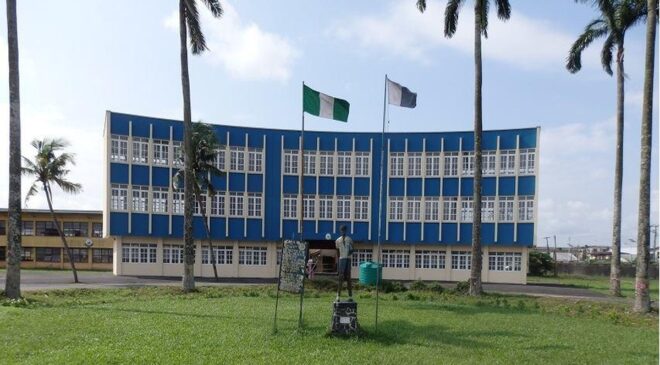
The inauguration of the upgraded sports complex at Hussey College, Warri, during FIFA President Gianni Infantino’s visit to Delta State has placed renewed attention on the role of schools and community facilities in developing young sporting talent.
Infantino visited Warri on Friday, November 20, accompanied by FIFA Secretary-General Mattias Grafström. During the visit, he inaugurated the Hussey College sports complex and inspected the remodelling work at Warri City Stadium. The Hussey College project was coordinated by the Brownhill Foundation, established by former Nigeria Football Federation president Amaju Pinnick, with support from the Nigerian Content Development and Monitoring Board.
The inauguration formed part of activities around Hussey College’s 80th anniversary. The institution has a long association with Warri’s sporting identity, and the investment in its facilities offers an opportunity to connect that history with the development needs of a new generation.
Infantino’s visit carried a wider message about the importance of taking football beyond major international stadiums. The development of the game depends not only on elite competitions but also on accessible facilities where children and young people can learn, practise and compete. Community pitches and school sports grounds are often the first places where talent is discovered.
For Warri, this point has particular significance. The city has a strong football culture and a history of producing players and administrators who have contributed to Nigerian football. Yet a sporting tradition cannot sustain itself through reputation alone. It requires functioning facilities, qualified coaches, organised school competitions and clear routes through which talented players can progress.
The Hussey College complex can contribute to that process if it is integrated into a regular programme of sports activities. The school management and old students’ association will have an important role in ensuring that the facility is maintained, used safely and made available for appropriate youth development activities.
Maintenance is often the overlooked part of sports infrastructure. A newly inaugurated facility can quickly deteriorate if there is no dedicated maintenance budget, clear management responsibility, access-control system and plan for replacing equipment. The quality of the project will therefore be judged over time by its condition and level of use, not simply by the ceremony that marked its opening.
There is also a need to connect facilities with people who can make them productive. Qualified coaches, physical education teachers, youth football organisers and medical support personnel are essential to turning a pitch into a development environment. Regular inter-school competitions and age-grade programmes could help identify talent while encouraging participation among students who may not otherwise enter organised sport.
The project also raises questions about access. While the facility is located within a school, stakeholders can consider structured partnerships that allow wider community participation without disrupting school activities or compromising the safety and security of students. Transparent arrangements could enable local clubs and youth groups to benefit from the investment at designated times.
Warri City Stadium remains another important part of the state’s sports infrastructure agenda. During his November 20 visit, Infantino inspected the remodelling project and commended the investment, while reports indicated that work remained ongoing and that the facility had not been formally commissioned at that point. The distinction matters: an inspection and expression of support should not be confused with formal commissioning or confirmation that every component is complete.
Taken together, the school complex and the stadium project show the importance of investing at different levels of the sports system. A major stadium can host high-level events, while school and community facilities can widen participation and strengthen the talent pipeline. Neither can replace the other.
The next task is to translate infrastructure into consistent activity. That means setting measurable targets for school participation, coaching sessions, youth competitions, facility maintenance and the identification of promising athletes. It also means making sure that girls and young women have equal opportunities to use the facilities and participate in organised sport.
The Brownhill Foundation and NCDMB have helped provide an important asset at Hussey College. The responsibility now extends to the school, its old students, sports administrators and the wider community. If the complex is maintained and used as part of a structured programme, it can become more than a commemorative project: it can be a practical investment in Warri’s next generation of athletes.
