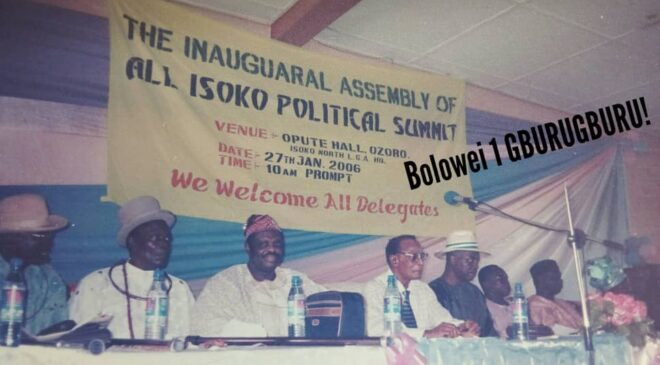
ASABA/Nigeria: A veteran journalist and public affairs commentator, Prince Amour, has raised serious concerns over what he described as a growing leadership vacuum and deepening divisions within Isoko nation, warning that the ethnic group risks political irrelevance if urgent steps are not taken to rebuild unity and credible leadership.
In a strongly worded reflection, Amour questioned the current state of cohesion among the Isoko people, lamenting what he termed the erosion of shared purpose, collective strength, and visionary leadership that once defined the nation.
“The question that must be asked loudly, boldly, and without fear is this: what has become of Isoko nation?” he queried, pointing to what he described as confusion, fragmentation, and absence of a unifying voice capable of commanding respect and direction.
Drawing from his years in journalism, including his time as Asaba Bureau Chief and Government House Correspondent for the now-defunct Niger Delta Standard, Amour contrasted the present reality with what he called a golden era of purposeful leadership, driven by men of integrity whose influence brought order and dignity to the Isoko nation.
He paid tribute to past leaders such as Ekpre Otobo, Tom Egbuwoku, S.O. Akpotu, Y.D. Igbrude, Paul Ufuoma Omu, Gregory Akpojene, A.P.J. Okpakpor, and Spanner Okpozo, describing them as disciplined and visionary figures who saw leadership as service rather than self-enrichment.
At the heart of his intervention is a pressing question: who truly leads Isoko today? According to him, leadership has been reduced to mere titles, with individuals laying claim to authority without demonstrating the capacity, credibility, or selflessness required to unite the people.
“What we have today is confusion dressed in empty titles,” he said, lamenting that in critical moments, there is no trusted figure capable of rallying the people or speaking for the collective interest.
Amour further decried the growing divisions among political actors and community leaders, warning that rivalry and personal ambition have overtaken the pursuit of common good, thereby weakening the socio-political fabric of the Isoko nation.
He also expressed concern over the role of traditional rulers, accusing some of abandoning their responsibility as custodians of unity and moral authority, while becoming entangled in political alignments and material pursuits.
In equally strong terms, he criticised religious leaders, alleging that many have become overly politicised, mirroring the conduct of the political class rather than providing moral guidance.
Reflecting on his early career with Delta Broadcasting Service (DBS Asaba) and contributions to Urhobo Voice under the pen name “Richard Omohode,” Amour recalled the enduring message of responsibility captured in the newspaper’s motto: “If you don’t fight your fight, who will?”
He stressed that the responsibility to defend unity and demand accountable leadership lies squarely with the Isoko people, warning that no external force would champion their cause if they fail to do so themselves.
As the 2031 political cycle approaches, Amour warned that continued disunity could have far-reaching consequences, noting that the absence of a central rallying point and erosion of trust have left the nation vulnerable.
He called for urgent reflection and a return to foundational values, urging Isoko leaders and stakeholders to rebuild trust, restore unity, and embrace a shared vision for progress.
“The future of Isoko nation cannot and must not be sacrificed on the altar of greed, ego, and short-sighted ambition,” he stated, adding that unity is essential for relevance and sustainable development.
Amour concluded with a call to action, urging the Isoko people to rise above internal divisions and work collectively to secure their future, insisting that the time to act is now.