By Emmanuel Enebeli
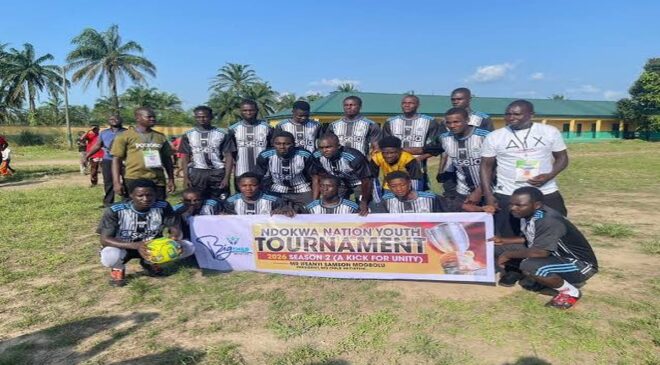
The 2026 Ndokwa Nation Youth Tournament has brought more than 30 football clubs into competition, giving young players from Ndokwa East, Ndokwa West and Ukwuani an opportunity to test their abilities while placing community football at the centre of a wider conversation about youth development.
The competition, which began on November 10 and is scheduled to run until December 24, is being powered by the Big Child Initiative under its president, Ifeanyi Samson Mogbolu. Its stated objectives include promoting unity and peaceful coexistence among communities in Ndokwa land while providing a platform for football development and youth engagement.
The opening fixture offered an early glimpse of the excitement expected from the tournament. Abbi United FC defeated Golden Stars FC of Ogume 3–1, with Endurance Enuneku, popularly known as Barber, scoring all three goals for the winning side. His hat-trick gave Abbi United a strong start and provided one of the early individual highlights of the competition.
More than the opening result, the scale of participation is significant. A tournament involving over 30 clubs creates opportunities for players to compete beyond the boundaries of their immediate communities. It also brings together supporters, coaches, organisers and local football stakeholders around a shared sporting activity.
For Ndokwa, where community identity remains an important part of social life, football can serve as more than entertainment. Properly organised competitions can encourage interaction among young people from different towns, build friendships across community lines and provide a constructive outlet for energy and ambition. Such benefits are particularly important when young people have limited access to organised recreational and sporting opportunities.
However, the discovery of talent is only the beginning of a much longer process. A promising performance in a local tournament does not automatically translate into a professional career. Players need consistent coaching, physical conditioning, access to appropriate equipment, medical support, competitive exposure and guidance on how to progress to higher levels of the game.
This is where the organisers and football stakeholders can make the tournament more valuable. A record of participating players, match performances and standout individuals could be developed into a basic talent database. Coaches and scouts could be invited to observe selected matches, while outstanding players could be referred to established academies or clubs for further assessment.
The tournament could also become a platform for strengthening local coaching. Short workshops for community coaches on player development, safeguarding, first aid and basic sports science would help ensure that the competition contributes to the wider football ecosystem rather than focusing exclusively on match results.
Facilities are another important consideration. Schools and community grounds that host fixtures need safe playing surfaces, basic changing arrangements, access to water and appropriate match organisation. Partnerships with local businesses, community associations and public institutions could help improve these conditions and make the competition more sustainable.
The tournament is scheduled to continue until December 24, leaving time for organisers to deepen its developmental impact. The final assessment should consider not only the eventual champions but also the number of players identified, the quality of organisation, the level of community participation and whether new opportunities emerge for young footballers.
Ndokwa has the human resources and community enthusiasm to sustain meaningful grassroots sports programmes. The challenge is to connect that enthusiasm with a structure that supports young people after the tournament ends. If the 2026 competition can establish stronger links between community clubs, schools, coaches and talent scouts, it will have achieved something more lasting than a trophy.
For now, the tournament has provided a visible platform for young footballers. Its enduring success will depend on whether that platform becomes a pathway.
