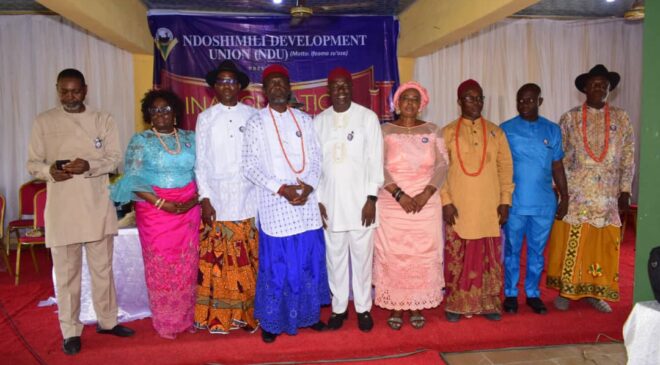
ABOH/Nigeria: Ndoshimili land in Ndokwa East Local Government Area, Delta State, has formally entered a new era of unity, strategic direction and collective development following the inauguration of the Ndoshimili Development Union (NDU), the apex socio-cultural body of the people. The ceremony, held in Aboh, the historic headquarters of Ndoshimili and cradle of its political heritage, also marked the successful merger of two parallel organisations, the former Ndoshumili Development Association (NDA) and the defunct Ndoshimili Development Union—into one united structure.
The unification, described as long overdue, followed months of consultations, reconciliation and negotiations aimed at ending years of division that stakeholders say hindered the area’s development despite its vast human and natural resources.
Speaking at the well-attended event, Chairman of Ndokwa East Local Government Area, Chief Hon. Vincent Oshilomya, commended the emergence of a united NDU and assured the new leadership of full collaboration from the council. He declared that under his watch, the local government would work closely with the union to fast-track the development of Ndoshimili communities.
In his acceptance speech, the newly inaugurated Chairman, Engr. Ikechukwu Onyenokwe, expressed deep gratitude and humility as he assumed leadership of the strengthened Union. Welcoming government representatives, traditional rulers, political leaders, captains of industry, youth groups and Ndoshimili sons and daughters from home and abroad, he said the day was not merely ceremonial but a renewed covenant with the people.
“We are not gathered here merely to decorate a few individuals with titles. We are here to renew a solemn covenant with our people and our land. Today represents both a celebration and a call to duty,” he said.
Onyenokwe lamented the six decades of neglect suffered by Ndoshimili despite hosting significant oil and gas resources that have powered Nigeria’s economy since the 1960s. He noted that the communities, though peaceful and protective of national assets, still lack basic infrastructure such as access roads, functional health centres, and well-equipped schools, forcing many young people to migrate in search of opportunities.
“Our land produces wealth that lights up distant cities, yet our communities remain in darkness,” he said, insisting that Ndoshimili seeks equity, not charity, and partnership, not pity.
While acknowledging past challenges, he said the revitalisation of NDU marked a turning point—one designed to create unity of purpose, strategic planning and collective action. He stressed that the new executive committee has a clear mandate to attract and effectively utilise interventions from government, the private sector, development partners and Ndoshimili indigenes worldwide. He urged the people to embrace self-help and collective responsibility.
“No one will build Ndoshimili land for us more than we are willing to build it for ourselves. Governments may change, companies may come and go, but our responsibility to our homeland is permanent,” he said.
Earlier, Chairman of the occasion, Pharm. Paul Enebeli, described the merger as a deliberate step toward overcoming the underdevelopment that had persisted for years. He applauded the leaders of the former bodies for their maturity and sacrifice.
“Despite its rich human and material resources, Ndoshumili has remained one of the least developed parts of the country, largely due to years of internal division. Today, we have chosen a different path — the path of unity, vision and transformation,” he said.
Delivering the keynote address titled “The Ndoshumili Golden Age: A Covenant of Unity, Vision and Transformation,” Professor Julie Umukoro, Kpakpando Furuni Eze of Ase Kingdom, said the inauguration signalled a generational moment to redefine the future of Ndoshimili. She stressed that unity must move beyond rhetoric and be reflected in policy, structure and everyday action.
She outlined the pillars required for success—social cohesion, cultural revival, human capital development, economic empowerment, political engagement and sustained peace. She also charged youths to be active drivers of change and paid special tribute to elders and women for their indispensable roles in community growth.
Traditional institutions were strongly represented at the event, including HRM Barr. Augustine Oghenejabor, Odio-logbo of Ibrede Clan, and HRM Obi Fredrick Chukwuloa Egbunkonye II, the Igwe of Abala Kingdom. Political leaders, development partners, government functionaries and distinguished sons and daughters of Ndoshimili land were also in attendance.
Participants described the inauguration as both symbolic and transformative, expressing optimism that the emergence of a single, united body would give Ndoshimili a stronger voice in engagements with government and other stakeholders.
With the inauguration of the new leadership, Ndoshimili turns a new page—one defined not by division but by unity, purpose and a strengthened resolve to build a prosperous and dignified future for its people.
The newly inaugurated Executive Committee includes Engr. Ike Onyenokwe, Chairman; Chief Chris Uzoalu, Vice Chairman; Barr. Robert Anyibama, Secretary; Dr. Oke Oziakpono, Assistant Secretary; Prof. Adaobi Ugbomeh, Treasurer; Barr. Malachi Ugwummadu, Legal Adviser; High Chief Sony Neme, Public Relations Officer; Mrs. Gloria Chukwujekwe, Financial Secretary; and Mr. Austin Anochie, Assistant Secretary.
Prayers for Ndoshimili land, Ndokwa East LGA, Delta State and Nigeria rounded off the ceremony, leaving participants with renewed hope for a more equitable and progressive future.