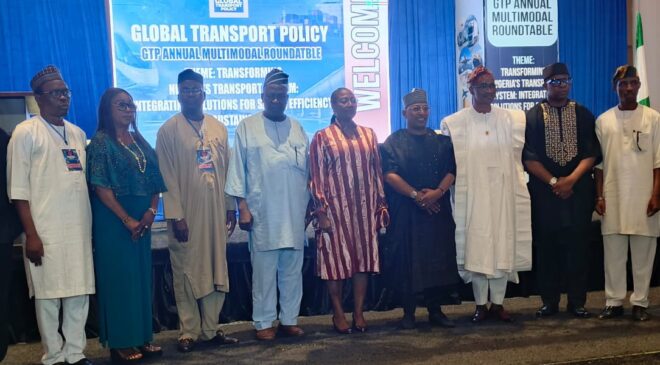
LAGOS/Nigeria: Nigeria’s transport sector requires urgent integration, modernisation and data-driven reforms to address inefficiencies that cost the country an estimated N3.2 trillion annually and continue to undermine economic growth, industry experts have warned.
The warning was issued on Wednesday at the Global Transport Policy (GTP) 2026 Annual Multimodal Roundtable in Lagos, where stakeholders called for a coordinated transport system linking roads, railways, inland waterways and pipelines to improve safety, efficiency and sustainability.
Speaking at the event, themed “Transforming Nigeria’s Transport System: Integrating Solutions for Safety, Efficiency and Sustainability,” Chairman of the Council of the Chartered Institute of Logistics and Transport (CILT) Nigeria, Dr. Boboye Oyeyemi, said the country must move beyond fragmented transportation planning and embrace integrated solutions capable of supporting a rapidly growing population and economy.
According to him, global attention has shifted towards predictive transport safety, high-efficiency logistics reforms, green transportation, innovative financing models, governance frameworks, futuristic mobility and human capacity development.
Oyeyemi noted that Nigeria, with a population of more than 240 million people spread across 923,000 square kilometres and over 830 kilometres of coastline, possesses enormous transport potential but continues to grapple with poor coordination among different transport modes.
He explained that the country’s road network exceeds 204,000 kilometres, with only about 5,000 kilometres under federal control, while the remainder is managed by state and local governments under a complex governance arrangement.
“With more than 14 million drivers and rising population pressures, transport demand continues to surge, exposing deep inefficiencies and highlighting the urgency for a functional multimodal transport system nationwide,” he said.
The former Corps Marshal of the Federal Road Safety Corps (FRSC) observed that road, rail, inland waterways and pipeline transportation systems remain poorly integrated, resulting in mobility challenges, higher logistics costs and reduced economic efficiency.
He lamented that despite substantial investments in roads, bridges, rail infrastructure and ports, weak institutions, inadequate maintenance culture, poor data management and accountability gaps continue to limit the sector’s performance.
According to him, overloading of trucks, the absence of functional weighbridges and weak enforcement mechanisms have accelerated the deterioration of transport infrastructure, while stationary heavy-duty vehicles on bridges have increased structural risks.
Oyeyemi stressed that Nigeria had already invested significantly in transport assets and should now prioritise integration, intelligence-driven operations and efficient systems management to maximise returns on those investments.
He warned that lack of policy continuity, poor data-driven planning and weak transport governance structures would continue to constrain the sector, increase the cost of doing business and slow economic development.
Earlier, Chairman of the Global Transport Policy (GTP), Dr. Oluwasegun Musa, said the theme of the roundtable was particularly relevant given the mounting challenges confronting the nation’s transport sector.
Musa revealed that available data showed Nigeria loses approximately N3.2 trillion annually to transport inefficiencies, while logistics costs account for more than 42 per cent of the country’s Gross Domestic Product (GDP).
He noted that excessive dependence on road transportation, limited rail utilisation and high accident fatalities remain major concerns within the sector.
The GTP chairman also identified significant institutional weaknesses, including low workforce digitisation levels and critical skills shortages that continue to hamper sectoral growth.
According to him, sustained investment in human capital development remains essential to building a resilient, technology-driven and globally competitive transport system.
He called for stronger public-private sector partnerships, wider adoption of smart mobility solutions and the implementation of an integrated multimodal transport framework capable of supporting Nigeria’s economic aspirations.
“The roundtable must deliver actionable solutions for a safer and greener transport future,” Musa said.
Participants at the roundtable agreed that without coordinated reforms, stronger institutions and strategic investments in technology and infrastructure, Nigeria’s ambition of building an efficient, sustainable and globally competitive transport system may remain elusive.