By Itohan Abara-Laserian
LAGOS/Nigeria: Nigeria needs a dedicated national air ambulance network to complement road emergency services and reduce the time required to evacuate critically ill or injured patients from remote, offshore and hard-to-reach locations, a medical expert has said.
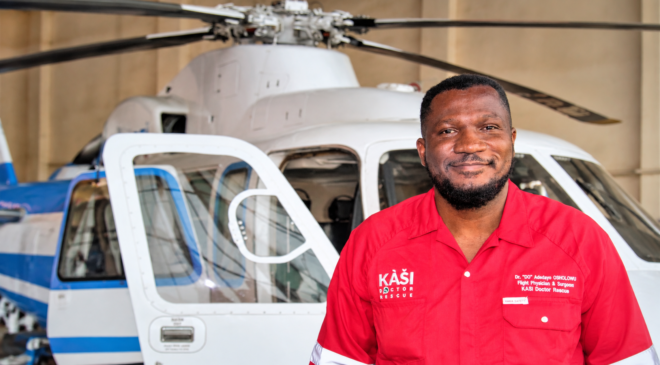
Medical Director of Kasi Healthcare, Dr Dayo Osholowu, made the call in Lagos while speaking with the News Agency of Nigeria (NAN), arguing that the country’s emergency medical system needs to move beyond dependence on road transportation and hospital-based care.
Osholowu said the size and population of Nigeria made it increasingly important to have aircraft that could be deployed rapidly when conventional road evacuation was impractical.
He said delays in air medical evacuation could range from about an hour to as much as 48 hours in some remote and offshore situations, describing the situation as a serious challenge for patients whose chances of survival may depend on rapid intervention.
According to him, emergency medicine operates within a narrow window in which delays can significantly affect outcomes, particularly in cases involving severe trauma and other critical conditions.
He said Nigeria had at times depended on aircraft coming from outside the country, with the mobilisation process involving flight clearances, crew arrangements and other operational requirements capable of consuming several hours before an aircraft could reach a patient.
Osholowu said the challenge was not limited to the availability of helicopters, but also involved aviation procedures, operating hours at some airfields and inadequate infrastructure for receiving medical helicopters.
He identified the shortage of certified hospital helipads as another constraint, noting that landing at a conventional airport could require a patient to be transferred again by road ambulance before reaching a medical facility.
The medical expert said a functioning air medical system therefore needed to be integrated with existing ground emergency services rather than operated as a standalone aviation service.
He cited the Lagos State Emergency Medical Services (LASAMBUS), with its network of ambulance points connected to the 112 emergency line and trauma facilities, as an example of the ground infrastructure that could be linked to a wider air medical response system.
Osholowu said discussions around an integrated ground-to-air emergency network were already taking place, with the objective of connecting ground ambulance operators with regional Helicopter Emergency Medical Services (HEMS) and ensuring that patients could move seamlessly from the point of emergency to appropriate medical facilities.
He also highlighted financing as a major obstacle to expanding access to air ambulance services.
According to him, aircraft mobilisation, specialised medical equipment, aviation fuel, maintenance and other operational requirements make aeromedical evacuation expensive, while Nigeria’s heavy reliance on out-of-pocket healthcare payments and relatively limited insurance coverage could restrict access.
He argued that investment in aeromedical services should therefore be viewed as part of the country’s emergency healthcare infrastructure rather than as a service reserved for wealthy individuals or large corporations.
The development of dedicated HEMS capacity is already beginning to take shape in Nigeria. Airbus Helicopters announced in June that it had signed an agreement with Kasi Healthcare for the procurement of up to two H135 helicopters configured specifically for emergency medical services. Airbus described Kasi as the first Nigerian customer for the HEMS-configured H135, with the programme also involving training for flight crews and engineers and support for maintenance infrastructure.
The planned aircraft are expected to provide a platform for critical medical missions, emergency response and patient transfers once delivered. Airbus and Kasi said the helicopters are expected to be delivered in 2028.
Osholowu said the aircraft would only represent one component of a much broader system, stressing the need to develop trained personnel, suitable landing infrastructure, hospital readiness, regulatory coordination and sustainable financing alongside the helicopters.
He likened the potential impact of an integrated aeromedical network to Nigeria’s adoption of GSM technology, arguing that air medical services could help overcome some of the country’s physical infrastructure limitations.
For Nigeria, he said, the objective should be to build an emergency response system in which a patient can be located, evacuated and transferred to appropriate medical care without avoidable delays.