By Ndokwa Reporters Editorial Desk
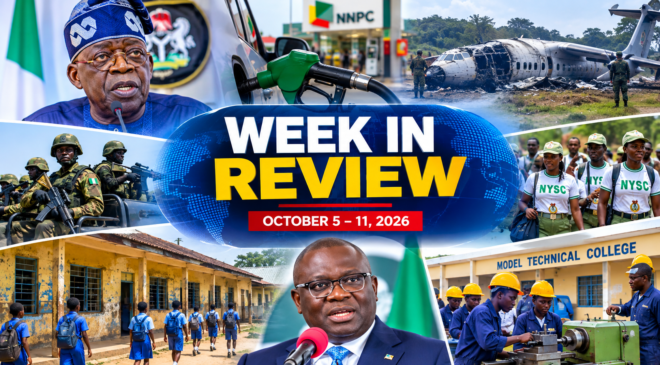
A review of major political, security, constitutional and economic developments across Nigeria from November 1 to 7, 2026.
The week of November 1–7, 2026, brought a fresh round of political uncertainty, renewed debate over the structure of policing, concerns about public debt and a disturbing episode of political violence in Asaba. Across the country, developments in the courts, state assemblies, security operations and public finance showed how closely Nigeria’s democratic stability is tied to public trust and institutional accountability.
One of the most consequential political developments came from the Federal High Court in Abuja, which delivered a judgment affecting the leadership structure of the African Democratic Congress (ADC). Reports said the court nullified the leadership arrangement associated with David Mark and recognised Nafiu Bala Gombe as the party’s national chairman. The judgment also affected actions linked to the party’s political preparations, including arrangements associated with former Vice-President Atiku Abubakar.
Atiku said he would remain in the 2027 presidential race, while the ADC indicated that it would challenge the judgment. The dispute therefore remained unresolved politically and legally at the close of the week. The case raises questions about internal party democracy, compliance with party rules and the role of the courts in resolving leadership disputes. It should not be treated as the final word while an appeal remains possible.
Delta State was also drawn into the national political conversation after violence was reported during a political procession in Asaba on Saturday, November 7. The incident, along Nnebisi Road, reportedly left one person dead and five others injured. Police said they had received intelligence about a possible breakdown of law and order, invited organisers to a security meeting and advised against an open-road procession, recommending a designated venue instead. Organisers disputed aspects of the police account and security arrangements. The police said investigations were ongoing.
The incident has renewed concerns about political safety as parties and aspirants prepare for the 2027 elections. An impartial investigation is necessary to establish what happened and identify anyone responsible. Political organisers and security agencies must also ensure that lawful political participation is protected and that public disagreements do not degenerate into violence.
Another major issue was the proposed establishment of state police. By the first week of November, reports from official sources indicated that the constitutional amendment proposal had secured approval from more than the required two-thirds of state Houses of Assembly. The Federal Ministry of Information reported that 30 state assemblies had approved the proposal by November 4, while the Senate gave the remaining six assemblies until November 15 to communicate their positions.
The approvals mark an important step in the constitutional amendment process, but they do not mean state police have become operational. Further constitutional procedures remain, including transmission and consideration of the amendment at the federal level and the required presidential action. The debate will also depend on safeguards against political abuse, adequate funding, professional standards and effective oversight.
Public debt and the management of government revenue remained prominent economic concerns. A recap of World Bank data put Nigeria’s total public and private external debt at approximately $145.02 billion at the end of 2025. The figure covers both public and private external borrowers and should not be mistaken for the Federal Government’s direct debt alone. Its significance lies in the wider pressure that external obligations and debt servicing can place on the economy.
At the state level, Delta Government said it had reduced inherited debt from about ₦463 billion to ₦63 billion and was targeting full repayment by the first quarter of 2027. The claim, attributed to the state government, will be better assessed when detailed debt schedules, repayment records and the categories of liabilities covered are made publicly available.
A separate report citing World Bank analysis highlighted a rise in combined revenues across Nigeria’s 36 states, from about ₦4.99 trillion in 2022 to ₦15.53 trillion in 2025. Higher revenue can strengthen state capacity, but the central test is whether citizens experience better roads, schools, healthcare, water supply and other essential services. Increased collections must translate into visible public value.
Electricity supply remained a source of frustration for consumers, with reports of customers on premium Band A tariffs in Lagos receiving less electricity than the service category is expected to provide. The complaints point to the continuing challenge of matching tariff arrangements with reliable supply, transparent billing and effective consumer protection.
Public health authorities were also monitoring contacts linked to an imported Ebola case. Reports said the Nigeria Centre for Disease Control and Prevention was following 62 contacts, with the monitoring period expected to conclude on November 13 if no further developments required an extension. The date was a projected end to monitoring, not confirmation that the exercise had already been completed. Public communication and adherence to health guidance remained important.
In the North-East, the military reported that four Islamic State West Africa Province (ISWAP) leaders, including two Arab fighters, and other fighters were killed during an operation in Kukawa, Borno State, on October 31. The account was attributed to the military and should be understood as an official operational claim. The wider security challenge in the region remains significant despite reported gains.
The Independent National Electoral Commission was reported to have flagged 268 voter records over suspected irregularities involving photographs, including concerns about possible AI-generated images. The records were said to be undergoing further examination. The development highlights the need for strong safeguards in voter registration, reliable identity verification and careful use of emerging technology, while ensuring that legitimate voters are not wrongly excluded.
Taken together, the week’s developments point to a country negotiating difficult questions about political competition, institutional authority, public safety and the value citizens receive from public resources. Court decisions can reshape party calculations, but parties must resolve internal disputes through credible processes. Constitutional reform can change the security architecture, but only with safeguards that protect citizens from abuse. Higher revenues and borrowing can create opportunities, but only accountable implementation can turn them into development.
Delta’s experience of political violence in Asaba makes the national picture immediate and local. The right to participate peacefully in politics must be protected in every community. The coming months will test the ability of political leaders, security agencies and electoral institutions to manage competition without intimidation and maintain public confidence.
