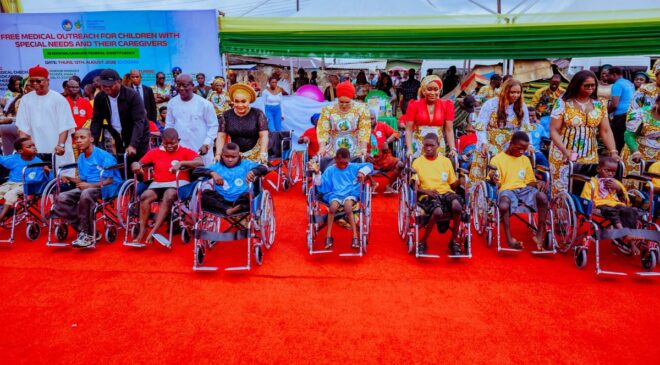
KWALE/Nigeria: The wife of the Delta State Governor, Deaconess Tobore Oborevwori, has renewed her call for greater attention to children living with autism and other special needs, saying their circumstances should not determine their access to healthcare, opportunities and a fulfilling life.
She made the call on Thursday, August 13, 2026, when the You Matter Charity Foundation, which she founded, took its free medical intervention to the Ndokwa/Ukwuani Federal Constituency, extending the foundation’s current outreach programme to its seventh federal constituency in Delta State.
Rather than focusing only on medical treatment, Deaconess Oborevwori used the intervention to draw attention to what she described as the wider responsibility of families, communities and institutions to ensure that children with special needs are not excluded from society.
She said the foundation had, during its outreaches across Delta, encountered families facing difficulties in accessing healthcare, as well as children requiring sustained attention and support because of their conditions.
“Our message is one of inclusion, acceptance and compassion,” she said, stressing that every child deserved the opportunity to grow, learn and live a healthy and fulfilling life regardless of their circumstances.
The First Lady said more than 740 children, alongside adults and elderly beneficiaries, had so far received medical care and other forms of assistance through the foundation’s interventions.
She said the figure should not be viewed merely as a statistic, but as a reflection of families whose lives had been touched by the programme.
According to her, the experience had strengthened the foundation’s resolve to continue reaching people who might otherwise struggle to obtain basic healthcare and other forms of support.
At the Ndokwa/Ukwuani outreach, beneficiaries received medical consultations, examinations, medications and other healthcare services, while 30 wheelchairs were presented to persons living with mobility challenges.
Deaconess Oborevwori thanked the chairmen of Ndokwa East, Ndokwa West and Ukwuani local government areas and their wives for supporting the programme. She also commended the Commissioner for Health, Dr. Joseph Onojaeme, and members of the medical team for their contribution to the exercise.
The Chairman of Ndokwa West Local Government Area, Hon. Obi Nzete, who welcomed the First Lady to the area, described the intervention as an example of a programme that addressed an immediate need while also drawing attention to the broader welfare of vulnerable residents.
Nzete said healthcare should be accessible to every child and family, regardless of their background, and pledged the local government’s readiness to work with the state government and other partners on initiatives that would improve the wellbeing of residents.
The Commissioner for Secondary Education, Dr. Kingsley Ashibogwu, said children with special needs required coordinated support to enable them to develop their abilities and participate more fully in society.
He commended the foundation for extending its intervention to Ndokwa and described the support provided to the beneficiaries as an important demonstration of compassion.
The Commissioner for Finance, Chief Fidelis Okenmor Tilije, also praised Deaconess Oborevwori’s humanitarian activities and announced a ₦20 million pledge to the You Matter Charity Foundation to support its healthcare and humanitarian programmes.
Tilije expressed confidence in the foundation’s ability to continue assisting vulnerable residents and said the people of Ukwuani would continue to appreciate the First Lady’s efforts.
The Ndokwa/Ukwuani intervention follows earlier outreaches by the foundation in parts of Delta, including the Okpe/Sapele/Uvwie, Ethiope, Ughelli/Udu, Isoko and Ika federal constituencies.
For Deaconess Oborevwori, however, the significance of the exercise extends beyond the medical services delivered on the day. Her emphasis on autism and other special needs places inclusion at the centre of the foundation’s intervention and highlights the need for continued support for families raising children who require specialised care.