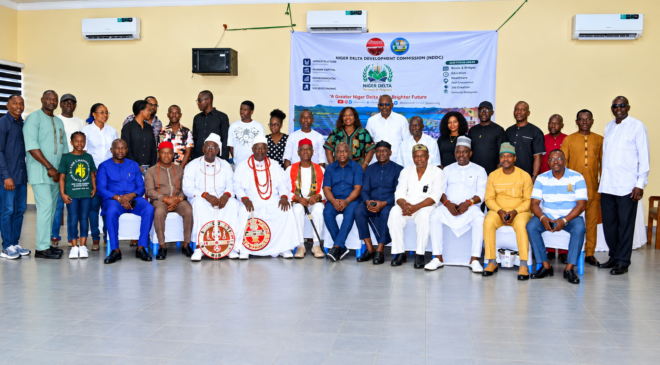
EFFURUN/Nigeria: Stakeholders in Nigeria’s oil and gas industry have called for stronger investment in local technology, human capital, environmental protection and energy infrastructure as part of efforts to reposition the Niger Delta for sustainable development.
The call was made at the 2026 Niger Delta Sustainable Development Summit and Awards, organised by Vijon International Media Limited in collaboration with the Delta State Ministry of Oil & Gas, on Thursday, September 17, at the Petroleum Training Institute (PTI) Conference Centre, Effurun, Delta State.
The summit, which focused on “Repositioning Nigeria’s Oil & Gas Industry for Energy Security, Local Content Growth and Sustainable Development,” brought together stakeholders to examine the challenges facing the Niger Delta and the region’s role in Nigeria’s energy future.
Speaking at the event, Publisher and Chief Executive Officer of Vijon International Media Limited, Ben Anthony Edejor, said the summit was a call to collective responsibility involving government, industry, communities, investors, professionals, traditional institutions, young people and development partners.
Edejor said the Niger Delta had contributed significantly to Nigeria’s economic development through its oil and gas resources, but stressed that the resources should become catalysts for industrialisation, human development, environmental sustainability and regional prosperity rather than merely commodities for export.
He called for deeper collaboration between government and the private sector to accelerate investments in refining, gas processing, petrochemicals, renewable energy and emerging energy technologies.
According to him, the ambition should be to transform the Niger Delta from primarily a resource-producing region into a major centre of energy production, processing, technology and innovation.
In line with the summit’s focus on energy security, Tantita Security Services Nigeria Limited was commended for its efforts in protecting oil pipelines and supporting the fight against crude oil theft in the Niger Delta.
The commendation formed part of the wider discussions on the need to protect critical oil infrastructure while creating greater opportunities for local participation in the petroleum industry.
Tantita was also among the individuals and organisations recognised at the Niger Delta Awards for contributions to pipeline security, local content and community development.
Edejor further stressed the need for local content to translate into meaningful opportunities for indigenous companies, engineers, professionals, entrepreneurs and young people across the oil and gas value chain.
He said greater access to finance, technology, training, procurement and mentorship would enable Nigerian businesses to move beyond peripheral service provision and develop into competitive companies capable of operating at regional and global levels.
The chairman of the occasion, Engr. Prof. Christopher Ezeagwu, Dean, Faculty of Computing, Dennis Osadebay University, Asaba, also emphasised the importance of strengthening Nigeria’s technological capacity.
Ezeagwu urged stakeholders to work together to develop indigenous technology and reduce dependence on foreign expertise, while encouraging young Nigerians to take a more active role in the country’s technological and socio-economic development.
He said greater investment in local technological capacity could create opportunities for Nigerians and contribute to the development of Delta State and the country.
The Deputy Director, Training, Petroleum Training Institute, Effurun, Dr Fredrick B. Owoyemi, who represented the Principal and Chief Executive, Dr Samuel E. Onoji, highlighted the importance of technical training in strengthening local content in the oil and gas industry.
Owoyemi encouraged young people and residents of oil-producing communities to take advantage of professional and technical training opportunities at PTI.
He said sustained collaboration among government, communities and industry stakeholders was necessary to develop the human capacity required to support the petroleum sector.
He also highlighted PTI’s practical training facilities and called for greater attention to alternative energy sources as Nigeria considers the future of its energy industry.
Owoyemi urged communities, government institutions and relevant agencies to support young people through scholarships and other capacity-building initiatives.
The emphasis on skills development was also reflected in Edejor’s speech, where he identified technical and vocational education, apprenticeships, digital skills, entrepreneurship, research, innovation and industry-linked training as important tools for preparing young Nigerians for the evolving energy economy.
He identified the Petroleum Training Institute and the Federal University of Petroleum Resources, Effurun, as institutions with important roles in developing the workforce required for Nigeria’s future energy and industrial economy.
Edejor also drew attention to the environmental challenges confronting the Niger Delta, stressing that economic development must go hand in hand with environmental protection.
He called for stronger cooperation among government, industry, communities and environmental experts in monitoring, enforcement and remediation to address the effects of oil spills, gas flaring and other forms of environmental degradation.
He said the region’s rivers, forests, farmlands and communities must be protected to safeguard the livelihoods of its people.
Infrastructure development, he added, remained essential to sustainable transformation, with roads, bridges, drainage, electricity, water, healthcare, schools and telecommunications identified as areas requiring coordinated attention.
According to Edejor, collaboration involving federal and state governments, development institutions and private investors would help connect communities to economic opportunities and create conditions capable of attracting investment and industrial growth.
Representing the Chairman of Uvwie Local Government Area, the Secretary to the council, Mr Grayham Osakwe, described Uvwie as a destination for peace and sustainable development and pledged the council’s support for initiatives aimed at promoting growth and opportunities within the area.
Edejor said the ultimate vision should be a Niger Delta where communities are peaceful, young people are productive, businesses thrive, industries innovate, the environment is protected and citizens participate meaningfully in the prosperity generated from the region.
He urged stakeholders to replace confrontation with constructive engagement, dependence with enterprise, environmental degradation with restoration and unemployment with opportunity.
He said the wealth of the Niger Delta should serve not only as a source of national revenue but also as an instrument for human development, regional prosperity, energy security and a sustainable future.
The summit concluded with the presentation of the Niger Delta Awards to selected individuals and organisations recognised for their contributions to the region, with Tantita Security Services among the recipients.