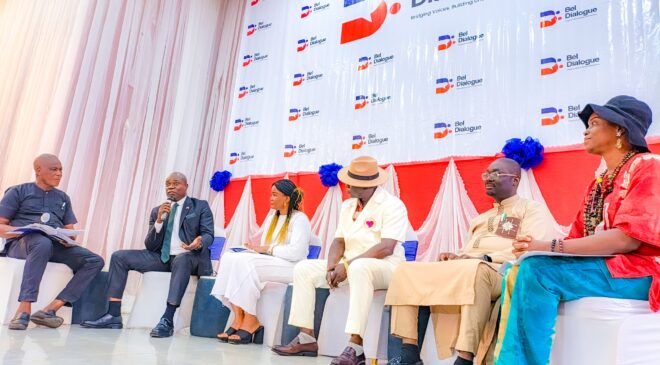
ASABA/Nigeria: Stakeholders at the 2026 BEL Dialogue, held on Thursday, July 30, 2026, in Asaba, identified weak democratic institutions, declining meritocracy and poor accountability as some of the greatest threats to Nigeria’s democratic and socio-economic development, calling for reforms that place competence, integrity and strong institutions at the centre of governance.
The consensus emerged during the public policy dialogue, which brought together former Resident Electoral Commissioner of the Independent National Electoral Commission (INEC), Mike Igini; former member of the Delta State House of Assembly, Hon. Gibson Akporhe; Sustainable Development Goals (SDGs) Technical Consultant and development practitioner, Ambassador Augusta Chibuzor Keneboh; Chairman of the Conflict Prevent Council, Prof. Andrew Agbaro; award-winning author Lady Ejiro Umukoro; communication and public relations expert Dr. Monday Michaels Ashibogu; Moderated by Mr Lawrence Okpewho, General Manger, Kruzz FM, Asaba alongside government officials, traditional rulers, civil society organisations, media practitioners, academics, students and other stakeholders.
Held under the theme, “Democracy That Works: Bridging the Gap Between Votes, Results and Institutional Accountability,” the dialogue examined the challenges confronting Nigeria’s democratic institutions and governance system, with participants agreeing that sustainable national development would remain difficult unless public institutions are strengthened and leadership is driven by merit and accountability.
Participants observed that while elections remain central to democracy, the effectiveness of governance ultimately depends on the strength of institutions responsible for implementing policies, enforcing the rule of law and protecting public interest.
They maintained that democratic institutions must be allowed to function independently without undue political interference, stressing that no individual should wield greater influence than the institutions established by the Constitution.
The stakeholders also identified the gradual erosion of merit in public appointments and recruitment as a major setback to national development, insisting that competence, professionalism and integrity should take precedence over ethnic, religious and political considerations.
According to participants, adopting merit-based recruitment across public institutions would improve efficiency, strengthen public confidence and enhance service delivery, while creating a more accountable and productive public sector.
The dialogue further noted that Nigeria’s democratic progress would remain limited if institutions responsible for conducting elections, enforcing laws and protecting democratic values are not adequately funded and empowered to perform their constitutional responsibilities.
Participants therefore called for increased operational and financial support for the Independent National Electoral Commission (INEC) and security agencies to enable them to effectively manage electoral processes before, during and after elections.
The forum also advocated clearer electoral laws, stronger enforcement mechanisms and the implementation of an enforceable code of conduct for political parties, candidates and institutions involved in the electoral process.
Beyond electoral reforms, stakeholders emphasised that democracy should not end with voting, urging Nigerians to become more actively involved in governance by demanding accountability, participating in civic activities and contributing meaningfully to national development.
They argued that an informed and engaged citizenry remains one of the strongest safeguards against poor governance, corruption and institutional failure.
Participants also reiterated that electoral outcomes should genuinely reflect the will of voters at polling units, noting that public confidence in democracy depends largely on transparent and credible electoral processes.
The dialogue concluded with a commitment by stakeholders to continue promoting evidence-based policy discussions capable of strengthening democratic governance, institutional accountability and sustainable development in Nigeria.
Convened by BEL Dialogue, a public policy initiative of Bel Media Consult Limited, publishers of Ndokwa Reporters and The Brief, the annual forum provides a platform for policymakers, governance experts, development practitioners, academics, civil society organisations and citizens to engage in constructive dialogue on national issues and generate practical recommendations for policy reforms.