By Emmanuel Enebeli
The Delta State 2026 Budget, currently before the State House of Assembly, proposes a landmark aggregate expenditure of N1.664 Trillion, representing a substantial 70% increase over the 2025 Appropriation of N979.2 Billion (themed “Budget of Fiscal Consolidation”). Tagged the “Budget of Accelerating the MORE Agenda,” this fiscal plan is fundamentally a statement of expansionary policy, largely driven by enhanced post-subsidy removal revenues. As the budget undergoes its legislative process, an economic analysis must critically evaluate the ambitious size and capital focus against the crucial indicators for sustainable growth, debt management, and especially the impact on small business growth and development (SBGD).
- Fiscal Expansion and Capital Bias: A Strategy for Productive Growth
The sheer magnitude of the N1.664 Trillion budget is its most salient feature, positioning Delta State as a top sub-national spender. The proposed allocation ratio is strategically capital-intensive: 70% (N1.165 Trillion) is earmarked for Capital Expenditure, compared to 30% (N499 Billion) for Recurrent Expenditure. This aggressive capital bias (an 85% increase over the N630 Billion 2025 capital budget) is a significant policy choice. It correctly leverages the current higher revenue environment to shift away from consumption towards long-term productive assets, which is essential for boosting the state’s potential Gross Domestic Product (GDP) and future competitiveness.
- Strategic Revenue Rebalancing and Fiscal Discipline Credibility
The funding mechanism reinforces the administration’s claim of fiscal prudence. The projected Internally Generated Revenue (IGR) of N250 Billion for 2026, an 86.5% increase over 2025 estimates, is built upon the strong performance noted between 2023 and 2024. This growth is attributed to “plugging tax leakages and widening the tax net” without imposing new burdens, demonstrating improved administrative efficiency. Furthermore, the plan to fund a substantial portion of the budget (N489 Billion or 29.4% of revenue) from “Savings and Oil Revenue Recoveries” while committing to “zero borrowing” represents a robust and highly credible debt management strategy, sharply contrasting the borrowing dependency observed in many sub-national governments.
- Infrastructure and Urban Development as Economic Enablers for SBGD
The dominant allocation of N450 Billion to Road Infrastructure is justified as a key catalyst for economic activity. Improved roads, flyovers (like those in Warri, Ughelli, and Agbor), and drainage systems (in Asaba and Warri, allocated N20 Billion each for their respective development agencies) directly reduce operational friction for small businesses. Lower logistics costs, reduced transit times, and protection of assets from perennial flooding directly enhance the profitability and expansion potential of Small and Medium Enterprises (SMEs), providing a tangible non-tax incentive for private sector activity.
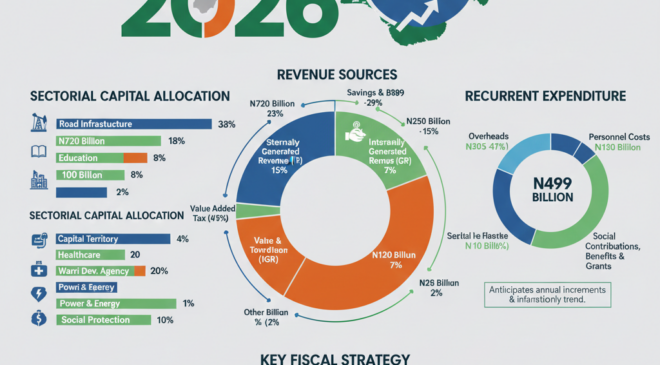
📊 Infographic 1: Fiscal Strength and Financial Discipline
This infographic focuses on the budget’s overall size, structure, and the administration’s fiscal responsibility metrics, drawing comparisons to previous periods.
| Feature | Visual Representation | Key Data Points (2026) | Economic Significance |
| Total Budget Size | Large Central Figure | N1.664 Trillion (70% increase over 2025) | Signals an aggressive expansionary fiscal policy. |
| Expenditure Ratio | Capital vs. Recurrent Pie Chart | Capital: 70% (N1.165T) vs. Recurrent: 30% (N499B) | Strong commitment to productive long-term infrastructure over consumption. |
| Revenue Structure | Breakdown of Funding Sources | Statutory Allocation: N720B (43.3%) | Primary driver due to post-subsidy removal gains. |
| Savings & Recoveries: N489B (29.4%) | Funds available due to fiscal prudence; enables Zero Borrowing goal. | ||
| IGR: N250B (15.0%) | Massive growth target (86.5% increase over 2025 estimate). | ||
| Fiscal Performance | Progress Bar/Checkmark | 2025 Capital Execution: 97% performance (Jan-Oct) | Demonstrates high capacity for implementation efficiency. |
- Pioneering the Blue Carbon Economy for Revenue Diversification
A highly innovative and forward-looking element is the commitment to the Delta Azure Carbon Mosaic Project through the Blue Carbon Initiative. This project, focused on mangrove and seagrass restoration in partnership with international firms, represents a genuine effort to diversify the state’s revenue base beyond oil and FAAC. By aligning with the newly approved National Carbon Framework and Registry (Paragraph 58), Delta State is positioning itself as a pioneer in the global climate finance market. This not only strengthens fiscal sustainability in the long term but also opens up a new, environmentally resilient economy that can attract foreign direct investment and specialised jobs.
- Urban and Agricultural Policy for Food Security and Micro-Enterprise
The budget articulates a dual strategy for food security. Beyond the anchor-farmer Public-Private Partnership (PPP) model, the promotion of Urban Farming is a pragmatic measure to involve citizens and civil servants in combating food price inflation and shortages. While the direct financial allocation to agriculture (N10 Billion) is relatively small, the focus on PPP for commercial farming and direct market linkage for farmers incentivizes scale. Crucially, addressing food price stability through diversified production and reduced transportation costs is a fundamental macro-economic relief for both small businesses and households.
- Power Sector Reform: Addressing the Major Constraint to Productivity
The N16 Billion earmarked for the Ministry of Energy is a strategic allocation focused on systemic change. The administration’s adoption of the mini-grid model and the plan to establish an Electricity Master Plan (Paragraph 48) signal a move to decentralise and secure power supply. For SMEs, particularly those in manufacturing, processing (agro-processing mentioned in Paragraph 95), and services, energy costs and unreliability are major inhibitors. Successful implementation of the multi-grid template would significantly reduce reliance on expensive self-generated power, immediately boosting the competitiveness and job creation capacity of the informal and formal small business sector.
- Human Capital and Social Inclusion as Pillars of Growth
The combined investments in Education (N105.086 Billion) and Healthcare (N50.067 Billion) highlight the focus on Human Capital Development. The budget aims to equip Deltans with the necessary skills and ensure a healthy, productive labour force. Furthermore, the N20 Billion for Social Protection, targeted at vulnerable groups through schemes like D-CARES and the MORE Grant Scheme, serves a dual economic purpose: it acts as a demand-side stimulus and directly provides seed capital and business support to empower micro-entrepreneurs, artisans, and women, directly strengthening the grassroots economy.
🏗️ Infographic 2: Strategic Capital Allocation & Human Development
This infographic highlights where the massive N1.165 Trillion capital expenditure is directed, connecting the spending to enhanced economic competitiveness and human capital.
| Sectoral Focus | Allocation (Naira) | Intended Economic Impact | SBGD Relevance |
| Road Infrastructure | N450 Billion | Catalyst for growth; reduces logistics costs; improves access to markets. | Direct reduction of small business operational costs. |
| Education & HCD | N105.086 Billion | Strengthens technical colleges; supplies skilled labour and graduates. | Addresses skill gaps; ensures a productive workforce. |
| Local Gov’t Intervention | N100 Billion | Direct investment in grassroots needs (Avg. N4B per LGA). | Ensures equitable distribution of development; supports localized projects. |
| Health Sector | N50.067 Billion | Expands insurance (2.7M beneficiaries); upgrades equipment (MRI, CT-Scans). | Creates a healthier, more productive populace; strengthens the labour pool. |
| Urban Development | N40 Billion (Asaba & Warri/Uvwie Agencies) | Addresses rapid urbanization; stormwater control and urban renewal. | Protects commercial assets from flooding; revives major business hubs. |
- The Recurrent Expenditure and Inflationary Pressures
The Recurrent Expenditure of N499 Billion includes N204 Billion (41%) for Overheads, which is noted to “mirror the inflationary trend in the country” (Paragraph 77). This acknowledges the significant inflationary pressure facing the economy. While personnel costs (N185 Billion) accommodate increments, the high overheads must be meticulously scrutinised by the legislative committees to ensure efficiency and prevent resource leakage. The House of Assembly must balance the necessity of compensating workers (to maintain morale, given the high N16 Billion monthly wage bill) against the risk of non-productive consumption expenditure accelerating inflation.
- Execution and Oversight Imperatives for the Assembly
The review of the 2025 Budget performance shows a stellar 97% capital expenditure execution rate for the first ten months, a highly positive outlier in Nigerian fiscal management. However, replicating this efficiency on a dramatically larger base of N1.165 Trillion is the administration’s most significant challenge. The committees of the Delta State House of Assembly, where the budget currently sits, have a critical oversight role to ensure that the N100 Billion allocated for Local Government Intervention (N4 Billion average per LGA) is strategically deployed for maximum economic impact rather than political expediency. Scrutiny must focus on project tracking and value for money to translate high capital spend into tangible outputs.
🌱 Infographic 3: Diversification and Direct MSME Support
This infographic focuses on innovative and targeted programs designed to diversify the economy, combat inflation, and provide direct support to micro, small, and medium enterprises (MSMEs).
| Initiative/Policy Area | Allocation/Mechanism | Key Policy Action | Impact on MSMEs & Economy |
| Economic Diversification | Blue Carbon Initiative (MoU with UK firms) | Development of the Delta Azure Carbon Mosaic Project (Mangrove restoration). | Establishes a new, environmentally resilient revenue stream via climate finance. |
| Social Protection | N20 Billion | Funds the MORE Grant Scheme (petty traders/artisans) and D-CARES. | Direct seed capital; lifts people out of poverty; stimulates grassroots demand. |
| Power Sector Reform | N16 Billion (Ministry of Energy) | Adopts the Mini-Grid Model; implements new Electricity Master Plan. | Overcomes unreliability; drastically lowers power costs for small businesses. |
| Food Security & Agriculture | N10 Billion + Non-monetary initiatives | Supports Anchor-Farmer PPP model for commercial production. Promotes Urban Farming. | Stabilises food prices (a major inflation driver); ensures consistent feedstock for agro-processing. |
- Conclusion: A High-Octane Pro-Development Trajectory
The Delta State 2026 Budget is an unapologetically high-octane, pro-development fiscal document. Its boldness is evident in the strategic capital-to-recurrent ratio and the pioneering efforts in the Blue Carbon market. By reducing transaction costs through infrastructure and power reform, while directly supporting micro-enterprises via social grants, the budget establishes a robust framework for accelerating SBGD. The challenge for the administration, and the focus of the ongoing legislative review, remains the disciplined execution of the massive capital programme to ensure the “Budget of Accelerating the MORE Agenda” delivers sustainable prosperity and shared welfare for all Deltans. ( Analysis Partly Produced with Gemini, Infographic inclusive)
Prepared By Bel Media Consult Economic Unit