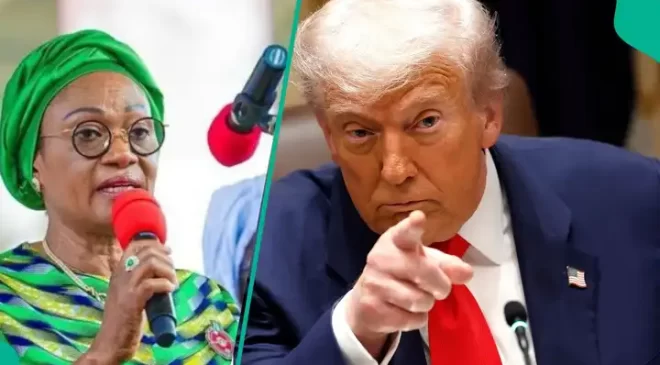
In a world saturated with information, optics matter as much as policy. Every handshake, every public appearance, every symbolic recognition carries meaning far beyond the moment itself. As Harold Burson, co-founder of Burson-Marsteller and a doyen of modern public relations, once put it, “Perception is reality in the absence of information.” This is why the recent recognition of Nigeria’s First Lady, Senator Oluremi Tinubu, United States President Donald Trump at a prayer meeting deserves more than passing mention. It is not merely a footnote in social or religious diplomacy; it is a mirror held up to Nigeria’s political class, reflecting how the world sees its leaders, and, by extension, the country they represent.
The incident underscores a reality many Nigerian politicians are either unwilling or unable to confront: outsiders are watching closely. They observe not only Nigeria’s elections, economic indicators, or security challenges, but also the mannerisms, temperament, and behavioural patterns of those who occupy positions of power. These observations inform judgments about credibility, seriousness, and national character. In short, personal conduct has become inseparable from national image.
Donald Trump is not a neutral or inconsequential observer. Love him or loathe him, he remains a globally recognizable political figure whose actions are scrutinized and decoded for meaning. Recognition from such a figure, especially in a setting tied to values, faith, and public morality, signals that Nigeria’s leadership is visible on the global radar in ways that go beyond official state visits or diplomatic communiqués.
This is where the conversation must move beyond sentimentality. The recognition of Oluremi Tinubu did not occur in a vacuum. It happened in a global environment where Nigeria’s political behaviour is constantly assessed against standards of decorum, restraint, and responsibility. That assessment is shaped by how Nigerian leaders speak in public, how they manage conflict, how they treat institutions, and how they handle dissent.
Too often, Nigerian politicians behave as though their actions are consumed only by a domestic audience that is already polarized along party, ethnic, or regional lines. They assume that fiery rhetoric, public intimidation, and theatrical confrontation play well because they energize supporters at home. What they fail to grasp is that the same conduct, when viewed from outside Nigeria, tells a very different story. One that can tarnish the country’s image.
This is why the moment involving the First Lady is instructive. It highlights a contrast between composure and chaos, between measured public presence and abrasive political performance. It suggests that while some actors in Nigeria’s political space thrive on noise and provocation, the world often notices something else entirely: stability of character, consistency of values, and restraint in conduct.
The global audience is not impressed by political tantrums. It does not applaud leaders who treat governance as a boxing ring or politics as permanent warfare. Instead, it reads such behavior as a sign of fragility, insecurity, or institutional weakness. When senior political figures engage in unrestrained verbal combat, threaten institutions, or publicly demean opponents, it raises questions about the maturity of the political system that enables them.
This brings into sharp focus the brand of politics that has gained troubling acceptance in Nigeria, what can be described as “Iye ndieba, ye ndieba” politics. It is a politics of partisan reward, retaliation and escalation, where aggression is answered with more aggression and restraint is dismissed as weakness. It thrives on public spats, media dominance, and the cultivation of fear rather than trust.
Figures like Nyesom Wike and others who practice this style are often celebrated by supporters as “strong men” who do not back down. Locally, such behavior is framed as courage or authenticity. Globally, however, it reads differently. It signals unpredictability. It suggests a political culture comfortable with brinkmanship but uneasy with consensus. And it projects an image of a state where personal ego frequently overrides institutional norms.
The uncomfortable truth is that this style of politics is no longer confined within Nigeria’s borders. The same clips that trend on local social media platforms circulate internationally. The same statements meant to intimidate local opponents are dissected by foreign analysts. The same power plays that play well to partisan crowds at home are interpreted abroad as indicators of political volatility.
This is where Nigeria’s leaders must wake up to the new reality of global visibility. In the digital age, there is no such thing as “local politics” for a country of Nigeria’s size and strategic importance. Every major political actor becomes, willingly or not, an ambassador of the Nigerian state. Their conduct shapes how Nigeria is discussed in foreign capitals, investment circles, and diplomatic forums.
The recognition of Oluremi Tinubu subtly reinforces this point. It shows that Nigerian leaders who carry themselves with dignity and consistency are noticed. It suggests that there is value in calm presence over combative posturing. It also implies that the world differentiates between noise and substance, between fleeting political drama and enduring personal conduct.
This is not to suggest that Nigeria’s First Lady is being judged in isolation from the administration she is part of. Rather, it highlights how individual comportment can influence broader perceptions. In international politics, symbolism matters. Who is acknowledged, and how, often speaks volumes about the image a country projects.
For Nigerian leaders, the lesson is straightforward but uncomfortable: your behavior does not end with you. It travels. It lingers. It shapes narratives long after the applause of supporters fades. When leaders choose belligerence over balance, they may win temporary loyalty at home but lose credibility abroad. And credibility, once lost, is painfully difficult to regain.
This is why calls for restraint, civility, and respect for institutions should not be dismissed as moral grandstanding. They are pragmatic imperatives. Countries seeking respect cannot afford leaders who behave as though impulse is policy. Nations aspiring to influence cannot project perpetual internal discord through the actions of their top officials.
Ironically, many Nigerian politicians understand this reality when they travel abroad. Their tone softens. Their language becomes diplomatic. Their posture changes. What they fail to accept is that the boundary between domestic and international perception has collapsed. The world now sees both versions, and judges the inconsistency.
Donald Trump’s recognition of Oluremi Tinubu, therefore, should prompt reflection within Nigeria’s political class. It should force a reconsideration of the idea that political relevance must be loud, aggressive, or divisive. It should challenge the notion that strength is measured by how much noise one can generate rather than how much stability one can sustain.
Leadership, ultimately, is about example. And examples are contagious. When leaders model restraint, it signals institutional confidence. When they model recklessness, it legitimizes chaos. The world notices the difference.
As this reflection concludes, it is important to separate analysis from courtesy. Senator Oluremi Tinubu deserves congratulations for the recognition she received. Beyond the personal honor, the moment projected a version of Nigeria that is too often overshadowed by political drama, a Nigeria capable of grace, dignity, and positive global engagement.
In a time when Nigeria’s image is frequently defined by the excesses of its political actors, her recognition offered a counter-narrative. For that, she has not only earned commendation; she has, in a meaningful way, made Nigeria proud.