By Emmanuel Enebeli
KWALE/Nigeria: The President-General of the Ndokwa Neku Union, Amechi Asugwuni, on Monday presented a detailed account of his administration’s first year in office, highlighting institutional reforms, stakeholder engagement, and policy advocacy as pillars of progress while outlining an ambitious roadmap for the coming year.
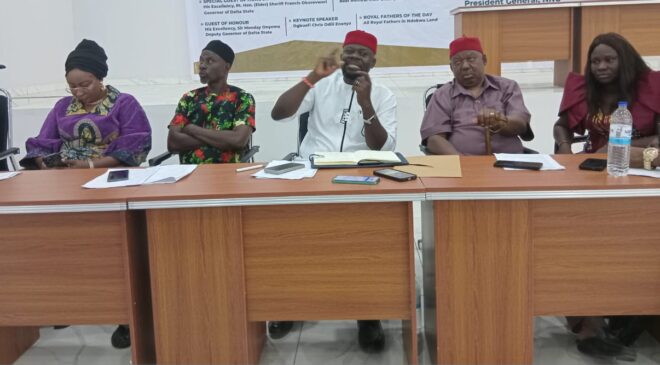
Addressing journalists during a media briefing at Kwale, flanked by members of his executive council, Asugwuni said the anniversary was deliberately marked to demonstrate accountability and reassure the public that the leadership remains conscious of its mandate. He explained that the choice of the first working day after the anniversary for the briefing underscored the administration’s commitment to transparency and measurable results.
The NNU leader recalled that his executive was inaugurated on February 13, 2025, noting that the past year represented not merely a passage of time but a phase of structured planning and purposeful action. According to him, a strategic session held less than a month after inauguration led to the adoption of a governing agenda designed to translate campaign promises into practical programmes capable of addressing community needs.
He emphasized that unlike government agencies, the union does not possess a fixed revenue stream to execute large-scale projects independently. Instead, he said, its operational strategy focuses on identifying pressing community challenges and mobilizing the appropriate authorities and stakeholders to intervene, stressing that effective engagement structures can be as powerful as financial resources in delivering results.
To strengthen governance and broaden participation, Asugwuni disclosed that the administration constituted about 14 committees, both ad-hoc and standing, to decentralize responsibilities and ensure wider stakeholder involvement. He said the initiative reduced unnecessary criticism, enhanced transparency, and promoted collective ownership of decisions by ensuring that leadership functions were not concentrated in a few hands.
One of the administration’s most significant milestones, he revealed, was a comprehensive constitutional review undertaken immediately after inauguration. The review committee, after about eight months of consultations with leaders, clans, and grassroots stakeholders, produced a revised document that addressed longstanding gaps and ambiguities in the union’s legal framework.
He announced that the amended constitution was formally adopted by the General Assembly on December 2, 2025, describing the development as a landmark achievement that now binds all leaders equally and provides clear guidelines capable of preventing future disputes within the organization.
Asugwuni also highlighted strategic engagement with government institutions as a central policy thrust, explaining that the union adopted a proactive approach by visiting officials at local, state, and federal levels rather than waiting for responses to community demands. Such interactions, he said, have strengthened goodwill and created channels for constructive dialogue.
He listed meetings with local government chairmen, legislators, and national officials among steps already taken to ensure that Ndokwa concerns are heard within decision-making circles. He stressed that the union remains nonpartisan and committed solely to public interest, noting that collaboration with government institutions often yields more sustainable development outcomes than confrontational tactics.
Among priority issues being pursued, he said, are improved electricity supply, fairer resource allocation, enhanced federal representation, and greater attention to underserved communities. These demands, he explained, are being advanced through policy advocacy, dialogue, and lawful engagement mechanisms.
The President-General further underscored education as a strategic focus, calling for broad support for a federal university in the region and noting that emerging institutions require collective backing from government, organizations, and citizens to mature into strong academic centers.
Looking ahead, Asugwuni announced plans for extensive stakeholder consultations, community town hall meetings, expanded civic education initiatives, and sustained government engagement, all aimed at strengthening participation in democratic processes and ensuring that citizens understand both their rights and responsibilities.
He concluded that the administration’s first year has been devoted to building systems, reinforcing institutions, and laying a foundation for long-term progress, urging citizens and partners to sustain their support, as collective commitment remains essential for meaningful development and effective representation of Ndokwa interests.