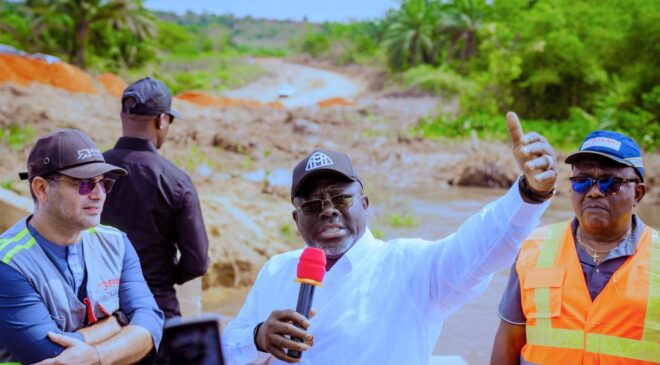
Photo: Samuel Jibunor.
ASABA/Nigeria: Determined to enforce performance and accountability, Delta State Governor, Sheriff Oborevwori, on Tuesday carried out inspection tours of ongoing road works across the state, reiterating that quality infrastructure delivery is non-negotiable under his administration.
At the Ugbolu–Okpanam Road site, he explained that his presence was to assess the actual pace and quality of work firsthand, noting that physical inspections provide a clearer picture of project realities than written updates alone.
The governor said he began prioritising the 12.12-kilometre road project around July last year following persistent complaints from residents about movement difficulties along the corridor. The project was later flagged off in October, with an official completion period of 18 months, although the contractor has assured government it will be delivered by December this year.
Oborevwori disclosed that the road is being constructed with extensive drainage infrastructure, including 7.7-metre-wide concrete drains on both sides, an overall width of about 11 metres, and an 8-metre carriageway. He explained that the elaborate drainage design is essential because of the severe flooding challenges historically experienced in the area.
According to him, Okpanam’s higher elevation causes runoff water to flow into surrounding lower communities, worsening flood conditions over the years. He said the new drainage channels are designed to redirect stormwater safely into nearby river systems and significantly reduce flooding during heavy rainfall.
“Some of the previous drainage systems were either single or double but not adequate to handle the volume of water. We are ensuring that this drainage infrastructure is comprehensive and durable. Residents will notice the difference during the rainy season,” the governor stated.
He described the road as strategically important, noting that it links Ugbolu and Okpanam communities, stimulates economic activity, and strengthens social interaction between urban and semi-urban settlements. He stressed that his administration is intentional about balanced development, ensuring that infrastructure projects are distributed across different parts of the state rather than concentrated only in major urban centres.
“We are not only constructing flyovers and roads in urban centres; we are also extending infrastructure to rural communities. Development must be balanced,” he said.
At the Phase Two section of the Oko-Anala–Oko-Ogbele–Oko-Odifili Road project, Oborevwori again emphasized the need for visible progress and strict adherence to timelines. He explained that the road was designed in phases, with Phase One covering about 4.7 kilometres already completed, while Phase Two spans roughly five kilometres.
The governor described the terrain as extremely difficult, revealing that large quantities of unsuitable clay soil had to be excavated before construction could proceed. He warned that failure to remove weak soil and properly stabilise the foundation would compromise durability and shorten the lifespan of the road.
He disclosed that the contractor initially proposed August 2027 as the completion date for Phase Two but said he rejected the timeline as unacceptable. He assured residents that the state government has fully mobilised the contractor and made funds available, stressing that financing is not responsible for any delay.
Oborevwori urged the construction firm to intensify work and complete the project before the end of this year or early next year, warning that future contract opportunities would depend on timely and quality delivery. He reaffirmed that his administration’s guiding principle remains uncompromising adherence to standards.
“We believe in standards, and we will not compromise on quality,” the governor declared.