By Emmanuel Enebeli
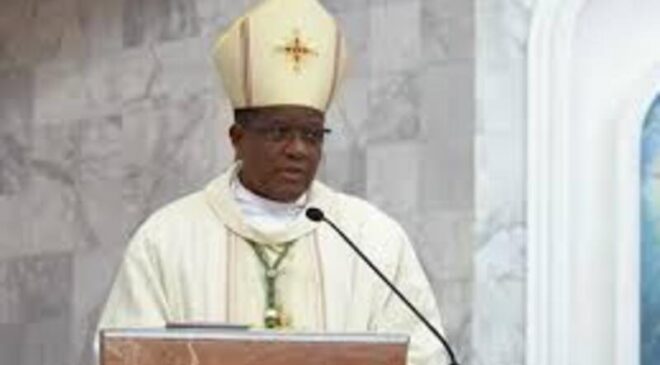
NSUKKA/Nigeria: The Catholic Bishop of Nsukka Diocese, Godfrey Igwebuike Onah, has cautioned Nigerians against what he described as a growing culture of manipulation driven by powerful interests, warning that Information and Communications Technology (ICT) is increasingly being used as a tool to divide citizens along ethnic and religious lines.
The message, delivered during a homily and now circulating widely in a viral video on TikTok, has sparked conversations across social media platforms, with many Nigerians sharing excerpts of the cleric’s remarks.
In the video, Bishop Onah described ICT as one of the most potent instruments of manipulation in contemporary society, noting that many Nigerians now believe and act on information they have never verified.
“One instrument of manipulation in contemporary society is ICT — Information and Communications Technology,” he said. “Spending money, believing stories you have never checked — that is manipulation.”
The cleric stressed that many of the decisions people take today are often influenced by unseen actors pursuing selfish interests. According to him, some individuals and groups deliberately spread divisive narratives to provoke crisis and maintain control over political and economic power.
“Some of the decisions we are arriving at were first decided by people who have other interests,” he warned. “Don’t allow yourself to be manipulated.”
Bishop Onah particularly decried the resurgence of ethnic and religious rhetoric in Nigeria, describing it as a dangerous strategy aimed at instigating violence and chaos.
“Those same manipulators have come again now in Nigeria talking about ethnic divisions, talking about religious divisions so that there will be crisis, so that there will be destruction, so that there may even be war,” he said.
He alleged that while ordinary citizens are pushed into conflict, those who profit from instability — including arms dealers and political actors — stand to benefit. “Those who sell arms will import arms. Those who are in power will cling to power,” he added
Drawing practical examples, the bishop cited the peaceful coexistence between different ethnic groups in commercial hubs such as Lagos. He noted that many shops operated by Igbo traders are owned and rented out by Yoruba landlords, with no conflict in their day-to-day business relationships.
“Many of the shops in Lagos where Igbo people are trading are owned by Yoruba people and rented to them by Yoruba people. Many of the houses they are living in are owned by Yoruba people and rented to Igbo people — and they don’t have problems,” he said. “How then do you think that those same people or their children will rise up one day and set those shops on fire? Manipulation.”
Bishop Onah insisted that Nigeria has never truly been divided along ethnic or religious lines, arguing instead that the real divide is between the rich and the poor, the powerful and the oppressed.
“Nigeria has never, ever been divided according to ethnic or religious lines — never and never will it be,” he declared. “It has always been divided between the rich and powerful and the poor and oppressed.”
He accused members of the elite of manipulating economically vulnerable citizens into fighting one another, thereby distracting them from the structural inequalities that define the nation’s socio-economic landscape.
“Our problem is not religion — whether Islam, Christianity or traditional religion. Our problem is not ethnic group — whether Igbo, Yoruba, Hausa-Fulani or any other. Our problem is the wealth of Nigeria — how it is controlled between the rich and the poor,” he said.
In an emotional appeal, the bishop urged Nigerians to reject divisive narratives and stand firm in their convictions.
“May the death of Christ on the cross wake you up to stand for your convictions, for your truth, for your beliefs. You must say no to this manipulation,” he admonished.
He warned that anyone who attacks a fellow Nigerian in the name of ethnic or religious loyalty is merely advancing the agenda of powerful interests operating behind the scenes.
“Whoever thinks he is attacking his fellow Nigerian to advance the cause of his ethnic group or religion will only be doing the bidding of the powerful and the rich,” he said.
While acknowledging that individuals must take responsibility for their actions, Bishop Onah maintained that those who orchestrate and manipulate violence from the background bear greater guilt.
“All of us are responsible for the decisions we take. But those who stay in the background and manipulate are more guilty,” he concluded.
The viral circulation of the homily has reignited national conversations on unity, social cohesion and the role of digital platforms in shaping public opinion