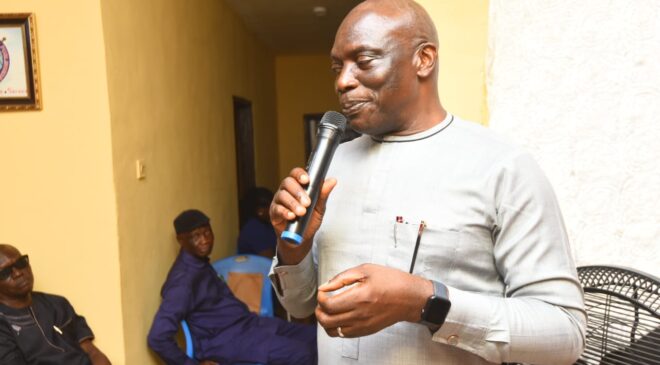
By Mokobia Rita.
ASABA/Nigeria: As Nigeria gradually moves toward the 2027 general elections, Chairman of the Delta Online Publishers Forum (DOPF), Mr. Emmanuel Enebeli, has called on journalists, media owners and political actors to embrace responsible journalism capable of promoting peace and preventing conflict across the country.
Enebeli gave the warning while speaking during an interview on Advocate Broadcasting Network Television (ADBNTV) to commemorate this year’s World Press Freedom Day, where he spoke extensively on the theme, “Journalism and Conflict De-escalation.”
The DOPF Chairman said journalism remains one of the most powerful institutions in society, with the capacity to either calm tensions or inflame already fragile situations, particularly in volatile regions like the Niger Delta.
According to him, media practitioners must begin to see press freedom not merely as a constitutional right to publish information, but as a serious responsibility that directly affects peace, public trust and national stability.
“In a volatile environment like the Niger Delta, journalism cannot operate in a vacuum,” Enebeli said. “The effect of what we publish can either restore peace or deepen existing tensions. A single unverified claim, a sensational headline, or reckless framing of a story can trigger distrust and conflict among communities already living on fragile lines.”
He noted that the Niger Delta region has, over the years, witnessed communal conflicts, political crises, agitations and violent confrontations, with the media sometimes playing both constructive and destructive roles in shaping public perception.
While acknowledging the positive role responsible journalism has played in conflict resolution and peace building, Enebeli expressed concern over the growing spread of misinformation, sensationalism and divisive narratives, especially on social media platforms.
He warned that the increasing influence of untrained individuals masquerading as journalists on social media now poses a major threat to ethical journalism and national cohesion.
“The challenge today is not necessarily the absence of professional journalists,” he said. “The bigger problem is the rise of untrained individuals who use social media irresponsibly. Some politicians even sponsor them to fight political battles online. That is dangerous for society.”
Speaking on the role of the media ahead of the 2027 elections, Enebeli stressed that journalists would play a decisive role in determining whether the electoral process remains peaceful, credible and violence-free.
“The work of journalists is vital for a successful election,” he stated. “The role of the media is not just to report events but to protect the integrity of the democratic process. Journalism must serve as a tool for peace building and conflict resolution both during elections and beyond.”
He explained that election seasons in Nigeria are usually characterised by heightened political tension, misinformation and deliberate manipulation of public narratives by desperate political actors seeking advantage.
According to him, continuous professional training remains the most effective way to address such challenges and ensure ethical media practice.
“We must constantly remind ourselves of our duty as journalists,” he said. “Most media organisations today are privately owned, but owners must understand that establishing a media platform also comes with the responsibility of investing in the training of staff. Headlines can either calm situations or inflame them.”
Enebeli disclosed that the Delta Online Publishers Forum regularly organises training programmes and professional engagements aimed at strengthening ethical journalism among members and discouraging practices capable of promoting violence, hatred and political instability.
He also urged politicians to stop sponsoring online attacks and propaganda campaigns capable of deepening divisions within society.
“If you want somebody to work for you in the media, allow the person to go through proper training and understand the ethics of journalism,” he stressed.
The DOPF Chairman further identified poor welfare conditions for journalists as another major challenge confronting the media industry in Nigeria.
According to him, many reporters are poorly paid and left vulnerable to unethical compromises because some media organisations fail to invest in staff welfare and professional development.
“Some organisations simply hand reporters identity cards and send them out to survive on their own,” he lamented. “If journalists are not properly paid and taken care of, many may be tempted to seek survival through unethical means, including publishing damaging or false reports.”
He advised media proprietors to recognise journalists as the foundation of their organisations and ensure they are properly trained, adequately paid and professionally supported.
“If you establish a media company without making provisions for the welfare of your staff, then you are not truly ready for the business,” he said. “Any negative report published by poorly managed organisations can eventually destroy the credibility and future of that same organisation.”
Enebeli maintained that journalism must continue to serve as a force for unity, dialogue and national development rather than fear, division and hostility.
“Journalism should promote dialogue, not division; facts, not fear,” he declared. “Our reports should never create panic in the minds of readers or citizens. Our core message must always be peace.”
While acknowledging that social media has helped amplify important societal issues in recent years, he insisted that the primary responsibility of journalism should remain nation-building and peaceful coexistence.
“We should not use journalism to destroy one another,” he said. “We must understand what it truly means to be journalists and what it means to operate a media house responsibly.”
He concluded with a strong message to journalists across the country ahead of the next electoral cycle.
“As we move towards the 2027 elections, our headlines must be responsible, our stories must be truthful, and our mission must be peace,” Enebeli stated. “Because sometimes, the difference between violence and stability begins with the words we choose to publish.”