By Emmanuel Enebeli
As political activities gradually gather momentum ahead of the 2027 general elections, the political atmosphere across the Ndokwa/Ukwuani Federal Constituency is becoming increasingly charged. Within the All Progressives Congress (APC), attention is already focused on the May 16, 2026 House of Representatives primary election, a contest that is expected to shape the future political direction of the constituency and perhaps redefine the careers of several political actors.
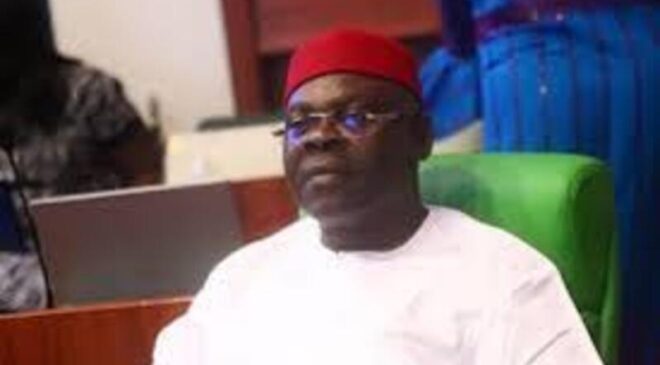
Among the leading names in the race is Rt. Hon. Ossai Nicholas Ossai, one of the most experienced politicians to emerge from the Ndokwa nation in recent political history. His political journey has been long, eventful and impactful. From the Delta State House of Assembly to the National Assembly, Ossai has remained visible within the political landscape of Delta State and the Ndokwa/Ukwuani axis.
As a close friend of Rt. Hon. Ossai dating back to our days at the prestigious University of Nigeria, Nsukka, this writer has had the rare privilege of witnessing his political evolution from the formative years. Long before he became a household name in Delta politics, Ossai had already demonstrated unusual leadership qualities within the university environment.
It was at the university that his political journey truly began. As a student of the Faculty of Agriculture, he became actively involved in students’ union politics and was elected Senator representing the faculty in the Students Union Government. Those who were on campus during that era still recall his courage, eloquence and ability to mobilize support among students.
History also records that during a period of crisis within the students’ leadership structure of the university; Ossai emerged as one of the prominent student leaders who helped stabilize the situation. His activism, negotiation skills and organizational capacity earned him recognition across the campus community, eventually elevating his profile within the students’ movement of the university.
From that university environment, he gradually transitioned into mainstream politics. In 1998, as Nigeria returned to democratic rule, Ossai ventured fully into national politics, right from the University Campus. Fate and political destiny would later smile on him when he successfully contested and was elected into the Delta State House of Assembly in 1999 to represent Ndokwa West State Constituency.
There is no doubt that Rt. Hon. Ossai possesses one of the richest legislative résumés in the constituency. He served for eight years in the Delta State House of Assembly representing Ndokwa West State Constituency, where he rose to become Majority Leader, a position that reflected not just seniority but political influence, negotiation skills and legislative competence. His emergence as Majority Leader at the state assembly level positioned him among the strategic political figures in Delta State during his tenure.
Beyond the state assembly, Ossai also represented Ndokwa/Ukwuani Federal Constituency three consecutive times in the House of Representatives. Spending over a decade within the legislative arm of government is no small achievement in Nigerian politics. It speaks to political acceptance, grassroots relevance, resilience and strategic political networking.
However, recent political developments and his public concerns over the conduct of the APC House of Representatives primary election have further exposed the deeper political contradictions within the party structure in the constituency. In a public address to his supporters and party faithful through his verified Facebook page, Ossai raised alarm over what he described as alleged attempts by some party leaders to disenfranchise members ahead of the Saturday, May 16, 2026 primary election.
According to him, intelligence available to his team suggested that there were alleged moves to compile restricted lists of selected voters to be submitted to officials expected to conduct the primary election. He argued that such an arrangement would violate both the democratic principles of the APC and the provisions of the Electoral Act governing party primaries.
“This is not the spirit of the APC, it is not the spirit of the constitution, and it is not in line with the Electoral Act. Every registered and card-carrying member of the APC has the right to vote during the primary election,” Ossai stated while addressing supporters.
The former federal lawmaker specifically questioned any attempt to restrict participation in a direct primary system, insisting that every duly registered APC member across the wards of the constituency must be allowed to freely participate in the process.
“In my ward alone, we have over 4,000 registered members. Those members have the right to vote, and they must be allowed to participate in the process. The law is very clear on this,” he argued.
Expectedly, his comments have generated mixed reactions within political circles. While some supporters see his position as a courageous defense of internal democracy and party transparency, others believe the controversy further highlights why a politician of his experience should now begin to move toward broader statesmanship and long-term political recalibration beyond the House of Representatives contest.
From an analytical standpoint, the concerns raised by Ossai may indeed be legitimate within the context of internal party democracy. Across Nigeria, disputes over delegate lists, voter eligibility and primary election procedures have remained recurring sources of political tension within major political parties. His intervention therefore reflects not only personal political frustration but also a wider concern about fairness, inclusiveness and credibility within the democratic process.
Yet, even beyond the controversy surrounding the primaries, the unfolding events appear to strengthen the argument that Rt. Hon. Ossai may have reached a point in his political career where he should now begin to pursue a larger and more strategic political future.
Many political observers within Ndokwa/Ukwuani believe that after his extensive experience in both the State House of Assembly and the National Assembly, Rt. Hon. Ossai should naturally be looking beyond the House of Representatives. To many, the Senate appears to be the next logical destination for a politician of his profile, experience and political exposure.
At this point in his political career, another attempt to return to the House of Representatives may appear like a step sideways rather than a step forward. Having spent years building legislative experience, mentoring younger politicians and participating actively in national politics, the expectation among many supporters is that he should now begin positioning himself for the Senate.
The argument being advanced in several political circles is simple: Rt. Hon. Ossai already possesses the institutional memory, legislative understanding, national contacts and political maturity required of a senator. His years in parliament have exposed him to national policy debates, constituency representation dynamics and party structures beyond the local level. These are qualities considered essential for the Red Chamber.
More importantly, the political reality within Delta North Senatorial District suggests that future contests for the Senate will require experienced and politically tested figures capable of standing shoulder to shoulder with personalities such as Ned Nwoko and former Delta State Governor Ifeanyi Okowa, both of whom remain highly influential forces within the district’s political landscape. Nevertheless, some political commentators have argued that Rt. Hon. Ossai N. Ossai should have considered testing his strength in the senatorial race ahead of the 2027 elections. To this writer, such a move would not have been misplaced, especially against the backdrop of growing political conversations and permutations that appear to create the impression that Ndokwa lacks a viable and formidable contender for the Delta North Senate seat.
For many analysts, a future political battle involving such heavyweights would require experienced politicians with tested political structures and deep grassroots appeal. Rt. Hon. Ossai clearly fits that category. Rather than continue recycling himself within the House of Representatives, many believe he should begin now to strategically prepare for that bigger political stage ahead of 2031.
Indeed, if properly managed, the period between now and 2031 could become the most important political rebuilding phase of his career. It would give him enough time to reconnect with political stakeholders, rebuild alliances, strengthen grassroots structures and consolidate support across wards and local government areas within the federal constituency and beyond.
Politics, especially in Delta State, is heavily influenced by relationship management and sustained political reconciliation. Over the years, political misunderstandings and alignments have naturally emerged across party lines and interest groups. For Ossai to successfully position himself for a future senatorial ambition, many believe he must begin deliberate reconciliation and bridge-building efforts from his ward upward.
Despite his complaints and concerns over developments within the APC in Delta State, political maturity and party loyalty will demand that whatever the outcome of the Ndokwa/Ukwuani Federal Constituency APC primary election on Saturday, May 16, 2026, Rt. Hon. Ossai should accept the result in good faith, mobilize his supporters and fully support whoever eventually emerges as the party’s candidate.
Such a statesmanlike decision would not only strengthen party unity within the constituency but would also elevate his image as a leader who places collective political interests above personal ambition. More importantly, it would allow him to immediately begin the bigger political project of positioning himself for the Delta North Senatorial District race in 2031.
That journey, many believe, should start from home. Ossai would need to begin strategic engagements with other Ndokwa political leaders, stakeholders and opinion molders to build a united political front capable of advancing the Ndokwa interest within Delta North Senatorial politics. Beyond Ndokwa land, he would also need to gradually extend consultations and relationship-building across the entire Delta North Senatorial District.
The process of earning the acceptance, confidence and support of the wider Delta North political family cannot be delayed until election season. It is a long-term political investment that should ideally begin immediately after the 2027 general elections. With his experience and visibility, Rt. Hon. Ossai possesses the capacity to undertake such a political project successfully if approached with patience, humility and strategic coordination.
Without doubt, Rt. Hon. Ossai remains one of the most recognizable political figures from Ndokwa land. His contributions to legislative politics cannot be ignored. His experience remains valuable, and his political journey continues to inspire many younger politicians within the constituency. But politics is dynamic, and strategic timing often determines the difference between political expansion and political stagnation.
As the APC primaries holds on May 16, 2026, perhaps this is the moment for deep reflection, political recalibration and long-term strategic thinking. Rather than another battle for the House of Representatives, the wiser path may be to begin laying the foundation for a historic senatorial ambition in 2031.
For a politician with the experience, visibility and legislative credentials of Rt. Hon. Ossai N. Ossai, the Senate may indeed be the next natural destination.
Emmanuel O. Enebeli, FCSIM, MNIPR, Media and Public Relations, Consultant