LAGOS/Nigeria: The Founder of Path to Possibilities, a UK-registered charity organisation, Mrs. Titilolami Bello, has called on governments and stakeholders to increase investment in education and vocational training as a sustainable strategy for tackling youth unemployment and reducing Nigeria’s growing population of out-of-school children.
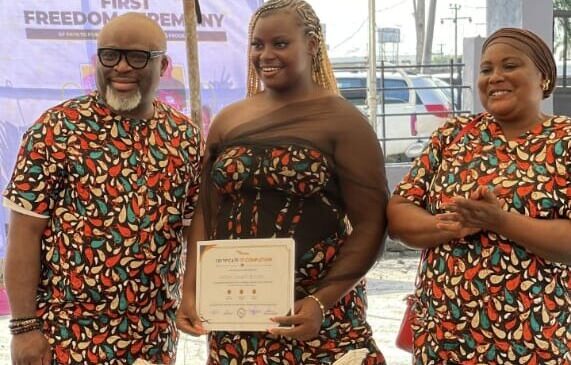
Bello made the appeal during the 10th anniversary celebration of the organisation and the graduation of the pioneer beneficiaries of its tailoring programme at the charity’s Community Resource Centre in Ikota, Ajah, Lagos.
She described vocational education as a critical tool for empowering young people with practical, income-generating skills, stressing that Nigeria must move beyond conventional classroom learning to address its education and unemployment challenges.
According to her, the country’s rising number of out-of-school children calls for urgent and innovative interventions that combine formal education with vocational and digital skills development.
“We need to diversify education by expanding vocational training and practical skills acquisition to engage more out-of-school children. Governments at all levels must commit greater resources to education and skills development if we are to prepare our young people for the future,” she said.
Bello explained that although Path to Possibilities was founded in 2009, its Community Resource Centre was established in 2016 to provide educational support, digital literacy and vocational opportunities for underserved children and young people.
She said the centre operates a library and a fully equipped computer laboratory with free internet access, where qualified instructors provide children with practical computer training and digital literacy skills.
According to her, the facility has become an important learning hub for schools within the Ikota community that lack computer laboratories, enabling pupils to acquire practical computer knowledge through scheduled educational visits.
Beyond academic support, Bello said the centre also serves as a safe space for vulnerable girls, providing access to sanitary products and other essential support without discrimination.
She added that the organisation regularly organises career development workshops on curriculum vitae writing, interview techniques and workplace readiness to improve the employability of young people.
Highlighting the organisation’s latest intervention, Bello disclosed that the tuition-free tailoring programme was introduced in 2025 to equip out-of-school youths and secondary school graduates with employable skills and enhance their economic independence.
She expressed delight that the organisation had successfully graduated its first set of five trainees after a 12-month intensive training programme, describing the milestone as another step towards empowering disadvantaged youths through entrepreneurship.
To support their transition into self-reliance, the graduates received certificates and brand-new sewing machines to enable them establish their own businesses.
Bello, however, identified inadequate electricity supply as one of the major challenges confronting the resource centre, revealing that plans were underway to install a solar energy system to guarantee uninterrupted learning and reduce operational costs.
She noted that through partnerships with individuals and donor organisations, thousands of children have benefited from the charity’s programmes in computer literacy, digital drawing, vocational training and menstrual hygiene support.
The charity founder commended its local and international partners for their financial and technical support, which she said has enabled the organisation to expand its impact within underserved communities.
She also appealed to established fashion designers and garment manufacturers to offer apprenticeship opportunities to graduates of the tailoring programme to enable them acquire advanced technical skills and build sustainable careers.
According to Bello, meaningful progress in addressing youth unemployment and educational inequality can only be achieved through stronger collaboration between government, the private sector and civil society organisations.
Also speaking, Trustee and Director of the organisation, Ms. Funmilola Akanmu, said Path to Possibilities was established to bridge educational inequality by providing quality learning opportunities for children from disadvantaged backgrounds.
She disclosed that the charity began by sponsoring six years of secondary school education for selected beneficiaries and has so far supported no fewer than 20 students through their entire secondary education.
According to Akanmu, the organisation bears the full cost of tuition, uniforms, textbooks and other educational materials without requiring any financial contribution from parents or guardians.
“Some of these beneficiaries are orphans, children from single-parent homes and others whose families simply cannot afford secondary education. We are committed to ensuring that poverty does not deny them the opportunity to succeed,” she said.
She further revealed that the Community Resource Centre receives about 500 children daily for reading sessions, computer training and other educational activities, while neighbouring schools also schedule regular visits to expose their pupils to library and digital learning resources.
Akanmu expressed optimism that increased investment in public education and stronger support for state-owned schools would improve access to quality education for more Nigerian children.
One of the graduating trainees, Jimoh Orilowo, who lives with a physical disability, described the opportunity as life-changing.
Despite having only one hand, Orilowo said the encouragement and support he received from his instructors enabled him to master tailoring.
“I am grateful to Path to Possibilities for seeing ability in my disability. Today, I can cut and sew confidently with one hand because they believed in me,” he said.
Another graduate, Destiny Godwin, said the programme had given her hope for a brighter future.
Raised by a single parent, she expressed appreciation to the organisation for investing in her future, adding that she intends to further her education while building a successful career in fashion design.
The presentation of certificates and sewing machines to the graduating trainees was the highpoint of the anniversary celebration, symbolising the charity’s enduring commitment to equipping young Nigerians with practical skills for self-reliance and economic empowerment.