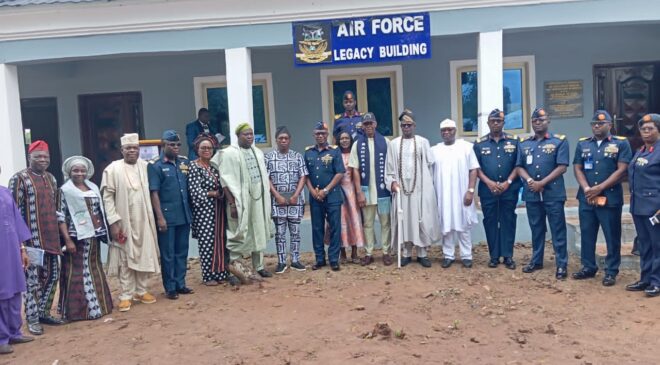
ILARO/Nigeria: The Nigerian Air Force (NAF) has reinforced its commitment to education and community development with the inauguration of a state-of-the-art Legacy Building at Baptist High School, Ilaro, Ogun State, describing the initiative as part of its broader strategy to strengthen civil-military relations while supporting national development.
The project, executed under the Chief of the Air Staff’s Special Intervention Programme, was inaugurated on Tuesday in Ilaro, Yewa South Local Government Area, and is dedicated to Air Vice Marshal (AVM) Sayo Olatunde (Rtd), an illustrious alumnus of the school, in recognition of his distinguished service to the nation.
Representing Ogun State Governor, Prince Dapo Abiodun, at the ceremony, the Special Adviser on Education, Mr. Lukmon Kiadese, described the intervention as a practical demonstration of the Nigerian Air Force’s commitment to advancing education while complementing President Bola Tinubu’s Renewed Hope Agenda for sustainable national development.
According to him, the project underscores the military’s role beyond territorial defence by making meaningful contributions to the socio-economic development of communities through strategic investments in education.
He noted that the newly completed Legacy Building comprises three modern classrooms, each with a seating capacity of 75 students, two staff offices, separate male and female conveniences, and a water supply system equipped with a 2,000-litre storage tank and pumping facility.
Abiodun said the facility would significantly decongest existing classrooms, provide a more conducive learning environment and improve both teaching and learning outcomes.
“The construction of these modern classrooms and offices is an investment in the future of our children and a legacy that will continue to benefit generations of learners,” he said.
He added that the intervention aligns with the Ogun State Government’s ongoing investments in educational infrastructure, teacher development, digital learning and technical education, aimed at ensuring every child has access to quality education in a safe and supportive environment.
Speaking on behalf of the Chief of the Air Staff, Air Marshal Hasan Bala Abubakar, the Director of Coordination and Cooperation at the Nigerian Air Force Headquarters, Air Vice Marshal Christopher Akpa, said the project forms part of the Air Force’s non-kinetic operations designed to strengthen public trust and foster stronger relationships between the military and host communities.
He explained that the Chief of the Air Staff’s Special Intervention Programme was introduced to enable senior Air Force officers to execute impactful projects in their respective communities, thereby promoting national development while reinforcing the humanitarian mandate of the service.
“Since the introduction of the initiative, about 15 intervention projects have been completed across the country, with several others at various stages of execution,” he said.
Akpa urged members of the community to continue supporting security agencies through the timely provision of credible intelligence, stressing that effective collaboration between the military and civilians remains critical to tackling the nation’s security challenges.
He assured Nigerians that the Air Force would continue to deploy air power and other operational capabilities to safeguard the country’s territorial integrity and ensure citizens can pursue their legitimate activities without fear.
In his remarks, AVM Sayo Olatunde (Rtd), who facilitated the project, said the intervention was inspired by the poor state of infrastructure in his alma mater, particularly the conversion of the school’s science laboratory into overcrowded classrooms.
He described the situation as detrimental to science education and inconsistent with Nigeria’s aspirations for technological advancement.
According to him, relocating students into the newly constructed classrooms will free the laboratory for renovation and restore it to its original purpose as a centre for practical science education.
Olatunde expressed appreciation to the Chief of the Air Staff for providing senior officers with an opportunity to give back to their communities through impactful projects.
He also highlighted the growing importance of civil-military relations in strengthening national security, noting that the Nigerian Air Force has increasingly embraced humanitarian initiatives alongside its constitutional responsibility of defending the nation.
He observed that the establishment and subsequent expansion of the Air Force’s Civil-Military Relations Branch have broadened the service’s engagement with communities through humanitarian interventions, human rights initiatives, gender affairs and grievance resolution mechanisms.
The retired Air Vice Marshal further commended the Nigerian Air Force’s Civilian Harm Mitigation and Response Action Plan, introduced in 2025, describing it as a landmark policy that demonstrates the service’s commitment to accountability, public confidence and responsible military operations.
He said the policy provides mechanisms for addressing civilian harm arising from military operations through investigations, compensation where necessary and the execution of quick-impact community projects aimed at rebuilding trust between the military and affected communities.
The inauguration of the Legacy Building, stakeholders noted, reflects the Nigerian Air Force’s evolving approach to national security—one that combines operational effectiveness with community engagement, educational development and strategic partnerships for sustainable national progress.