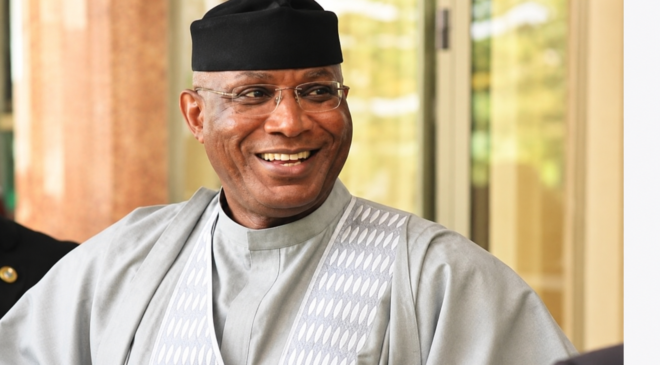
The enduring tragedy of political power in Nigeria is not merely the misuse of public trust, but the persistent sacrifice of regional development on the altar of parochial self-interest. For the Urhobo Nation—the fifth largest ethnic group in the country—the critical question begging for urgent answers is whether former Deputy President of the Senate, Senator Ovie Omo-Agege, allowed his personal geography to triumph over economic logic, ultimately costing his Urhobo people a once-in-a-generation industrial breakthrough.
At the centre of a growing national controversy is the proposed Nigerian Oil and Gas Park Scheme (NOGAPS), a monumental interventionist initiative conceived by the Nigerian Content Development and Monitoring Board (NCDMB). Designed to deepen local content, stimulate domestic manufacturing, reduce reliance on imported energy equipment, and generate thousands of direct and indirect jobs, NOGAPS was intended to serve as a catalyst for regional industrialisation. Yet insider accounts and industry assessments suggest political manoeuvring may have derailed what could have been a transformative economic ecosystem for Delta Central.
According to widespread reports from policy and industry insiders, during his tenure as the nation’s number two lawmaker, Senator Omo-Agege allegedly leveraged his political clout to dictate the site selection for the NCDMB-backed industrial gas park. Rather than subjecting the multi-billion-naira project to rigorous technical, logistical, and feasibility appraisals, the park was directed to Salubi, a landlocked community in the Orogun axis of Ughelli North Local Government Area—coincidentally backing onto the Senator’s ancestral village.
Industrial projects of this magnitude do not operate in a vacuum; they obey strict economic geography. A specialised oil and gas park requires seamless logistics, robust supply chain networks, direct transport arteries, and, fundamentally, immediate proximity to navigable waterways (NCDMB prerequisite for choosing a location) for heavy equipment transportation and maritime export logistics. By allegedly forcing a major industrial gas hub into a landlocked inland community, critics argue that the basic technical prerequisites established by the NCDMB were fundamentally violated from inception.
The consequences of this decision have been devastatingly swift. While land in Salubi was acquired and cleared with fanfare, the project has completely stalled. Institutional investors and technical partners have reportedly backed away, unwilling to sink massive capital into a facility handicapped by prohibitive freight and logistical constraints. A wrong location can turn a multi-billion-naira dream into nothing more than an expensive piece of cleared dirt.
Adding a disturbing layer to the controversy are allegations surrounding the official geographic description of the project site. Critics allege that in regulatory documentation, the park was nebulously framed as being situated within Eku in Ethiope East Local Government Area. Suspicions abound that this description was intentionally engineered to give the facility a broader, more inclusive territorial identity while keeping it firmly anchored within Omo-Agege’s immediate political orbit in Salubi-Orogun, in Ughelli North.
The immediate fallout from this logistical misalignment is already visible. Information from industry sources indicates that as the Orogun project lost operational momentum, institutional attention and strategic “support” within the NCDMB shifted toward alternative industrial gas park developments, such as the facility in Koko, Warri North Local Government Area. While NCDMB executive management maintains that its engagement in Koko constitutes operational “support” rather than direct construction, the underlying economic reality remains unchanged: vital capital, technical resources, and developmental momentum originally earmarked for Delta Central have effectively evaporated.
This brings the core issue of political equity into sharp focus. Leadership is about distributing development equitably across a constituency, not monopolizing federal infrastructure around a single hometown. If Senator Omo-Agege was genuinely committed to advancing Urhobo economic interests, why was there an insistence on Orogun to the exclusion of prime coastal and industrial locations within Urhobo land?
Why was Oghara not considered, with its established institutional infrastructure, industrial footprint, and direct maritime connectivity? Why not Okwagbe in Ughelli South, strategically positioned along the riverine corridor to support heavy marine logistics and energy transport? Locations like these offered ready-made industrial logic, access to water, and seamless operational integration. Instead, the obsession with concentrating federal investments—from tertiary institutions to utility hubs—strictly within the Orogun axis appears to have blinded the leadership to the wider economic imperatives of the Urhobo Nation.
An industrial park is not a constituency empowerment grant, nor is it a personal political monument. It is supposed to function as a self-sustaining economic engine—attracting global manufacturers, building local capacity, creating commercial value chains, and lifting thousands out of poverty. When political leaders treat heavy industrial infrastructure like village trophies, the entire region suffers the collateral damage.
The failure of the Orogun oil and gas park should serve as a sobering lesson for the Urhobo political class. A leader who sees only his village eventually deprives his entire ethnic nation of global opportunities. If the claims surrounding the project location hold true, Omo-Agege’s tactical error was placing personal political geography above technical competence.
The Urhobo Nation must now demand clear accountability from its representatives. The federal public, state stakeholders, and community leaders deserve straight answers:
Was the Salubi-Orogun site selected based on an independent, professional environmental and technical impact assessment, or was it dictated by political fiat?
Did the absence of water access which is prerequisite render the park commercially unviable for NCDMB’s long-term operations?
Who takes responsibility for the massive public funds expended on land acquisition and site preparation for an asset that sits abandoned while neighboring regions capture the economic benefits?
Moving forward, the Urhobo Nation must establish a firm consensus: major industrial and federal projects must never again be sited based on individual political dominance. Technical viability, infrastructure readiness, market accessibility, and broad public interest must take precedence over political expediency. Until our leaders learn to subordinate personal geography to economic logic, the Urhobo people will continue to pay the heavy price of missed opportunities and stalled development.
Comrade Ufuoma Egbe, A Political Analyst, Writes From Eku, Delta State.