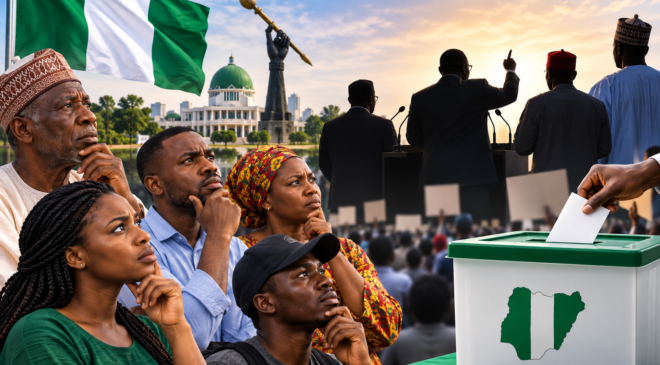
Graphic generated with the help of Artificial Intelligence (AI).
By Emmanuel Enebeli
Nigeria’s next general election may still be months away, but the political season is already taking shape.
Political alignments are being discussed. Aspirants are positioning themselves. Parties are reorganising. Support groups are becoming active.
For citizens, however, this should be more than another cycle of political excitement.
It should be a period of questions.
Too often, Nigerian elections become competitions over personalities, party loyalty, ethnicity, religion and political calculations, while the substance of governance receives less attention than it deserves.
That must change.
Before 2027, Nigerians should learn to ask better questions.
Not merely:
“Who is your candidate?”
But:
“What exactly will your candidate do?”
Not merely:
“Which party are you supporting?”
But:
“What does that party propose to do differently?”
And not merely:
“Who can win?”
But:
“Who can govern effectively?”
These questions matter because elections do not end when votes are counted. That is when the consequences begin.
The person elected will influence decisions on taxation, infrastructure, education, healthcare, security, electricity, agriculture, employment and the wider economy.
That makes the quality of the questions asked before election day extremely important.
Candidates should therefore be challenged to explain their priorities.
If someone promises jobs, voters should ask what type of jobs, in which sectors and through what policies.
If a candidate promises roads, voters should ask which roads, what the funding mechanism is and when the work will be completed.
If electricity is part of the manifesto, voters should ask whether the promise involves generation, transmission, distribution or simply another political slogan.
If security is promised, citizens should ask what practical strategy will be adopted and how success will be measured.
This is what a mature democracy should look like.
Nigeria does not lack political promises.
What the country needs is a stronger culture of testing those promises.
The responsibility, however, does not rest entirely with politicians.
The media has a role to play by examining manifestos, questioning candidates and following up on promises.
Civil society organisations have a role in voter education and accountability.
Traditional and community leaders can help create spaces for issue-based engagement.
And voters themselves must resist the temptation to surrender their political judgment to political godfathers, social-media campaigns or emotional appeals.
The Independent National Electoral Commission has already set the electoral process in motion for the 2027 general elections.
That means the country is moving steadily towards another major democratic test.
This time, Nigerians should insist on a higher standard.
Let candidates tell citizens what they intend to do.
Let voters compare the proposals.
Let journalists interrogate the claims.
Let political parties explain their programmes.
And after the elections, let citizens return to those promises and ask what has been delivered.
Democracy should not be reduced to the excitement of election day.
It should be a continuing relationship between citizens and those entrusted with public authority.
Before 2027, Nigerians should therefore make one commitment: we will listen to the promises, but we will also ask the questions.
Because a country that asks better questions before an election stands a better chance of demanding better governance after it.