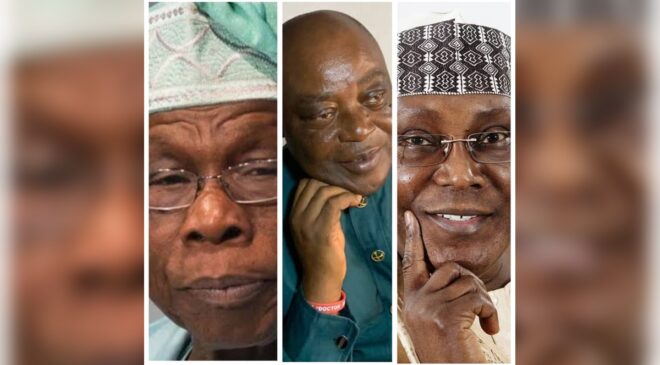
PORT HARCOURT/Nigeria: A chieftain of the African Democratic Congress (ADC), Chief Eze Chukwuemeka Eze, has criticised former President Olusegun Obasanjo over his renewed expression of regret about choosing Atiku Abubakar as his running mate in the 1999 presidential election.
Eze, in a statement on Monday, said Obasanjo should put the long-running political disagreement behind him and focus on reconciliation and the broader interests of the country.
His reaction followed comments by Obasanjo at an event in Lagos where the former president was asked to identify a major mistake he made while in government.
Obasanjo said he would not have selected his former deputy had he known him then as well as he came to know him during their years in government. When asked whether he was referring to Atiku, he confirmed that he was speaking about his former vice president. Obasanjo, however, said he bore no bitterness over their political differences.
Reacting, Eze questioned the continued focus on the political relationship between the two former leaders more than two decades after they served together.
He argued that the disagreements between Obasanjo and Atiku were largely rooted in the political struggles that characterised their second term, particularly the controversy surrounding the attempt to amend the Constitution to permit a third presidential term.
The National Assembly rejected the proposed constitutional amendment in May 2006, effectively ending the effort to extend the tenure limit at that time. Atiku was among the prominent political figures who opposed the proposal.
According to Eze, Atiku’s opposition to the third-term proposal contributed significantly to the deterioration of his relationship with Obasanjo.
He maintained that Atiku’s political influence was also important to Obasanjo’s emergence as the Peoples Democratic Party’s presidential candidate ahead of the 1999 election.
Eze, who said he was involved in political activities around Atiku’s political structure in Adamawa State, recalled that he had previously advised the former vice president against supporting Obasanjo’s presidential ambition.
He said Atiku nevertheless backed Obasanjo, arguing at the time that national considerations and the need to address political tensions following the death of Chief MKO Abiola were more important.
Eze further claimed that Atiku provided substantial political support and organisational resources during the 1999 campaign and subsequently became Obasanjo’s running mate.
He also recalled the contest between Obasanjo and Chief Olu Falae in the 1999 presidential election, arguing that Atiku’s political network and support contributed to the PDP ticket’s success.
The ADC chieftain said the political relationship between the two men later deteriorated, particularly during Obasanjo’s second term, when disagreements over succession and the proposed constitutional amendment became more pronounced.
Eze said it was therefore unfair, in his view, for the contribution of Atiku to Obasanjo’s emergence in 1999 to be overlooked because of their subsequent political differences.
He also pointed to Atiku’s role as Chairman of the National Economic Council and National Council on Privatisation during the Obasanjo administration, arguing that the former vice president contributed to economic reforms pursued by the government.
Some of the economic achievements cited by Eze, however, are matters of political interpretation and attribution, rather than independent assessments contained in his statement.
Eze urged Obasanjo to close what he described as a chapter of past political disagreements and allow Atiku to concentrate on his current political project.
The ADC has already paired Atiku, its presidential candidate for the 2027 election, with former Rivers State Governor and former Minister of Transportation, Rotimi Amaechi, as its vice-presidential candidate. The party announced the ticket in June following consultations with its stakeholders.
Eze said the Atiku-Amaechi ticket would now focus on challenging President Bola Tinubu and the ruling All Progressives Congress in the 2027 presidential election.
He described the ongoing exchange between Obasanjo and Atiku as unnecessary and urged political leaders to prioritise the country’s challenges over unresolved disputes from the past.
The latest disagreement is another chapter in the long-running political history between Obasanjo and Atiku, whose eight years together in government began with the 1999 presidential election and ended amid deep political differences before the 2007 election.ADC Chieftain, Media Consultant, Public Relations Strategist & former National Publicity Secretary, nPDP