By Nwaorgu Faustinus
An investigative journalist and President of Citizens Quest for Truth Initiative, Chief Oby Christie Ndukwe, has thrown her weight behind the proposed creation of Anioma State, describing the move as a strategic and non-kinetic pathway toward addressing longstanding concerns over political imbalance affecting the South-East.
In a strongly worded intervention, Ndukwe said the initiative represents a turning point in what she termed the “Igbo struggle for reparation and political integration,” arguing that state creation offers a more constructive alternative to agitation-driven approaches.
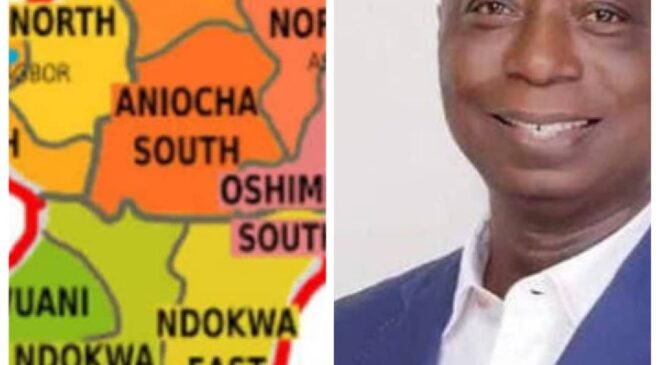
According to her, the push for Anioma State, which dates back to the 8th Senate, now stands a realistic chance of actualisation under the 10th Senate led by Senate President Godswill Akpabio, with sustained legislative advocacy by Senator Ned Nwoko.
Ndukwe, in a Facebook post, referenced remarks credited to Akpabio during the recent APC South-South Congress in Delta State, where the Senate President reportedly declared: “Only one new state will be created in Nigeria and it will be Anioma State. Asaba will serve as the capital of Anioma State, while Warri will become the new capital of Delta State. Anioma will be zoned to the South-East, making it the sixth state in the region.”
She argued that the proposal aligns with broader efforts by President Bola Ahmed Tinubu’s administration to correct structural imbalances in Nigeria’s federal arrangement, particularly the disparity in the number of states across geopolitical zones.
“This is a strategic move to challenge the status quo of imbalance in state creation, which has left the South-East with the least number of states and, by implication, reduced representation at the National Assembly and other levels of governance,” she stated.
While acknowledging that the initiative may not resonate with proponents of secession, Ndukwe maintained that it offers a pragmatic and inclusive solution to issues of marginalisation.
“It may not sound appealing to those who have long pushed for secession, but it marks the beginning of a new chapter for the marginalised Igbos of the South-East,” she noted.
She further highlighted the potential dual benefits of the proposal, noting that beyond increasing the number of states in the South-East to six—bringing it in line with other zones except the North-West—it would also address longstanding aspirations within Delta State for a capital in Warri.
Ndukwe recalled that the designation of Asaba as Delta State capital during the military era sparked controversy at the time but ultimately laid the groundwork for the current push for Anioma State.
“The benefits are enormous. Apart from upgrading the South-East to six states, Delta State would realise its long-standing aspiration of having a capital in Warri. This is a historic opportunity that should not be undermined,” she added.
Dismissing opposition to the proposal, she described resistance as largely driven by narrow interests, while conceding that divergent views are inevitable in a democratic setting.
“I see no reason for opposition except for selfish or uninformed considerations, even though it is expected that not everyone will applaud the National Assembly and the President for this timely decision,” she said.
She concluded by commending all stakeholders involved in advancing the Anioma State agenda, expressing optimism that the proposal would soon translate into concrete political reality, including participation in future electoral processes.
“For now, I commend all those who have contributed to this quest, including myself,” Ndukwe stated.