LAGOS/Nigeria: The Association of Waste Managers of Nigeria (AWAMN) has called for stronger partnerships and a structured national training framework to bridge critical skill gaps in construction, demolition and disaster waste management, as the country grapples with increasing environmental challenges.
The National President of AWAMN, Dr. Olugbenga Adebola, made the call in an interview with the News Agency of Nigeria (NAN) in Lagos, stressing the urgent need to build technical capacity across the waste management sector to meet evolving demands.
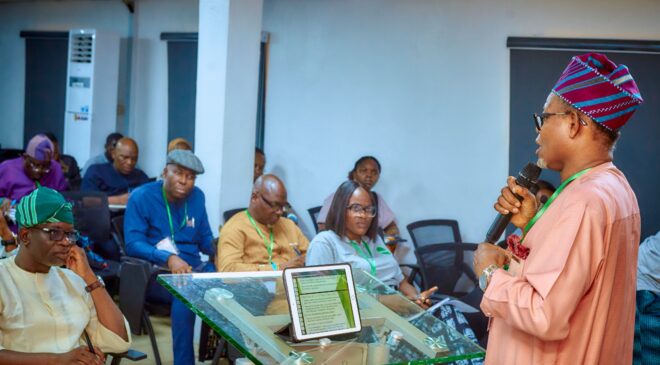
Adebola spoke against the backdrop of the Green Waste Remediation and Recycling Vocational Training (GROW) workshop recently held in Lagos, describing the initiative as timely and essential in addressing the growing complexity of waste streams in urban centres.
The workshop, organised by the Lagos Waste Management Authority (LAWMA) in collaboration with the European Union, focused on improving expertise in handling construction and demolition waste, an area he said requires urgent professional attention.
He noted that the scope must be expanded to include disaster waste, collectively referred to as construction, demolition and disaster waste (CDDW), particularly in Lagos where recurring building collapses generate significant volumes of such materials.
“It is not just construction and demolition waste; we must also include disaster waste. Lagos, in particular, produces a lot of this due to recurring building collapses,” he said.
The AWAMN president expressed the association’s commitment to sustained collaboration with LAWMA, the European Union and other stakeholders to strengthen vocational and technical capacity within the sector.
He disclosed that the association is currently developing a Waste Management Resource Centre, which will serve as a hub for research, data collection and professional training.
According to him, the centre—expected to be housed within the association’s new secretariat—will function as a repository of knowledge on waste management practices in Nigeria and across Africa.
“The facility will support research activities, including work by international scholars, and provide access to data and information on waste management practices,” he said.
Adebola added that AWAMN is actively seeking partnerships with international organisations, including the European Union, to support the establishment and effective operation of the centre.
He stressed the need to professionalise the waste management sector, noting that it now requires specialised technical expertise rather than being treated as an open field for unskilled participation.
He further revealed plans to develop a standardised curriculum for vocational and technical training, covering key areas such as recycling, resource recovery and waste-to-energy conversion.
According to him, AWAMN members play a critical role in waste collection and are increasingly exploring opportunities in waste disposal site management, an area he described as both challenging and essential to sustainable waste systems.
He emphasised the importance of transitioning from a linear to a circular economy, where waste is no longer seen as a burden but as a valuable resource.
“We are committed to ensuring Nigeria moves from a linear to a circular economy through improved waste management practices,” he said.
Adebola also called for stronger involvement by the Federal Government in creating an enabling environment for effective waste management nationwide, noting that current progress remains uneven across states.
While acknowledging Lagos State’s strides in the sector, he stressed the need for a coordinated national approach to achieve lasting and sustainable outcomes.
“Waste management must be addressed at the national level. You cannot have efficiency in one state while others lag behind,” he said.
He reaffirmed AWAMN’s readiness to collaborate with federal and state governments, as well as international partners, to drive reforms, enhance capacity and promote environmental sustainability across Nigeria.